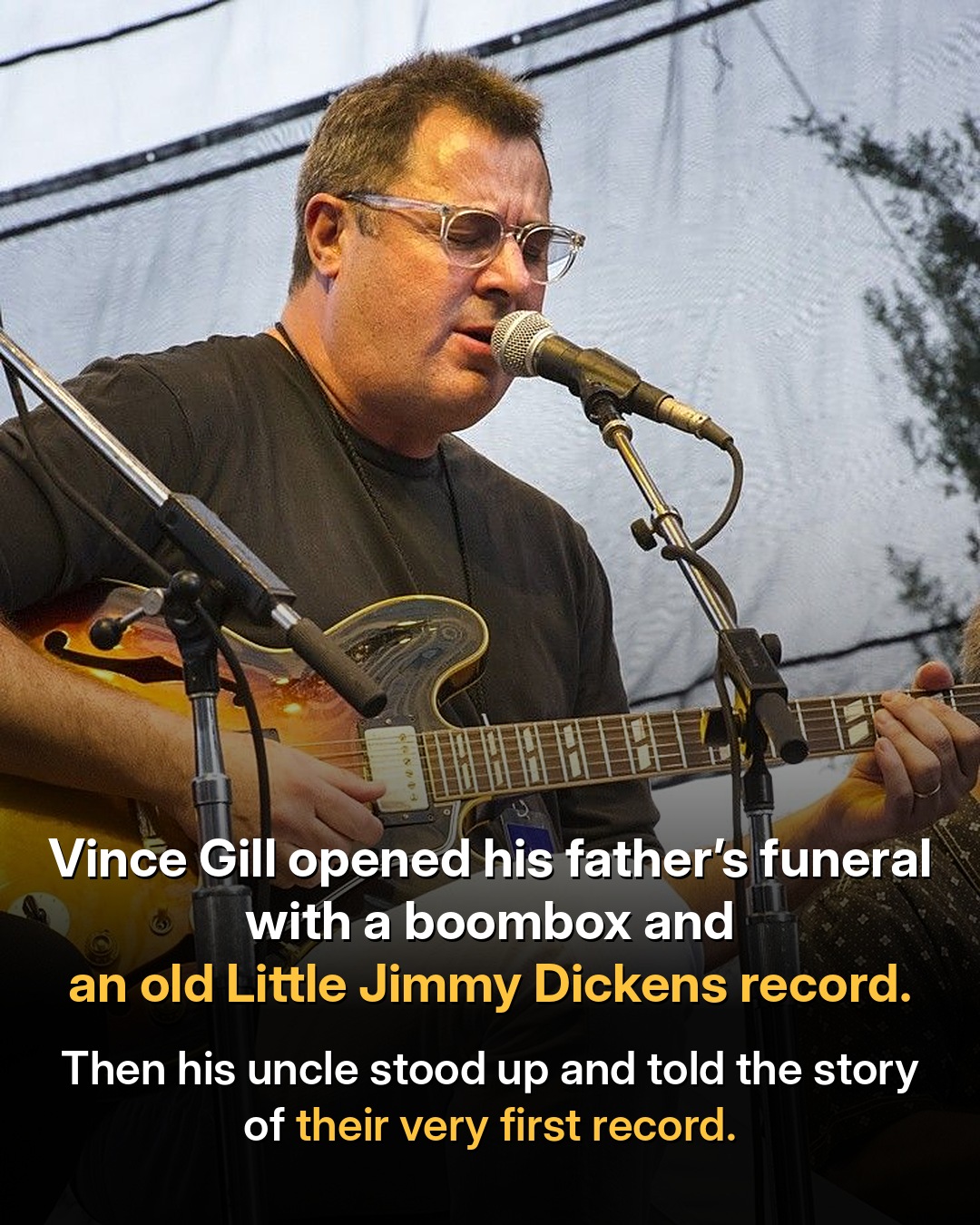
Funerals usually start with an organ, a hymn, or a few quiet words from a preacher. When Vince Gill said goodbye to his father in 1997, the service started with a boombox and an old country record. To understand why, you have to know the judge.
The Judge Who Loved Country Music
J. Stanley “Stan” Gill was a lawyer and an administrative law judge in Oklahoma. He was a big, strict, no-nonsense man. Vince Gill has said that having him as a father was like having General Patton, Clint Eastwood and John Wayne rolled into one person.
Away from the courtroom, Stan Gill was a different man. He loved country music, and he played guitar and banjo with friends at parties and dances. Vince Gill’s mother, Jerene, sang and played harmonica. The house was full of music, and the family listened to the Grand Ole Opry on the radio.
Stan Gill was not a polished player. He played a folky, frailing style of banjo and never managed to learn the three-finger Scruggs style. Vince Gill later laughed about it in an interview:
“He cussed Earl his whole life because he couldn’t figure it out.”
Still, the judge gave his youngest son the most important lesson of his life. When Vince Gill was a little boy, Stan Gill taught him three guitar chords: G, C and D. Vince Gill has said he wanted to play simply because his father did.
A Driving Lesson Nobody Forgot
Stan Gill’s lessons were not always gentle. When Vince Gill was learning to drive, his father told him to pull onto one of the busiest streets in Oklahoma City. Vince Gill cut off a speeding car. The other driver swerved around them and made a rude gesture.
Most fathers would have told their son to calm down. Stan Gill took a drag on his cigarette and told him to catch the guy. Vince Gill’s first driving lesson turned into a chase through downtown Oklahoma City. It is one of many stories Vince Gill still tells on stage about the man who raised him.
The Banjo That Went to Louisville
When Vince Gill left Oklahoma to play music in Louisville, Kentucky, his father let him take his banjo, a Fender Concert Tone. Vince Gill admitted it was not a great banjo, but it was his father’s, and that was what mattered.
Someone stole it. Years later, Vince Gill had another instrument made to honor the old man.
The Song Stan Gill Could Never Find
Stan Gill loved Little Jimmy Dickens, the tiny Grand Ole Opry star with the giant voice. One Little Jimmy Dickens song meant more to him than the rest: “Country Boy.” No matter where he looked, Stan Gill could not find a copy of the record.
Stan Gill eventually told Little Jimmy Dickens himself that he couldn’t find it anywhere. Little Jimmy Dickens tracked down a copy and sent it to him.
It was a small kindness from one of the Opry’s biggest personalities. Nobody knew yet how much that record would end up meaning.
Goodbye, 1997
Stan Gill died in 1997 at 65. As Vince Gill planned the funeral, he remembered the record from Little Jimmy Dickens. So he opened the service by playing “Country Boy” on a boombox.
Then Stan Gill’s brother stood up to give the eulogy. He told the mourners that when the two of them were boys, about five years old, the very first record they ever owned was “Country Boy.”
About sixty years after two little brothers got their first record, the same song opened the goodbye. Vince Gill has told this story many times since, often right before he sings the song he wrote for his father.
The Key to Life
In 1998, Vince Gill released The Key, a return to the traditional country sound he grew up on. He saved one song for the very end, track 13, “The Key to Life.”
The song is about a son who misses his father and wishes he could hear him play the old songs one more time, folk and country standards like “John Henry” and “On the Wings of a Dove.” It traces how Vince Gill became a musician at all: a few chords from his father’s hands.
The Key became Vince Gill’s first No. 1 album on the Billboard country chart and went Platinum.
What the Judge Left Behind
The Tennessee Golf Foundation later put up a bronze statue of Vince Gill and his father. It shows Stan Gill in a ball cap with one hand on a golf club and the other on the shoulder of young Vince, who has just swung. It is a fitting picture, because Stan Gill was always standing just behind his son.
Stan Gill never played the big stages. His son played them all, and he took those three chords with him: G, C and D.
Which Vince Gill song brings back the most memories for you?