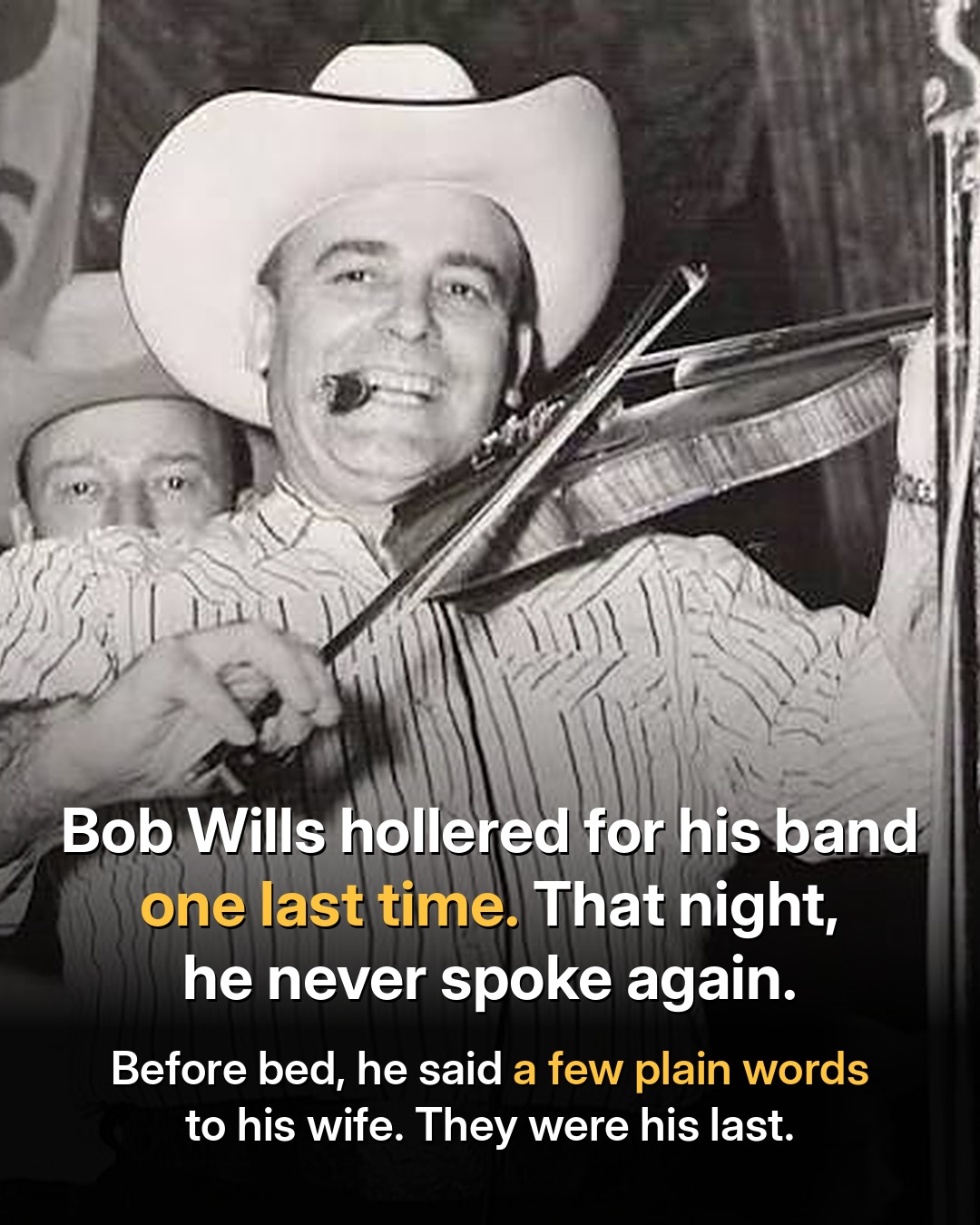
Scroll to the end of the article to hear the song.
On December 3, 1973, Bob Wills spent his last day in a recording studio. The King of Western Swing sat in a wheelchair at Sumet-Bernet Studios in Dallas, surrounded by the Texas Playboys he had led for four decades, and did what he had always done: he called out to his band and hollered. That night, at home in Fort Worth, he suffered a massive stroke. He never spoke again. The record they started that day was finished without him and released in 1974 under a title nobody could miss, For the Last Time.
The Last Words He Spoke
By late afternoon on that first day, Bob Wills was exhausted. His wife, Betty, wheeled him out of the studio and drove him home to Fort Worth. According to his biographer Charles R. Townsend, the evening was a gentle one. Bob played with his granddaughters, listened to his music and kissed Betty good night.
When it was time for bed, he told her simply, “Roll me down,” his way of asking her to help him lie down. Townsend wrote that he never spoke again. Sometime that night the stroke came, and the man whose voice had carried over dance halls from Tulsa to California slipped into unconsciousness.
Betty later told Townsend that Bob had loved the day, with one exception. He was disappointed that he could not speak and holler more distinctly while the tape was rolling. He felt he had not helped out much.
Why He Went Back One More Time
Bob Wills had not been well for years. On May 31, 1969, a stroke paralyzed his right side and put him in a wheelchair, and it made talking hard. Still, in 1973 he wanted to make one more record with the men who had built his sound. Merle Haggard, who had already recorded a tribute album to Wills in 1970, asked to be part of it. Tommy Allsup, who had produced Bob’s records in the early 1960s, agreed to produce.
The old band came back: Leon McAuliffe on steel guitar, Eldon Shamblin on guitar, Al Stricklin on piano and Smokey Dacus on drums, all from the 1930s Playboys, along with Johnny Gimble, Keith Coleman and Leon Rausch from later years. On December 2, the night before the session, they gathered at Bob’s Fort Worth home for a meal and a jam. Hoyle Nix and his 21-year-old son Jody, both devoted to the Wills sound, were there too.
One Last Day in the Studio
On December 3, Betty brought Bob into the studio and parked his wheelchair in the middle of the room. He held the microphone in his left hand. He called on his musicians when their solos came around and threw in his trademark “ah-haa,” the sound fans had heard on Bob Wills records since the 1930s.
Early in the day he asked young Jody Nix to sing “When You Leave Amarillo.” Jody later remembered Bob watching him through the whole song.
“I can see those jet black eyes to this day just gleaming.”
At the end of that song, Jody recalled, Bob changed the closing line on the spot, saying “cut out the lights” instead of “turn out the lights.” Jody has called it the last recorded voice of Bob Wills. Other accounts of the session place his last faint hollers a little later that afternoon, behind Leon McAuliffe’s vocal chorus on “My Shoes Keep Walking Back to You.” Either way, his voice is on the album, thin but unmistakable.
As Betty rolled him out that afternoon, a young Western swing band called Asleep at the Wheel was walking in. Ray Benson and his bandmates met Bob Wills only for a moment, and Bob was too tired to talk. Benson would spend the next fifty years carrying Western swing forward.
The Day Without Him
On December 4, news of Bob’s stroke reached the studio, and the mood changed completely. Jody Nix later described how the room felt.
“All the Playboys were quiet, but there was a job to do.”
Hoyle Nix stepped into Bob’s place, supplying the hollers the bandleader could no longer give. Merle Haggard arrived after driving in from a show in Chicago. He had missed Bob entirely. Haggard sang, joined Keith Coleman and Johnny Gimble in the fiddle section playing one of Bob’s own old fiddles, and was paid the same as every other musician on the date. Betty Wills summed it up in one line.
“Merle wanted to be a Texas Playboy for a day.”
Seventeen Months of Silence
Bob Wills never recovered. Accounts differ on the details. Some say he fell into a coma that first night and never came out of it. Others describe another stroke a few days later and a long stretch when he was bedridden and unable to speak, with a full coma only near the end. What every account agrees on is that he never spoke again. He spent his final months in a Fort Worth nursing home and died of pneumonia on May 13, 1975. He was 70.
United Artists released For the Last Time in 1974. Charles Townsend, the biographer who had sat in on the session and introduced the band on the record, wrote the liner notes. In 1975 those notes won the Grammy Award for Best Album Notes, an honor that came while Bob Wills lay silent in Fort Worth.