Scroll to the end of the article to hear the song.
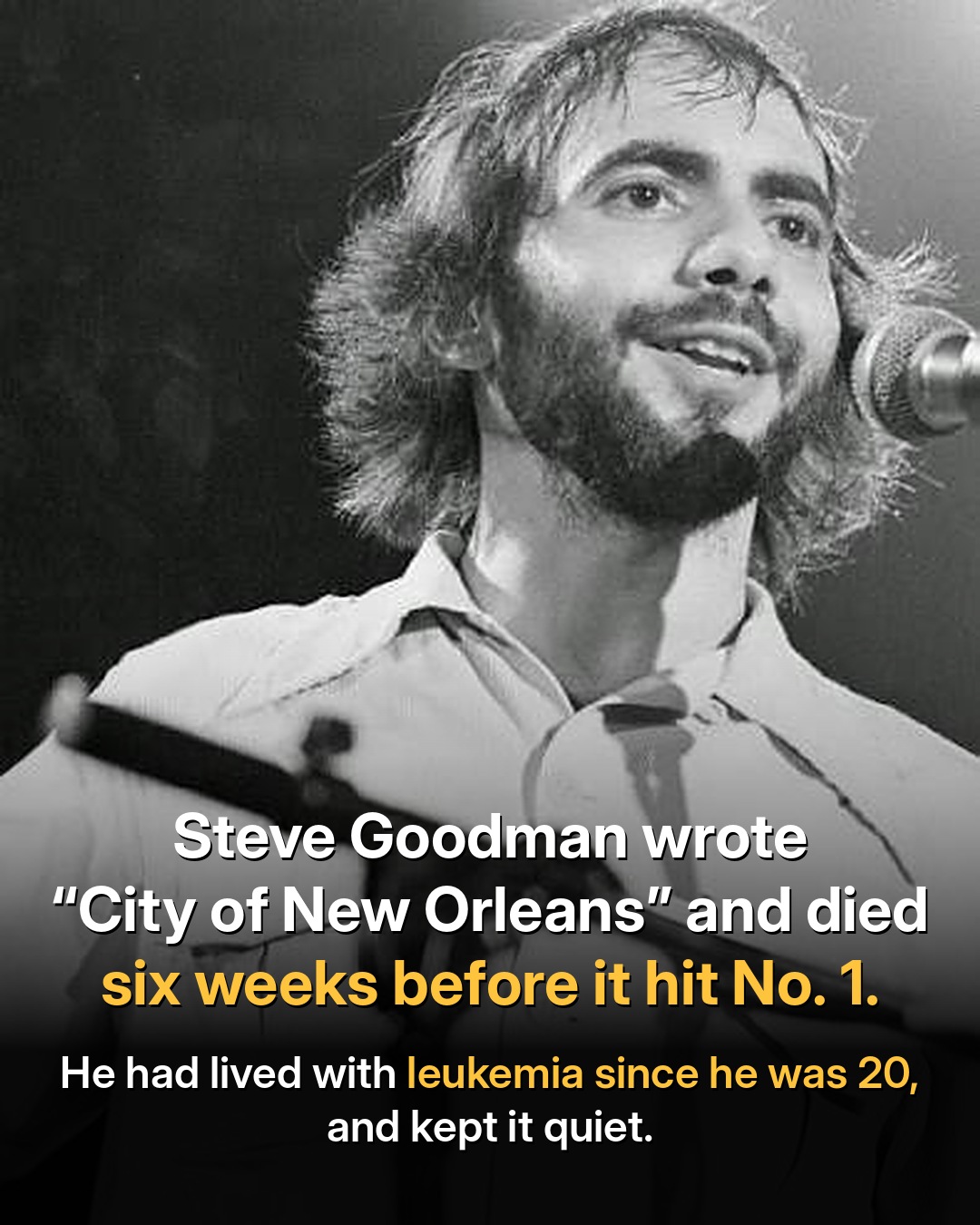
Willie Nelson’s recording of “City of New Orleans” reached No. 1 on Billboard’s country singles chart on November 3, 1984. The man who wrote it, Steve Goodman, had died about six weeks earlier in a Seattle hospital. He was 36, and he had been living with leukemia for nearly 16 years, writing and singing the whole time while very few people outside his circle knew he was sick.
A diagnosis at 20
Goodman was a 20-year-old student at Lake Forest College, north of Chicago, when doctors found the cause of his constant fatigue in late 1968. It was leukemia. His biographer, Clay Eals, author of Steve Goodman: Facing the Music, described the news as a blow that shook him to his core.
Effective leukemia treatment was still in its infancy, and Goodman would go through years of experimental care at Sloan-Kettering in New York. One of his oncologists there, Dr. Monroe Dowling, told Eals plainly what the odds looked like at the time:
“Most of the people with leukemia were going to be dead in six months.”
Goodman left college and threw himself into performing and songwriting around Chicago’s folk clubs. In September 1969 he met Nancy Pruter, a college student working as a waitress. They were married in February 1970.
Forty-five minutes on the Illinois Central
That spring, Steve and Nancy boarded the Illinois Central’s City of New Orleans in Chicago and rode south toward Mattoon, Illinois. They were not going anywhere near New Orleans. They were going to visit Nancy’s grandmother, who was in her 90s and living in a retirement home in southern Illinois.
Nancy fell asleep beside him. Steve Goodman looked out the window and started writing down what passed by. In a 1976 interview with British writer John Tobler, he remembered it without any romance at all:
“Nancy fell asleep, and I looked out of the window and wrote down everything I saw. The whole thing took 45 minutes, I don’t want to make it out as anything more than it was.”
He also said it was only the fifth or sixth song he had ever written, and that it “just tumbled out.” Not every account lines up perfectly. The liner notes to the posthumous anthology No Big Surprise connect the song to his time on the campaign trail with Senator Edmund Muskie, but in his own account from that 1976 interview, the song was born on the train ride with Nancy.
One beer for Arlo Guthrie
Goodman found Arlo Guthrie at the Quiet Knight, a Chicago club, and asked if he could play him something. Guthrie agreed on one condition: Goodman had to buy him a beer, and Guthrie would listen for exactly as long as it took him to drink it.
Goodman played “City of New Orleans.” Guthrie liked it enough to ask if he could record it. His version became a Top 20 pop hit in 1972, and it gave Goodman enough money and attention to make music his full-time career.
Keeping the secret
Steve Goodman did not want to be known as “the sick guy.” According to Eals, he kept his leukemia a secret as long as he could, and his friends protected it. Paula Ballan, one of the people close to him, described it this way:
“It was like a social contract that if you were really a friend of his, this is something that you keep among yourselves.”
He still made jokes at death’s expense, and once said he scheduled his tours around chemotherapy and the baseball season. And he kept writing. In 1971, in a New York hotel with his friend John Prine, he wrote “You Never Even Called Me by My Name.” Prine refused to take a writing credit, so when the royalties came in, Goodman bought him a jukebox. David Allan Coe’s 1975 recording reached No. 8 on the country chart, and Coe even mentioned Steve Goodman by name on the record. Country fans sang along all over America, and few of them could have known the writer was living on borrowed time.
The secret broke in July 1982, when the leukemia came back. Goodman returned to Sloan-Kettering the day before a memorial concert for Harry Chapin, and John Prine filled in for him. From then on, he talked about it openly, jokes and all.
The last weeks
In late August 1984, Goodman underwent a bone marrow transplant. His brother, David, was the donor. Eals called it “a last-ditch hope,” and a slim one. Complications in his kidneys and liver followed, and Steve Goodman died on September 20, 1984, at the University of Washington Medical Center in Seattle. He was 36, nearly 16 years after a diagnosis that was supposed to give him far less time.
The song kept going without him
Willie Nelson had recorded “City of New Orleans” in October 1983, and Columbia released it as a single in the summer of 1984. Willie Nelson’s album of the same name went to No. 1 on the country albums chart on September 29, nine days after Goodman died, and stayed there for 12 weeks. On November 3, the single reached No. 1 on Billboard’s Hot Country Singles chart.
On February 26, 1985, at the 27th Grammy Awards, “City of New Orleans” won Best Country Song. That award goes to the songwriter, so it went to Steve Goodman. The other nominees included Lee Greenwood’s “God Bless the U.S.A.” and Hank Williams Jr.’s “All My Rowdy Friends Are Coming Over Tonight.” Three years later, his posthumous album Unfinished Business won him a second Grammy.
In the liner notes to No Big Surprise, Nancy Goodman wrote that her husband “wanted to live as normal a life as possible, only he had to live it as fast as he could.”