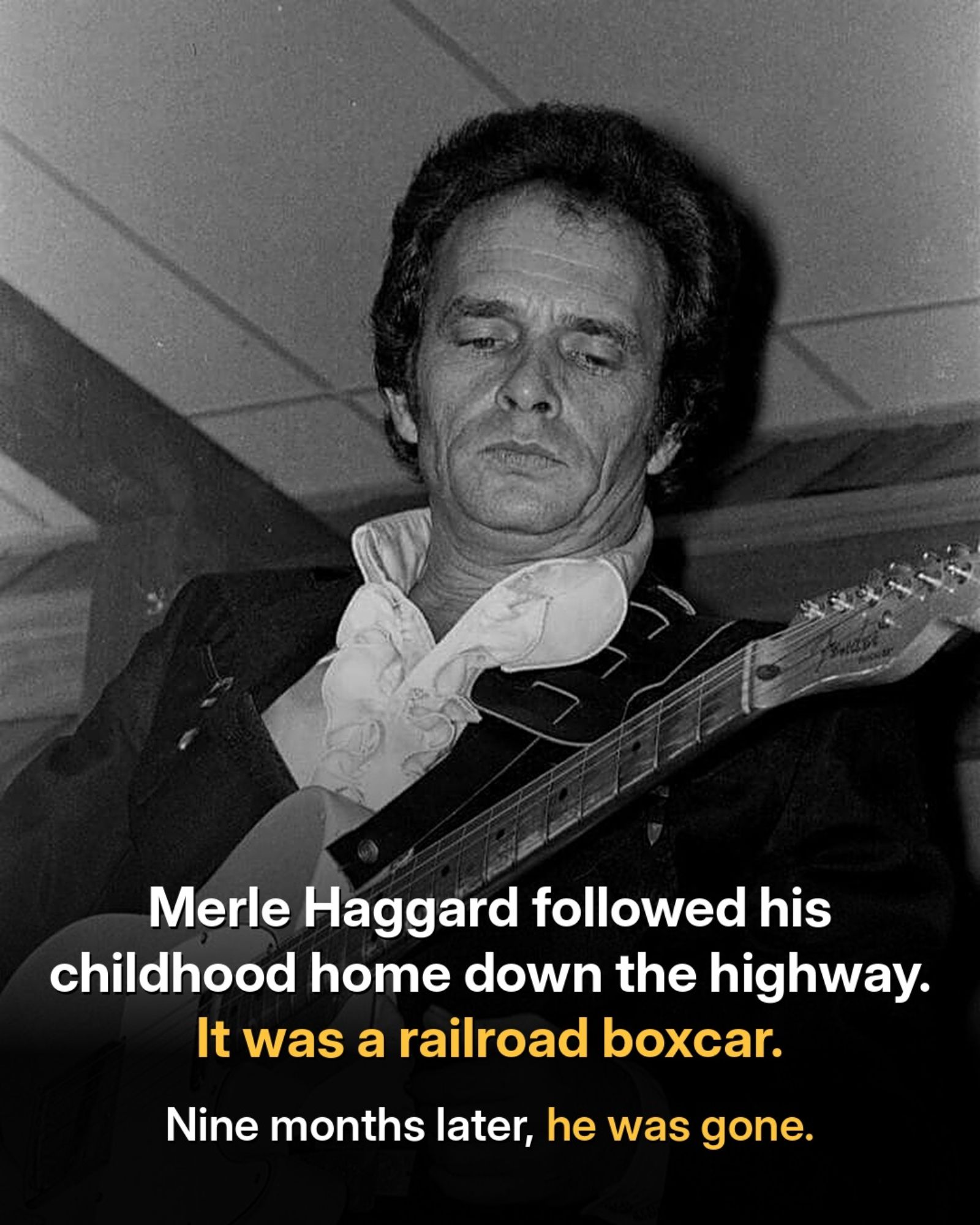
The song is “Hungry Eyes,” sometimes called “Mama’s Hungry Eyes,” written and recorded by Merle Haggard with The Strangers. It reached No. 1 on the Billboard country chart in May 1969, and it is widely seen as Merle Haggard’s tribute to his mother, Flossie. To understand why, you have to start with a railroad boxcar in Oildale, California.
From Oklahoma to Oildale
James and Flossie Haggard lived in Checotah, Oklahoma, until their barn burned down. In 1935, during the Great Depression, they headed west to California with their two older children, Lowell and Lillian.
James found work as a carpenter for the Santa Fe Railroad. He paid $500 for an old Santa Fe boxcar, moved it onto a vacant lot in Oildale, just outside Bakersfield, and began turning it into a home. The family added two rooms, plumbing, a stove and floral wallpaper. It was meant to be temporary.
Instead, it became home, and their youngest son, Merle Haggard, grew up inside it. Years later, Lillian Haggard Rea still remembered how it felt:
“The walls were thick: cool in the summer and warm in winter.”
The Year Everything Changed
In 1946, James Haggard died of a brain hemorrhage. Merle was nine years old.
Flossie Haggard took a job as a bookkeeper and became the family’s only breadwinner. With his mother working long days, the boy was often alone or passed between relatives. He grew restless and soon found trouble.
A Song Two Decades in the Making
On December 9, 1968, Merle Haggard, already a country star, recorded “Hungry Eyes” at Capitol’s studio in Los Angeles, the lead single from A Portrait of Merle Haggard.
According to Daniel Cooper’s liner notes for the box set Down Every Road, Merle Haggard had carried the title around in his head for two years before he knew what to do with it. Cooper also wrote that the humble home pictured in the song pointed back to the place of Escar and Willie, the great-uncle and great-aunt the boy stayed with after his father died.
What the Song Says
“Hungry Eyes” looks back at a migrant family living in a crowded workers’ camp. The father works with his hands and dreams of better; the mother holds on to her faith. The children are too young to understand that other people see them as lesser. Through it all, the mother never asks for much. She wants only what the family truly needs, and every time it does not come, the longing shows a little more in her eyes.
It is not a literal autobiography. Historian Bill Malone pointed out that the Haggard family never actually lived in a labor camp. Merle Haggard himself described the song as being about a whole era. In the documentary Beyond Nashville, he said it “was written about a period in America where there were places like labor camps,” and he added that the people in those camps were not what John Steinbeck imagined them to be.
So the details belong to a generation. The feeling belongs to Flossie.
What Came After
“Hungry Eyes” was one of three No. 1 singles Merle Haggard released in 1969. In 1994, a tribute album took its name, Mama’s Hungry Eyes: A Tribute to Merle Haggard, with Emmylou Harris singing the title song.
The boxcar had its own final chapter. In July 2015, it was lifted onto a flatbed truck and taken from Oildale to the Kern County Museum in Bakersfield. Merle Haggard and his sister Lillian were there to watch it go. Merle followed the truck in his tour bus, and he picked the spot where it would rest himself.
Nine months later, on April 6, 2016, his 79th birthday, Merle Haggard died.
Why It Still Matters
Today the boxcar has been restored to look the way it did in the 1940s, when a widowed bookkeeper raised a restless boy inside its thick walls.
And anyone who plays “Hungry Eyes” can still hear what her son saw in her, long after he had left that little house behind.