Scroll to the end of the article to hear the song.
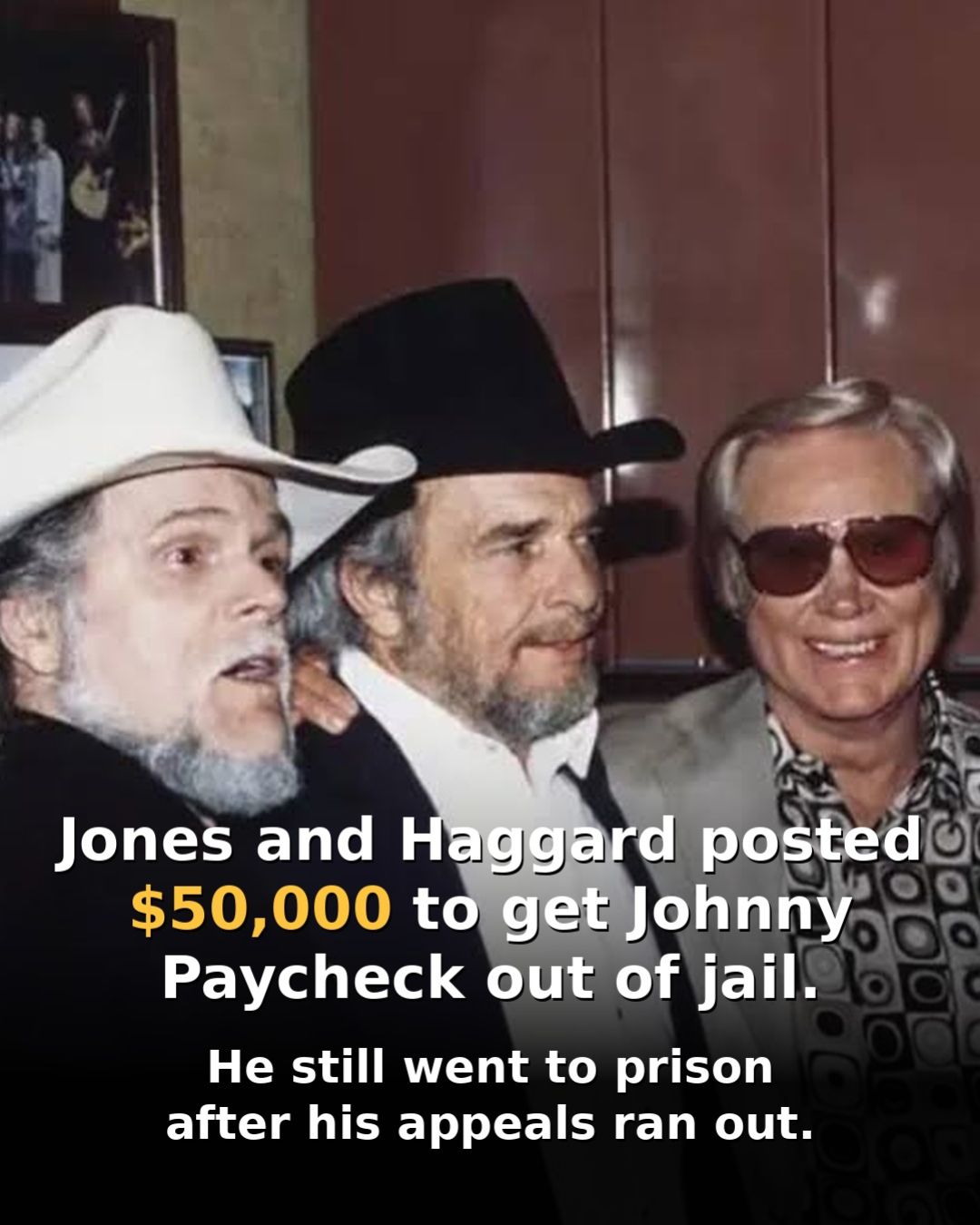
On May 16, 1986, a jury in Hillsboro, Ohio, found Johnny Paycheck guilty of aggravated assault and tampering with evidence. The judge sentenced him immediately, and the man who had sung “Take This Job and Shove It” went to jail. Within days, in May 1986, George Jones and Merle Haggard put up $50,000 to get him out. Saving Country Music dates the release to May 22, less than a week after the verdict.
What the record does not show is just as important. No source we found says how much each man paid, or whether either of them came to the jail in person. What it does show is that when Paycheck was at his lowest, two of the most respected singers in the business attached their names to his freedom.
What happened at the North High Lounge
On the night of December 19, 1985, Paycheck stopped at the North High Lounge in Hillsboro, not far from his hometown of Greenfield. A local man named Larry Wise wanted to talk with him. According to Rolling Stone’s account, Wise offered to take him home for a meal of deer meat and turtle soup, and the exchange turned hostile. Paycheck pulled a .22-caliber pistol and fired. The bullet grazed Wise’s scalp above his right eye. He was treated at Highland District Hospital and released.
Paycheck left the bar and was arrested early the next morning. United Press International reported that he was charged with felonious assault and released that same afternoon on $25,000 bond. For five months, he was a free man waiting for trial.
Two versions in the courtroom
At trial, Johnny Paycheck admitted firing the shot but said it was an accident. He testified that Wise and another patron had been bothering him, that Wise threatened him with a beer bottle, and that his thumb slipped on the hammer while he was trying to scare him. UPI reported his words on the stand:
“I didn’t mean to shoot nobody.”
Wise told a different story. He testified that he never saw the gun and never heard the shot. The jury convicted Paycheck on both counts. Because a gun was used, Ohio law required a mandatory three years before the assault term itself, two and a half to five years, could begin. Another year and a half for tampering brought the total to seven to nine and a half years.
Why Jones and Haggard
George Jones knew Johnny Paycheck from before the world knew that name. In the 1960s, when he still went by Donny Young, Paycheck played bass and steel guitar and sang high harmony in Jones’s band, the Jones Boys. Rolling Stone notes that Jones employed him as his bass player during that decade.
Merle Haggard’s connection ran through the music. In 1981, Paycheck released Mr. Hag Told My Story, an album built on Haggard’s songs, with Haggard joining him on duets. Haggard also knew something about a prison cell from the inside, having served time in San Quentin as a young man.
Time, not freedom
The bail kept Johnny Paycheck out of prison while his lawyers fought the case. During those years, his single “Old Violin” reached the country Top 25 in 1986. An appeals court later threw out his sentence because he had not received a proper sentencing hearing.
It did not save him. On February 6, 1989, Judge Darrell Hottle held a new hearing and handed down the exact same sentence, seven to nine and a half years. Paycheck, then 50, was taken from the courtroom in handcuffs. He would serve his time at the Chillicothe Correctional Institute.
He served 22 months. Ohio Governor Richard Celeste commuted his sentence, and Paycheck walked out in January 1991. Saving Country Music reports that while he was inside, Haggard produced a live album and TV special for him, though it was never officially released.
The last favor
Johnny Paycheck died in Nashville on February 19, 2003, at 64. He was buried at Woodlawn Memorial Park Cemetery, in a plot paid for by George Jones, the man whose band had given him his start and who had helped get him out of jail seventeen years earlier.