Scroll to the end of the article to hear the song.
Some country songs come from heartbreak. Some come from prison walls. This one came from a pair of shaking hands and a woman the world had never heard of until Merle Haggard said her name out loud.
A Life That Started Before the Automobile
She was born Martha Frances Arizona Belle Villines in Newton County, Arkansas. The family called her Zona. In 1901 she married, and from then on she was the anchor of a family that never had much money but never ran short of grit.
Her daughter Flossie grew up, married an Oklahoma man named James Haggard, and during the Great Depression the couple left Oklahoma for California after their barn burned. In 1937, in a railroad boxcar that James Haggard had turned into a home in Oildale, California, their youngest son was born. They named him Merle Ronald Haggard.
That boy would go on to become one of the most important songwriters country music has ever known. But to Zona Harp, he was simply her grandson.
The Song Merle Haggard Wrote When She Was Gone
By the early 1970s, Merle Haggard was a star. He had already turned his own life into hits. Then his grandmother passed away, and Merle Haggard did what he always did with the things that mattered most to him. He wrote them down.
On November 18, 1971, Merle Haggard and his band, The Strangers, went into a studio in Hollywood and recorded a song called “Grandma Harp.” There was no clever title and no hidden metaphor. The song carried her name, because that was the whole point.
No Legend, Just a Life
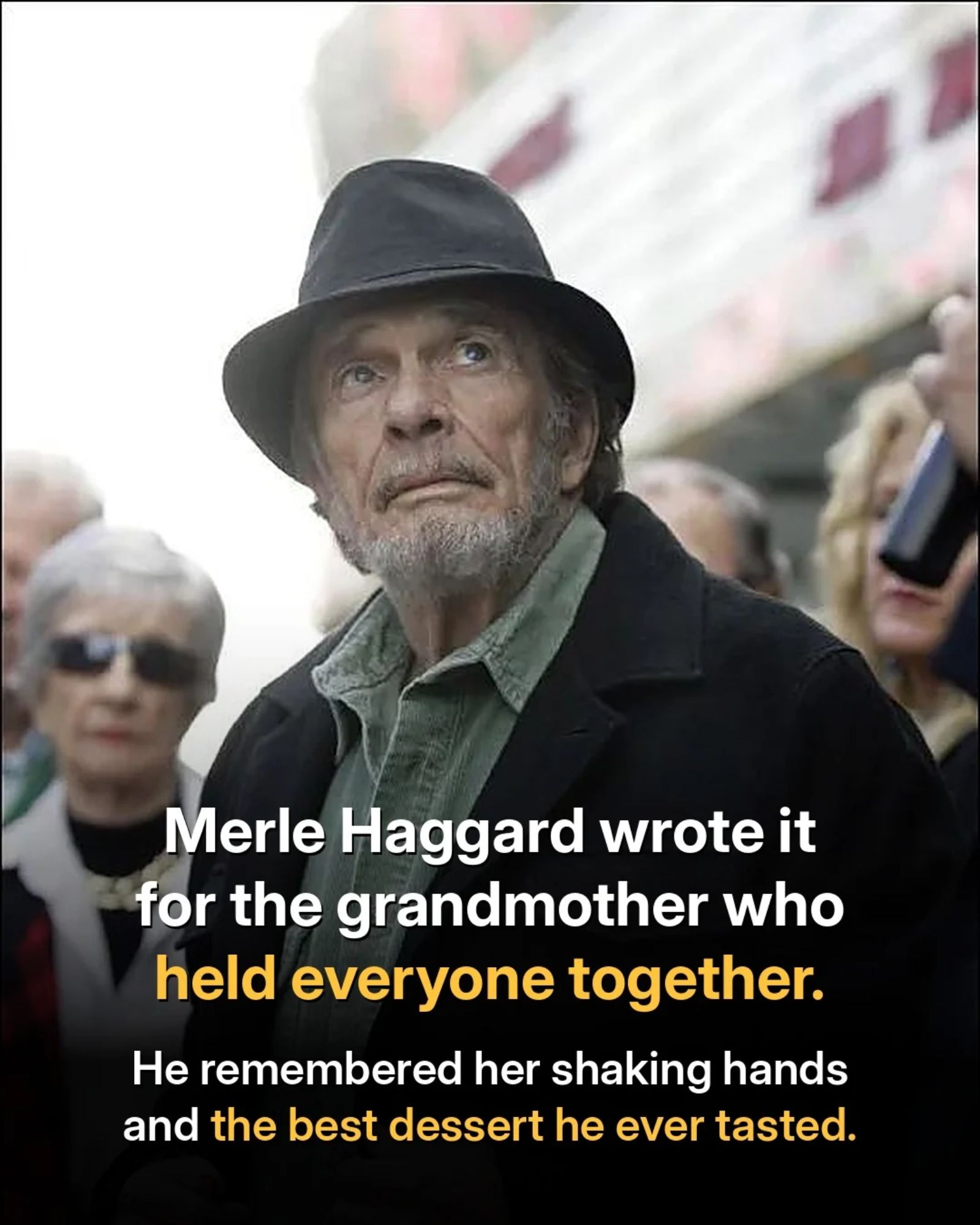
On the album version, Merle Haggard doesn’t start by singing. He starts by talking, almost like he’s sitting across from you on a porch. He remembers her blue eyes. He remembers her hands trembling as she set down the best homemade dessert he ever tasted. He marvels at how much the world changed while she lived in it, from the first automobiles to two world wars to a man walking on the Moon.
Then the music begins, and Merle Haggard makes a promise: this isn’t some grand family legend. It’s just the honest story of one woman. She was born in Arkansas, she married in 1901, and somehow she raised a good family out of hard poverty. In the last verse, the family lays her to rest on a Sunday morning, and everyone knows she did her part.
Not every hero in a country song wins a fight or breaks a heart. Some of them just keep a family standing.
A Quiet Song That Climbed All the Way to the Top
“Grandma Harp” was released as a single on March 20, 1972, from the album Let Me Tell You About a Song. Merle Haggard built that album like a musical autobiography, pieced together from his memories and the songs that shaped him. “Grandma Harp” reached No. 1 on Billboard’s country singles chart and held the top spot for two weeks.
The timing holds a small surprise. Three years earlier, “Hungry Eyes,” the song Merle Haggard wrote in tribute to his mother, Flossie, reached No. 1 on the chart dated May 10, 1969, the day before Mother’s Day. “Grandma Harp,” the song for Flossie’s own mother, reached No. 1 on the chart dated May 13, 1972, again the day before Mother’s Day.
What Remains When the Singer Is Gone
Merle Haggard died on April 6, 2016, on his 79th birthday. Among all his songs about trains, prisons and working people sits this short, plain song about a woman from the Arkansas hills.
The world outside her family never knew the name Zona Harp. But because her grandson loved her enough to sing about her, her name still comes through the speakers decades later.
Merle Haggard is gone now. But every time “Grandma Harp” plays, she gets to come home again for a few minutes.
Is there someone in your family whose story deserves a song like this?