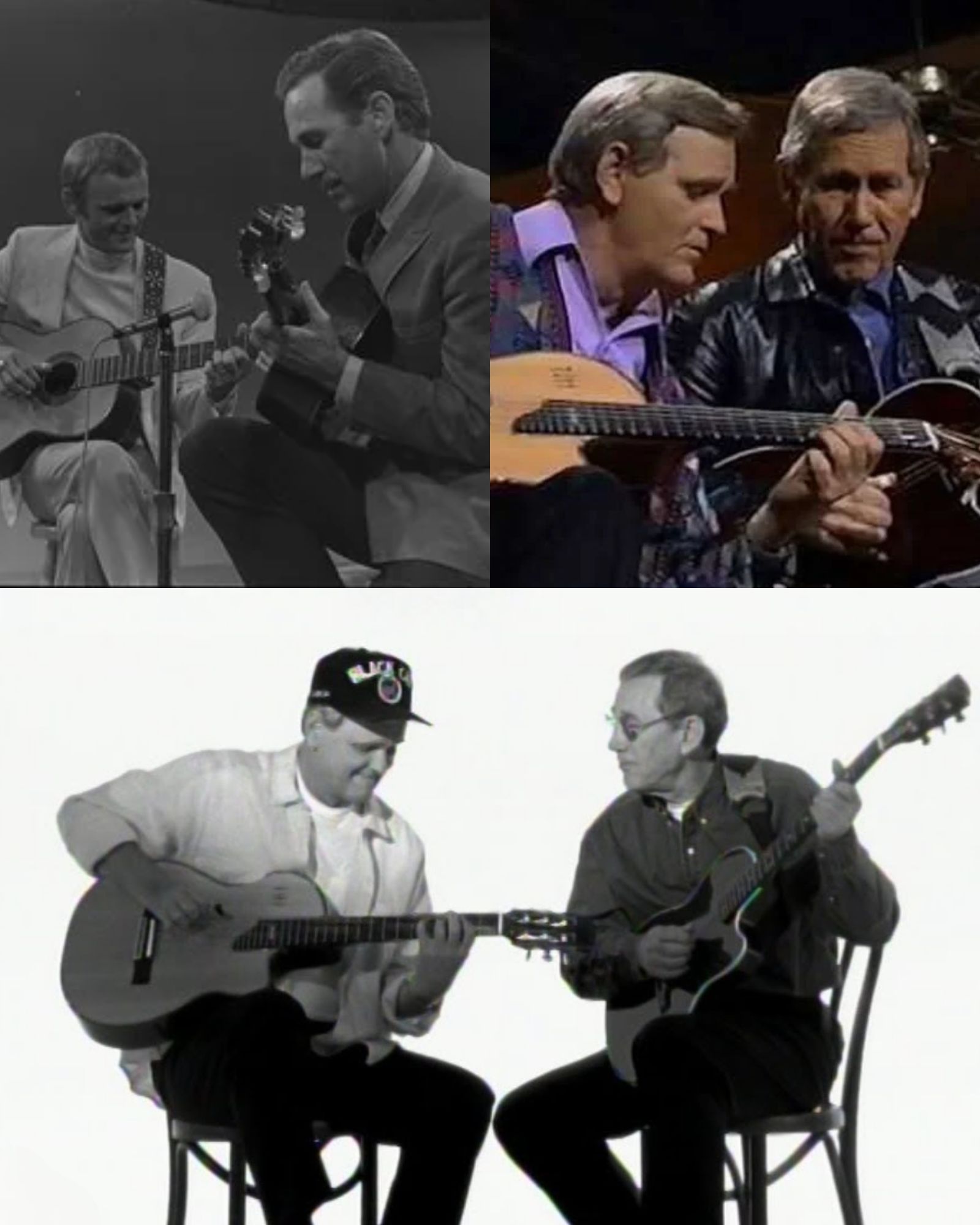
When Chet Atkins was recovering from cancer surgery in the early 1970s, Jerry Reed came up with an unusual way to help a close friend through a frightening time.
Jerry Reed didn’t write a gentle ballad or offer a few comforting words through a song. Instead, Jerry Reed composed an instrumental guitar piece filled with complicated fingerpicking, moving bass lines, and unexpected harmonic changes.
The idea was simple but remarkable: give Chet Atkins something difficult enough to occupy a brilliant musical mind.
The composition was called “Mister Lucky.” Nearly twenty years later, Jerry Reed would explain the story behind the music during a California concert. But to understand why that gesture mattered, it’s worth looking at the friendship that came before it.
The Man Who Helped Jerry Reed Find His Place in Nashville
Long before Jerry Reed became famous for “Guitar Man,” “Amos Moses,” and “East Bound and Down,” Chet Atkins recognized something special in the young Georgia musician.
After Jerry Reed moved to Nashville in 1962, the road to recording success was far from straightforward. Jerry Reed worked as a songwriter and session guitarist while trying to establish a career as a recording artist.
Chet Atkins eventually brought Jerry Reed to RCA Records and encouraged Jerry Reed to embrace an individual musical style rather than imitate what was already successful.
That encouragement helped change Jerry Reed’s career.
By 1970, Jerry Reed and Chet Atkins had recorded the instrumental album “Me and Jerry.” The collaboration earned a Grammy Award in 1971, demonstrating how well two distinctive guitar styles could work together.
The relationship was more than a professional partnership. Jerry Reed had found someone who understood the inventive guitar playing that made Jerry Reed different from other Nashville musicians.
When Chet Atkins Faced a Different Kind of Challenge
In 1973, Chet Atkins faced serious health problems, including cancer diagnoses and surgery. For someone whose life revolved around playing, recording, and producing music, the uncertainty was especially difficult.
According to Jerry Reed’s later account, Chet Atkins was worried about dying while recovering from cancer surgery.
Jerry Reed knew that Chet Atkins loved a musical challenge. A complicated guitar arrangement could demand attention to every note, every chord change, and every movement of the fingers.
So Jerry Reed wrote “Mister Lucky.”
Rather than relying on a simple melody, Jerry Reed created an intricate instrumental in which the bass and melody move with remarkable independence. Even an experienced guitarist would need concentration to work through the arrangement.
The composition appeared on Chet Atkins’ 1974 RCA Victor album “Chet Atkins Picks on Jerry Reed,” an album devoted to Jerry Reed’s music.
There is no documented proof that the composition relieved Chet Atkins’ fears. What is documented is Jerry Reed’s intention, and that intention reveals something memorable about the friendship.
The Night Jerry Reed Explained “Mister Lucky”
On August 31, 1992, Jerry Reed performed at the Crazy Horse Steak House in Santa Ana, California.
Music journalist Jim Washburn attended the performance and later described the evening in the Los Angeles Times.
Jerry Reed opened the acoustic portion of the show with a nylon-string guitar. One of the first pieces was “Mister Lucky.”
Before playing, Jerry Reed explained the reason behind the composition.
“I wanted to write him a song so complicated that it would take his mind off the cancer.”
It was a revealing explanation of a musical gift that might otherwise have seemed like nothing more than another technical exercise.
The performance carried another meaningful connection. Chet Atkins had recently encouraged Jerry Reed to return to the intricate acoustic fingerpicking that Jerry Reed had largely stopped performing in public.
Years earlier, Jerry Reed had written a guitar challenge for Chet Atkins. Now Chet Atkins was encouraging Jerry Reed to revisit the same kind of demanding musicianship.
Even Tommy Emmanuel Found the Music Difficult
The complexity of “Mister Lucky” was not merely a colorful description from Jerry Reed.
In a 2015 interview with Premier Guitar, Australian guitar virtuoso Tommy Emmanuel recalled struggling to understand the composition’s chords. Another musician eventually showed Tommy Emmanuel the fingering needed to make the arrangement work.
Tommy Emmanuel specifically remembered how the descending bass line moved independently of the melody.
For an accomplished guitarist to remember that challenge decades later says something about the sophistication of Jerry Reed’s writing.
A Friendship That Continued Through Music
Jerry Reed and Chet Atkins continued making music together long after “Mister Lucky” was written. The album “Sneakin’ Around,” released in the early 1990s, earned another Grammy Award for the two guitarists in 1993.
By then, both musicians had established lasting places in country music history. Chet Atkins had helped shape the Nashville Sound, while Jerry Reed had developed one of the most recognizable guitar styles in country music.
Yet “Mister Lucky” reveals something different from awards, hit records, and famous performances.
Jerry Reed understood that music could be more than entertainment. In the hands of two people who shared a deep love for the guitar, a difficult composition could become an expression of friendship.
And perhaps that is what makes “Mister Lucky” so memorable. Jerry Reed didn’t try to make the music easy for Chet Atkins. Jerry Reed made it challenging because Chet Atkins was one of the few people who could truly appreciate the challenge.
Sometimes, the most thoughtful gift is one that only a particular friend would understand.