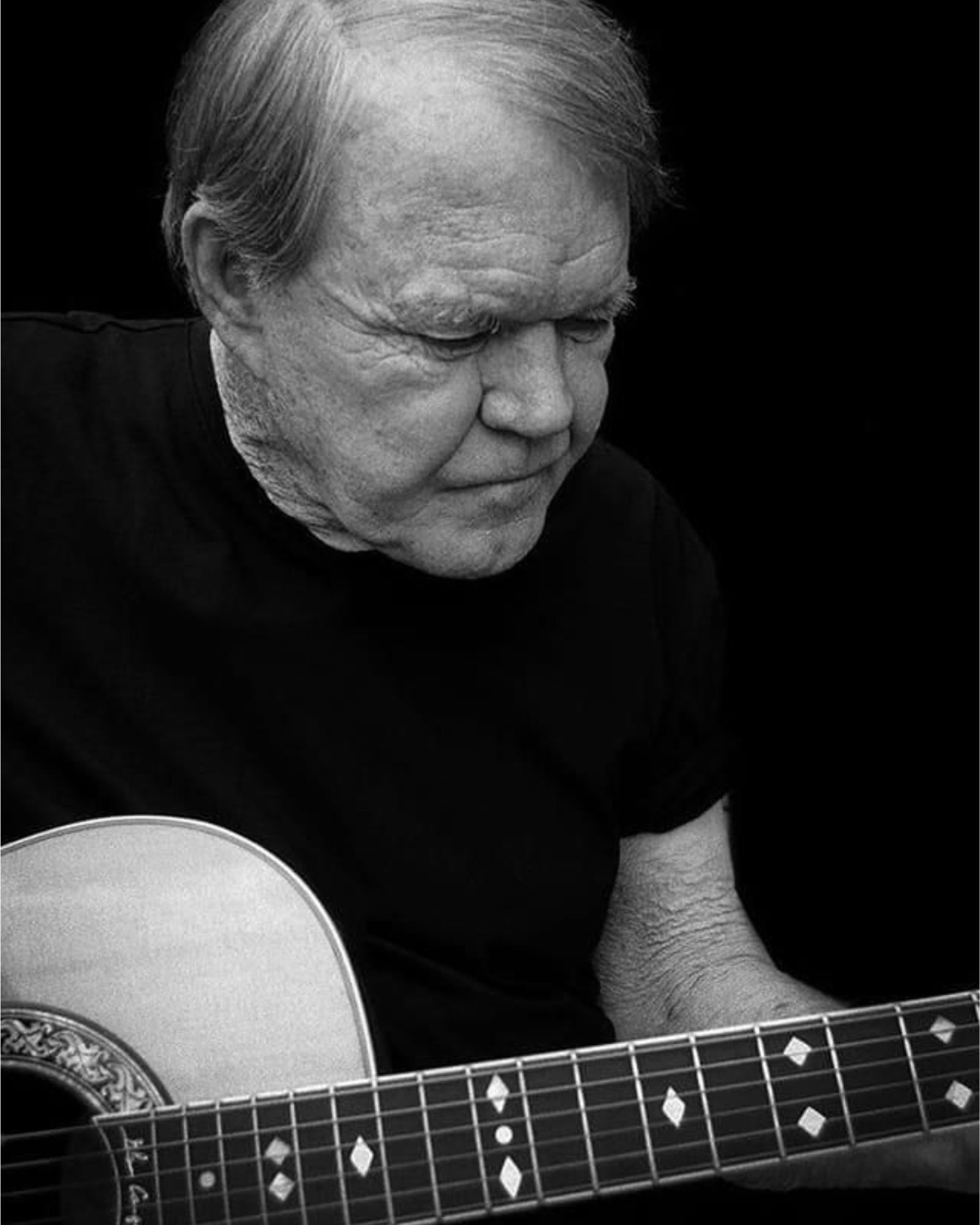
In a Nashville studio called Station West, Glen Campbell stood at the microphone with Alzheimer’s disease already taking the lyrics he had carried his whole life. Next to him stood Carl Jackson, his banjo player and friend of four decades, holding up sheets of paper with the words printed in large type. Carl fed them to him one line at a time.
The record they made was called Adiós. It was released on June 9, 2017. Glen Campbell died on August 8, 2017, two months later.
“It Was Now or Never”
Glen Campbell was diagnosed with Alzheimer’s in 2011. He then went back on the road for a farewell tour that ran through 2011 and 2012. When the tour ended, his family could see how fast he was changing.
His wife, Kim Campbell, wrote about it in the album’s liner notes. Glen’s ability to play, sing and remember songs, she said, had begun to decline rapidly after the diagnosis.
“A feeling of urgency grew to get him into the studio … to capture what magic was left. It was now or never.” — Kim Campbell
His daughter, Ashley Campbell, later told the Associated Press that the family never expected another album. They simply wanted Glen to record while he still could.
For a while, fans believed they had already heard his goodbye. The 2014 song “I’m Not Gonna Miss You,” made for the documentary Glen Campbell: I’ll Be Me, had been billed as his farewell recording. But the Nashville sessions had been kept back, and they would not be heard until 2017.
The Man Standing Beside Him
They turned to Carl Jackson. He had joined Glen Campbell’s band as an 18-year-old banjo player in the early 1970s and toured with him from 1972 to 1984. He was more than a sideman. In her memoir, Kim Campbell writes that her blind date with Glen on May 28, 1981, was arranged through Carl Jackson. Carl is also godfather to Ashley.
According to Kim, the album itself grew out of an afternoon with Carl, when they sat and remembered all the songs Glen had always wanted to record but never got around to.
One Verse, Often One Line, at a Time
Carl Jackson knew this could not be a normal session. He first cut basic tracks and sang the vocals himself, so Glen could live with the songs and practice them. Then they went into the studio together.
“I took him in and I stood with him on every line, beside him in the studio, and we did it.” — Carl Jackson
Carl told Rolling Stone that he printed the lyrics in big print because Glen’s memory of the words had gone quickly. Even on his farewell tour, Glen had needed teleprompters on stage.
But something else had not gone. Carl told NPR that Glen never lost his melodies, his perfect pitch or his tone. And the room was not a sad one. When Glen forgot something, Carl said, he would laugh about it rather than get upset. Kim wrote that Glen was clearly ecstatic about being back in the studio. Ashley called the sessions therapeutic for her father.
The Songs He Never Got Around To
The album opens with “Everybody’s Talkin’,” a song Glen Campbell had performed on television in 1973 on The Sonny & Cher Comedy Hour but never recorded. Carl Jackson, then 19, played banjo with him that night. On Adiós, Carl gave that banjo part to Ashley. He told NPR it meant the world to him.
Carl also wrote a new song for the record, “Arkansas Farmboy.” He wrote it on a flight after hearing Glen tell the story of learning “In the Pines” on a five-dollar guitar, taught by his granddaddy.
Willie Nelson joined Glen on “Funny How Time Slips Away.” Vince Gill sang harmony on Roger Miller’s “Am I All Alone (Or Is It Only Me),” which opens with a spoken introduction by Miller himself. Glen’s sons, Cal and Shannon, are on the record too.
And there were four songs by Jimmy Webb, the writer behind “Wichita Lineman,” “By the Time I Get to Phoenix” and “Galveston.” One of them closes the album and gave it its name: “Adiós.” Linda Ronstadt had recorded it in 1989, but Glen had never cut it himself.
The Two Months That Followed
By the time Adiós reached stores, Glen Campbell was in the late stages of Alzheimer’s and living in a memory care facility in Nashville. Ashley said he could no longer speak or understand speech, though when she played music for him, he would sometimes close his eyes, tap his toes, or try to sing along with her.
Carl Jackson admitted he could not really share the finished album with his friend. Still, he believed it meant the world to Glen.
The album debuted inside the top 40 of the Billboard 200. On August 8, 2017, Glen Campbell died at 81. In the days after his death, Adiós climbed to a new peak on the UK’s Official Albums Chart.
The last thing he left his fans was a dozen songs he had loved for years, sung one line at a time, with an old friend holding the words.