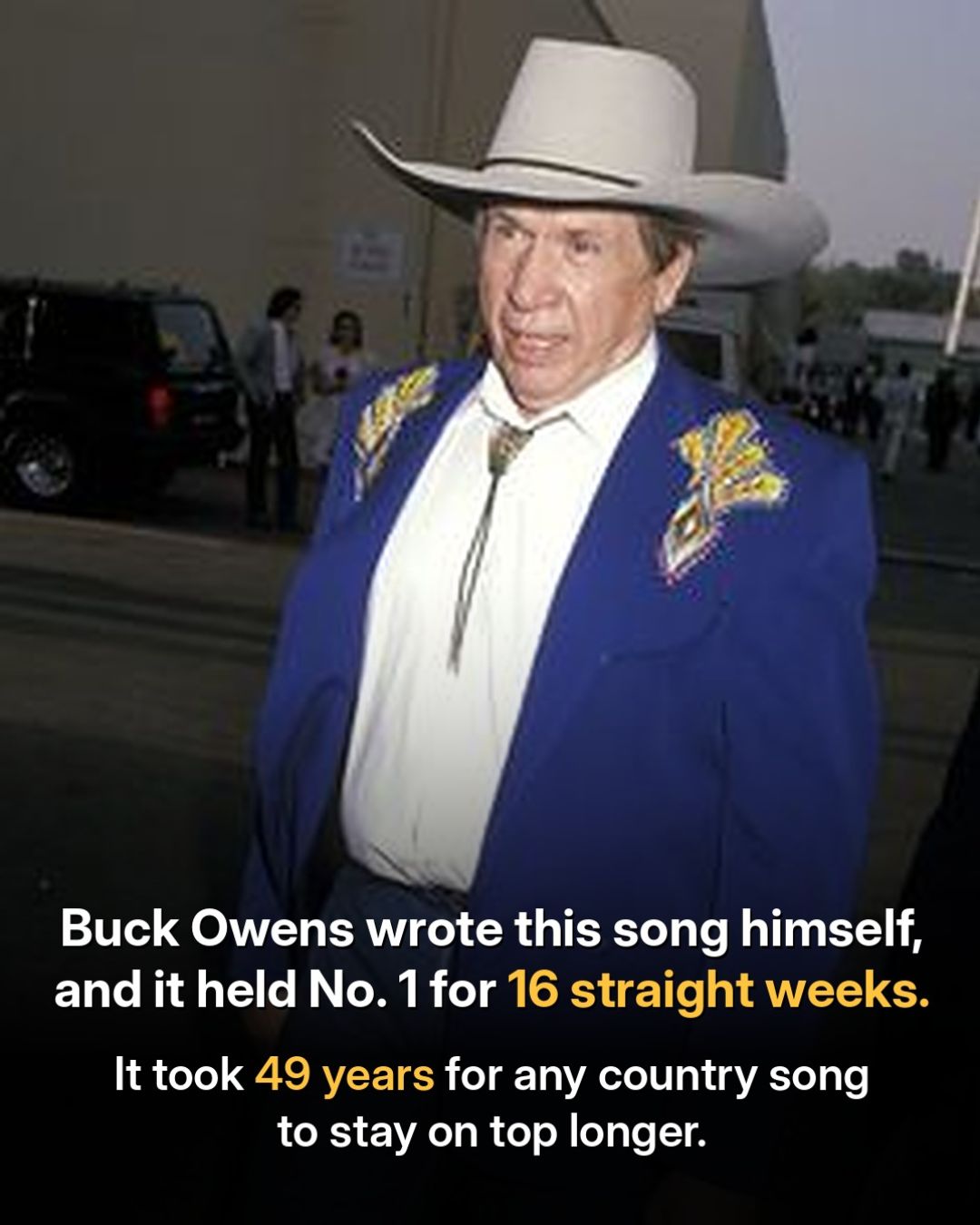
In the late summer of 1963, Buck Owens released a song he had written by himself, a quick, cheerful number called “Love’s Gonna Live Here.” By the time it finally gave up the top spot on Billboard’s country chart, it had been No. 1 for 16 consecutive weeks, from October 19, 1963, through the chart dated February 1, 1964. It would be 49 years before another country song spent longer at the top.
That run is the heart of this story, and it is worth looking at week by week, because those weeks included one of the darkest seasons the country had been through in years.
A Fast Climb to the Top
Capitol released “Love’s Gonna Live Here” on August 19, 1963, with Ken Nelson producing. Buck Owens was still new to the very top of the chart. His first No. 1, “Act Naturally,” had reached the summit only that June, so this was just the second chart-topper of his career.
The new single entered Billboard’s Hot Country Singles chart at No. 16 on September 21, 1963. By October 12 it had climbed to No. 2, and a week later, on the chart dated October 19, it was No. 1. Then it stayed there.
Through Thanksgiving, Christmas, and a Nation in Mourning
The song held the top spot through Halloween, through Thanksgiving, through Christmas, and through New Year’s Day. It was the No. 1 country song in America when President John F. Kennedy was assassinated in Dallas on November 22, 1963, and it was still No. 1 as the country moved through the grief of that holiday season.
There is a quiet irony in that. “Love’s Gonna Live Here” is not a sad song at all. It is about a man who has come through loneliness and can feel happiness on its way back, and it sat at the top of the chart for the entire stretch of those heavy weeks.
The song was No. 1 for the final eleven weeks of 1963, the longest unbroken run at the top during that calendar year. The streak carried five more weeks into 1964 before Marty Robbins’ “Begging to You” took over on the chart dated February 8. In all, “Love’s Gonna Live Here” spent 30 weeks on the chart.
A Record That Waited Nearly Half a Century
Sixteen weeks was not the longest run ever. A few hits from the late 1940s and 1950s had stayed at No. 1 even longer. But after Buck Owens, nobody came close. The nearest any song got in the decades that followed was David Houston’s “Almost Persuaded,” which held No. 1 for nine weeks in 1966.
No country song reached ten weeks at the top again until January 2013, when Taylor Swift’s “We Are Never Ever Getting Back Together” did it. Then, on July 6, 2013, Florida Georgia Line’s “Cruise” logged its 17th week at No. 1 and finally passed Buck Owens. The gap was more than 49 years.
There is an honest footnote here. In October 2012, Billboard changed how it built the Hot Country Songs chart, adding digital sales, streaming, and airplay from all formats. Critics at the time argued that the change made long runs at No. 1 much easier, which makes the 1963 run by “Love’s Gonna Live Here” look even more remarkable in hindsight.
The Start of Something Bigger
For Buck Owens, the song was not a peak so much as a launching pad. “Act Naturally” and “Love’s Gonna Live Here” opened a string of No. 1 records that ran through the middle of the decade, including “My Heart Skips a Beat” and “Together Again” in 1964. The sharp, twangy Bakersfield Sound he built with the Buckaroos became one of the defining sounds of 1960s country music.
A Song Other Legends Kept Coming Back To
Plenty of great singers have recorded “Love’s Gonna Live Here” over the years. Waylon Jennings cut it in 1964. Wanda Jackson recorded it in 1969, and Emmylou Harris included it on her 1982 album Last Date. Martina McBride put it on Timeless in 2005, Dwight Yoakam recorded it for Dwight Sings Buck in 2007, and Tanya Tucker cut it in 2009. None of them matched what Buck did with it.
Buck Owens himself returned to the song in 1991, nearly three decades after it first went to No. 1, singing it as a duet with George Jones on Jones’ album Friends in High Places.
If you heard it on the radio during that long winter of 1963, chances are it still takes you right back.