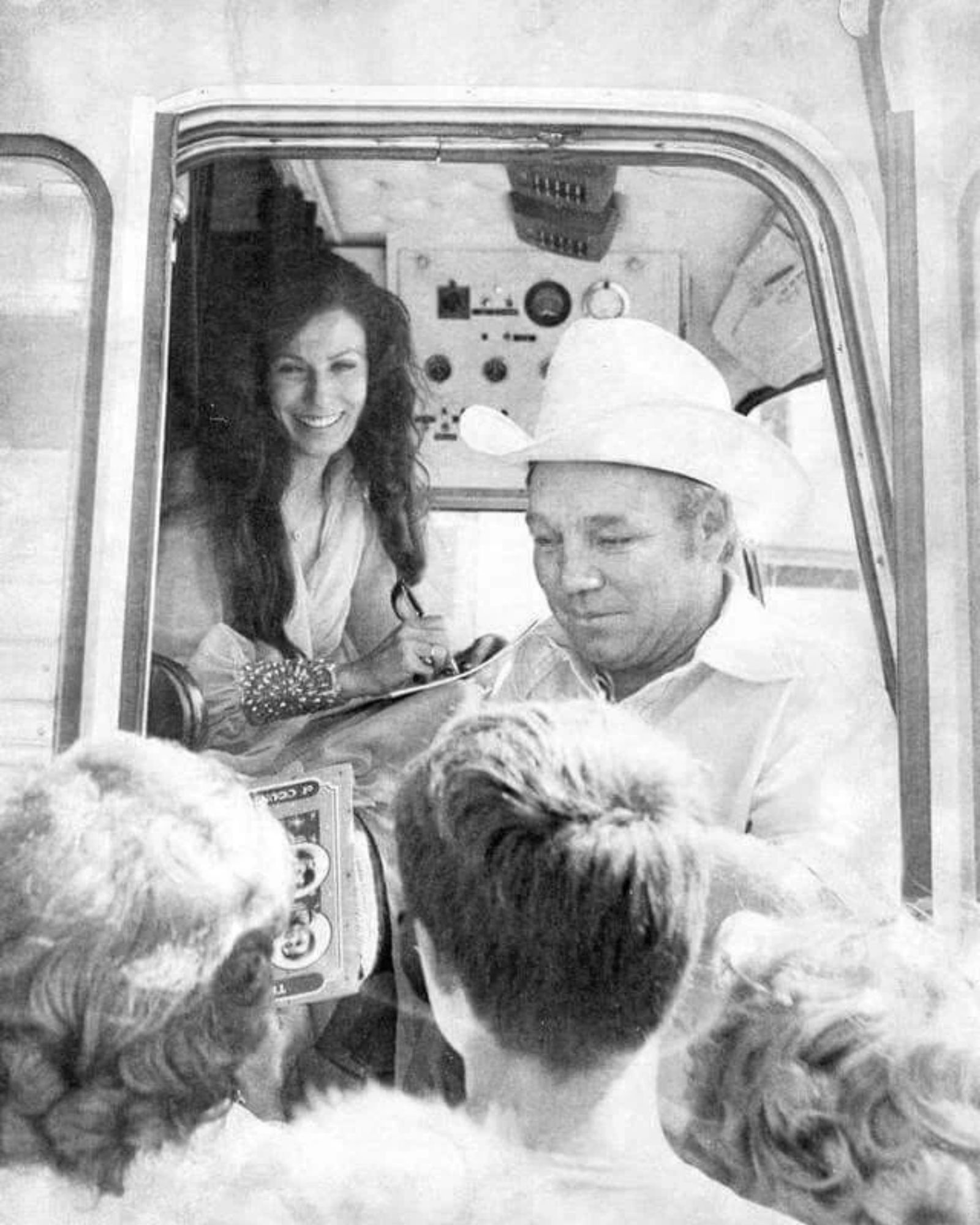
On the morning of October 15, 1960, Loretta Lynn woke up in the front seat of an old Mercury sedan and realized her husband, Oliver “Doolittle” Lynn, had parked it right in front of the Grand Ole Opry. That night she walked onto the Opry stage for the first time. Less than two years later, she was a member of the Opry for life.
Here is how a 28-year-old mother of four got from that car to the Opry cast, and what the man who parked it meant to her for the rest of his life.
How They Got to Nashville
Loretta’s first single, “I’m a Honky Tonk Girl,” came out in the spring of 1960 on Zero Records, a tiny label with no money to promote it. So Loretta and Doo did it themselves. They mailed copies to radio stations. When that wasn’t enough, Loretta sewed herself a fringed cowgirl outfit, and the two of them drove the record across the country in Doo’s Mercury, stopping at station after station.
She later described that trip without any shine on it. They couldn’t afford hotels, so they slept in the car and ate baloney-and-cheese sandwiches in parks. Then they walked into the next radio station and asked the DJ to play her record.
It worked. The song climbed to No. 14 on the Billboard country chart, and it carried them to Nashville.
The Night She Sang on the Opry
Loretta remembered surprisingly little of the performance itself. She wore a short, tight dress she had made herself and sang “I’m a Honky Tonk Girl.” In later years she said the only thing she really recalled was tapping her foot the whole time.
What she did remember was what happened after she left the stage. She ran out the back of the building shouting:
“I’ve sung on the Grand Ole Opry!”
She found out something else after the show. Ernest Tubb, one of the biggest stars on the Opry, had given up his own spot on that Saturday night broadcast so the newcomer could sing. “That was something for him to do that because he didn’t know me,” she told The Tennessean in 2022.
What Came Next
That night opened doors quickly. Ernest Tubb began booking Loretta Lynn on his Midnite Jamboree, broadcast from his record shop downtown, almost every Saturday night. She began appearing regularly on the Opry.
The Wilburn Brothers, Teddy and Doyle, took her under their wing and signed her to their management and publishing companies. Doyle Wilburn carried a tape of Loretta singing one of their songs, “Fool #1,” to producer Owen Bradley at Decca Records. Bradley gave the song to Brenda Lee, who turned it into a pop hit, and Loretta came away with a Decca contract.
Her first Decca single, “Success,” went to No. 6 on the country chart in 1962. On September 25, 1962, Loretta Lynn became an official member of the Grand Ole Opry, less than two years after she’d slept in the car out front.
The Man Behind the Wheel
Their marriage was not a fairy tale, and neither of them pretended it was. Doolittle Lynn spoke openly in interviews about his drinking and his unfaithfulness, and Loretta wrote much of that hurt into her songs.
Still, when his health failed, she largely stayed off the road from 1991 to 1996 to care for him. Doolittle Lynn died on August 22, 1996, after 48 years of marriage. Afterward, Loretta was so numb with grief that she barely spoke to anyone for about a year.
Home was the ranch at Hurricane Mills, Tennessee. Between tours, Loretta cooked, canned and pickled vegetables from her garden in her own kitchen there. Doolittle Lynn is buried on that ranch. When Loretta Lynn died in her sleep there on October 4, 2022, at 90, she was laid to rest on the same land, 62 years after a night spent in a Mercury parked outside the Opry.