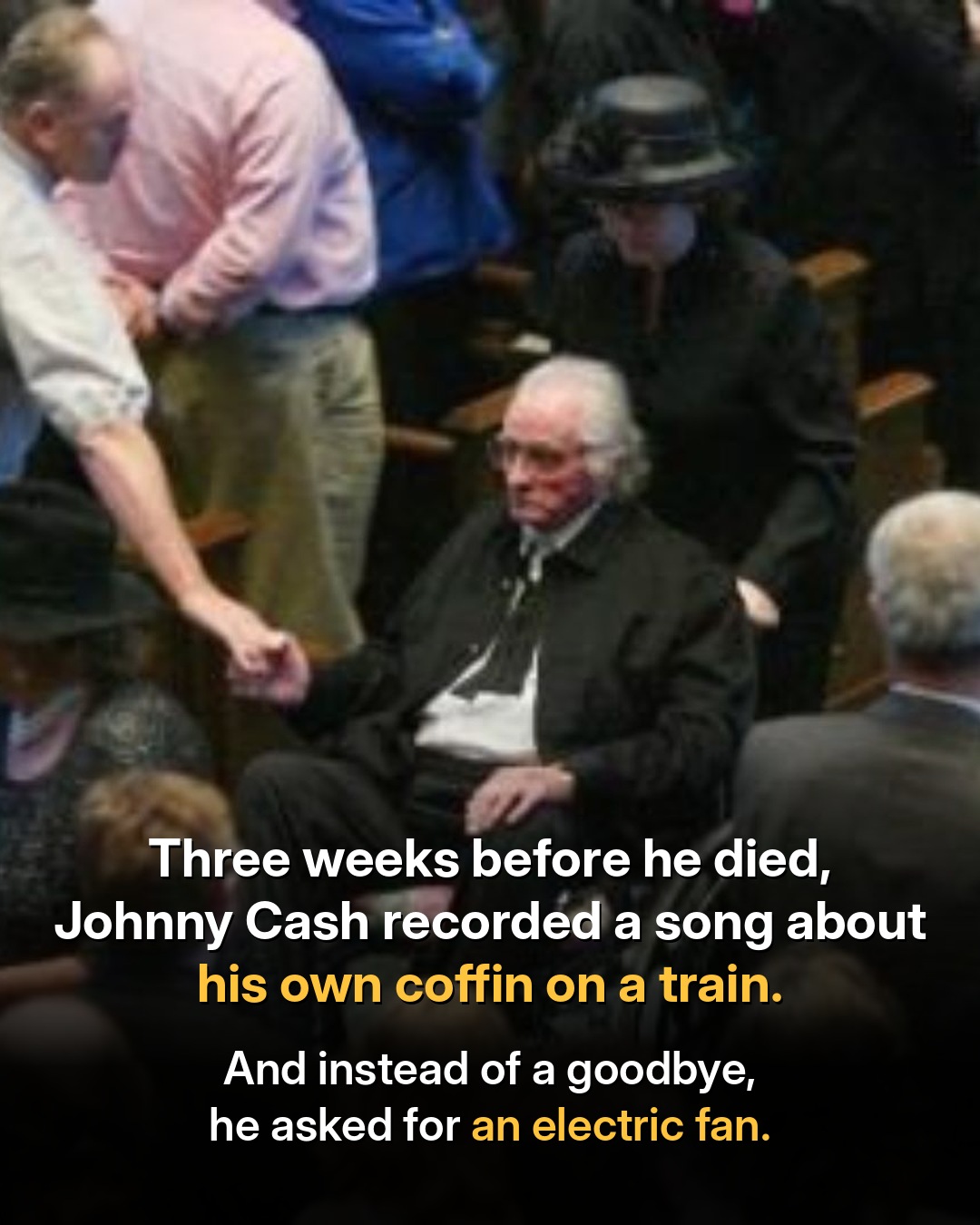
In the summer of 2003, everyone close to Johnny Cash knew time was running short. June Carter Cash, his wife of 35 years, had died on May 15. Johnny Cash was 71, he needed a wheelchair, and he had trouble breathing.
He spent those months doing what he had done all his life. He made music, and he wrote one more song.
That song was “Like the 309.” It was the last song Johnny Cash ever wrote, and it wasn’t a sad hymn or a tearful goodbye. It was a train song, it was about his own coffin, and it was funny.
A Song That Started With “Asthma”
Johnny Cash lived with chronic asthma in his final years, and he didn’t hide it in the song. The working title was “Asthma Like the 309.” He compared the asthma attacks coming on to a locomotive rolling down the line.
In the song, the narrator isn’t afraid of dying. He’s annoyed. He says he’d like to get his breath back before death arrives. He asks for an electric fan pointed at his tired old head. Then he tells everyone to load him, box and all, onto the 309 and watch him ride away.
He even half-jokes that people should take a look at him and see that he’s doing just fine.
Years later, his son John Carter Cash shared his father’s handwritten lyric sheets for the song in his book House of Cash. He summed it up in one line:
“Dad’s song ‘Like the 309’ shows his magical ability to laugh in the face of his own sickness and mortality.”
Recorded in the Final Weeks
After June Carter Cash died, Johnny Cash told producer Rick Rubin that he had to keep working. Rick Rubin set up recording equipment at Johnny Cash’s home in Tennessee and kept an engineer on call. On the days Johnny Cash felt strong enough, he sang. On the days he didn’t, he waited for tomorrow.
Johnny Cash recorded “Like the 309” on August 21, 2003. It was the next-to-last song he ever recorded. According to Robert Hilburn’s biography Johnny Cash: The Life, it was cut during his final day in a recording studio.
On some takes you can hear his breathing, rough and labored, right there in the microphone. It was the same problem he was singing about, and he left it in.
Johnny Cash died on September 12, 2003, about three weeks later.
Where It All Began: Trains
The song brought Johnny Cash’s whole career full circle. Trains had been part of his music from the very start.
In 1955, his first single for Sun Records included “Hey Porter,” a song about a young man riding a train home to Tennessee, excited to see the South again. Over the years he kept coming back to the railroad. He made a concept album called Ride This Train in 1960, and in 1962 came the compilation All Aboard the Blue Train with Johnny Cash.
Almost 50 years after “Hey Porter,” Johnny Cash wrote one more train song. The young man heading home had become an old man heading somewhere else. This time, the train was carrying his coffin.
The Tapes Rick Rubin Dreaded
After Johnny Cash died, the final recordings sat waiting. Rick Rubin later admitted that going back to them was hard:
“I kind of dreaded doing it, after Johnny passed, going back and listening to it… it was difficult.”
About two years after Johnny Cash’s death, Rick Rubin finally began preparing the songs for release. He brought in musicians to build gentle arrangements around the vocals Johnny Cash had left behind. Rick Rubin described the result simply: “These songs are Johnny’s final statement.”
One Last No. 1
American V: A Hundred Highways came out on July 4, 2006. “Like the 309” was one of only two original Johnny Cash compositions on the album.
The album went straight to No. 1 on the Billboard 200. It was Johnny Cash’s first No. 1 album since At San Quentin in 1969, 37 years earlier.
That makes “Like the 309” one of the more unusual farewells in country music. Johnny Cash had every reason to write something heavy. He had just buried the love of his life, and his own body was failing. Instead, the last song he ever wrote was a train song with a wink. It gripes about asthma, asks for a fan, and tells everyone he’s fine. Then it puts him on board.