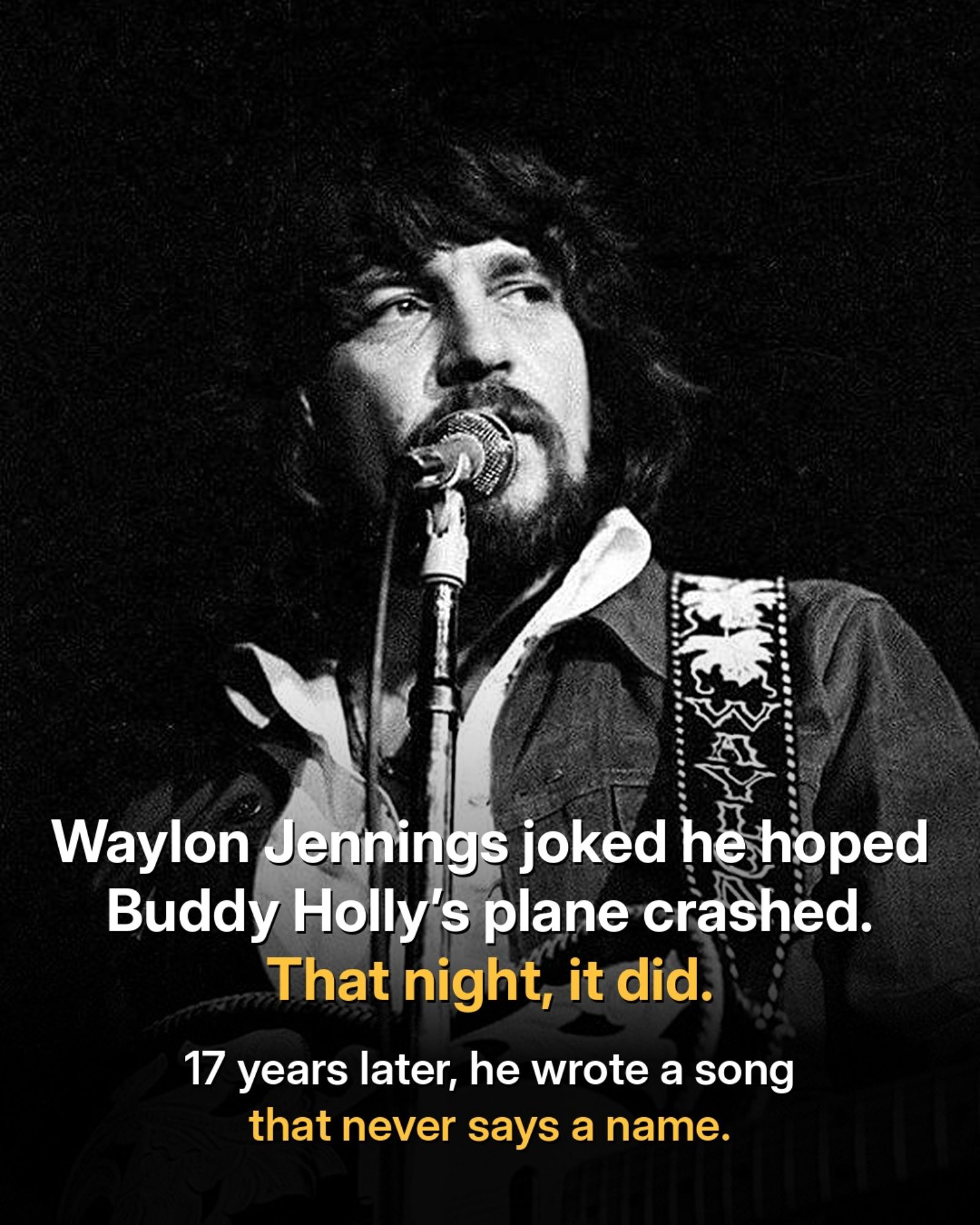
Scroll to the end of the article to hear the song.
Some sentences take a second to say and a lifetime to take back. Waylon Jennings said one of them on a freezing night in February 1959. He spent the rest of his life wishing he hadn’t.
A Kid From Texas and the Man Who Believed in Him
In 1958, Waylon Jennings was a young disc jockey in Lubbock, Texas, with a big voice and no clear path forward. Buddy Holly was already a star. Buddy took an interest in the kid at the radio station. He produced Waylon Jennings’ first single, a version of the old Cajun waltz “Jole Blon,” and then he did something bigger.
One day Buddy Holly walked in carrying an electric bass and dropped it in Waylon Jennings’ lap. He told him he had two weeks to learn to play it. Waylon Jennings never really learned the instrument the proper way. As he later explained, he simply memorized every song Buddy Holly had ever recorded. That was enough to get him on the road.
The Coldest Tour in Rock and Roll
The tour was called the Winter Dance Party, and it went through the upper Midwest in the dead of winter. The buses kept breaking down. The cold was brutal, and the musicians battled frostbite and the flu. By the time the tour reached Clear Lake, Iowa, on February 2, 1959, Buddy Holly had had enough. He chartered a small plane to fly ahead to the next show.
Waylon Jennings had a seat on that plane. But J.P. Richardson, known to fans as the Big Bopper, was sick with the flu and could not face another night on that bus. He asked Waylon Jennings if he could take his place. Waylon Jennings said yes. Guitarist Tommy Allsup flipped a coin with Ritchie Valens for the other seat, and Ritchie Valens won.
The Joke
Later that night, Buddy Holly was leaning back against the wall in a chair, laughing at his bass player for staying on the bus. According to Waylon Jennings, Buddy Holly teased him:
“Well, I hope your ol’ bus freezes up.”
And Waylon Jennings, twenty-one years old and just joking around with his friend, shot back:
“Well, I hope your ol’ plane crashes.”
Not long after takeoff in the early hours of February 3, 1959, the plane went down in a field outside Clear Lake. Buddy Holly, Ritchie Valens, J.P. Richardson and the pilot, Roger Peterson, were killed. Tommy Allsup was the one who broke the news to the band. Waylon Jennings later said he simply went numb.
The Weight He Carried
The grief was hard enough. The guilt was worse. Waylon Jennings admitted that for a long time he was terrified someone would find out what he had said that night. “Somehow I blamed myself,” he recalled. In another interview, he put it even more plainly: “God almighty, for years I thought I caused it.”
He also could not shake a simple, painful question: “Why would he die and not me?” He said it took him a long time to work it out, and that the answer changed the way he thought about his life. He stepped away from music for a while. When he came back, he slowly turned into one of the defining voices of outlaw country.
Seventeen Years Later
In the spring of 1976, Waylon Jennings went into a studio in Los Angeles to make an album called Are You Ready for the Country, named after a Neil Young song. Near the end of the record sits a quiet track he wrote by himself: “Old Friend.”
The song never says a name. It talks about how many years have gone by, and how it still feels like yesterday. It remembers the last time the singer saw this person, laughing at him and then leaving by air. It mentions the books and stories that have made this person sound like a saint, when the two of them knew he could be anything but. It says the music has changed a lot, yet keeps drifting back toward his sound.
So Who Was It For?
Waylon Jennings never publicly confirmed who “Old Friend” was about, at least not in any interview we could find. Many music writers have heard Buddy Holly in every line. The laugh, the departure, the growing legend: it is hard not to. Still, it remains a reading of the lyrics, not a statement from the man who wrote them. Maybe he wanted it that way.
The Last Verse
Waylon Jennings died on February 13, 2002, ten days after the anniversary of the crash. He carried that one sentence from Clear Lake for forty-three years. What he left behind is a song that sounds like it is finally talking back to someone.
Listen to “Old Friend” and decide for yourself: who do you think Waylon Jennings was singing to?