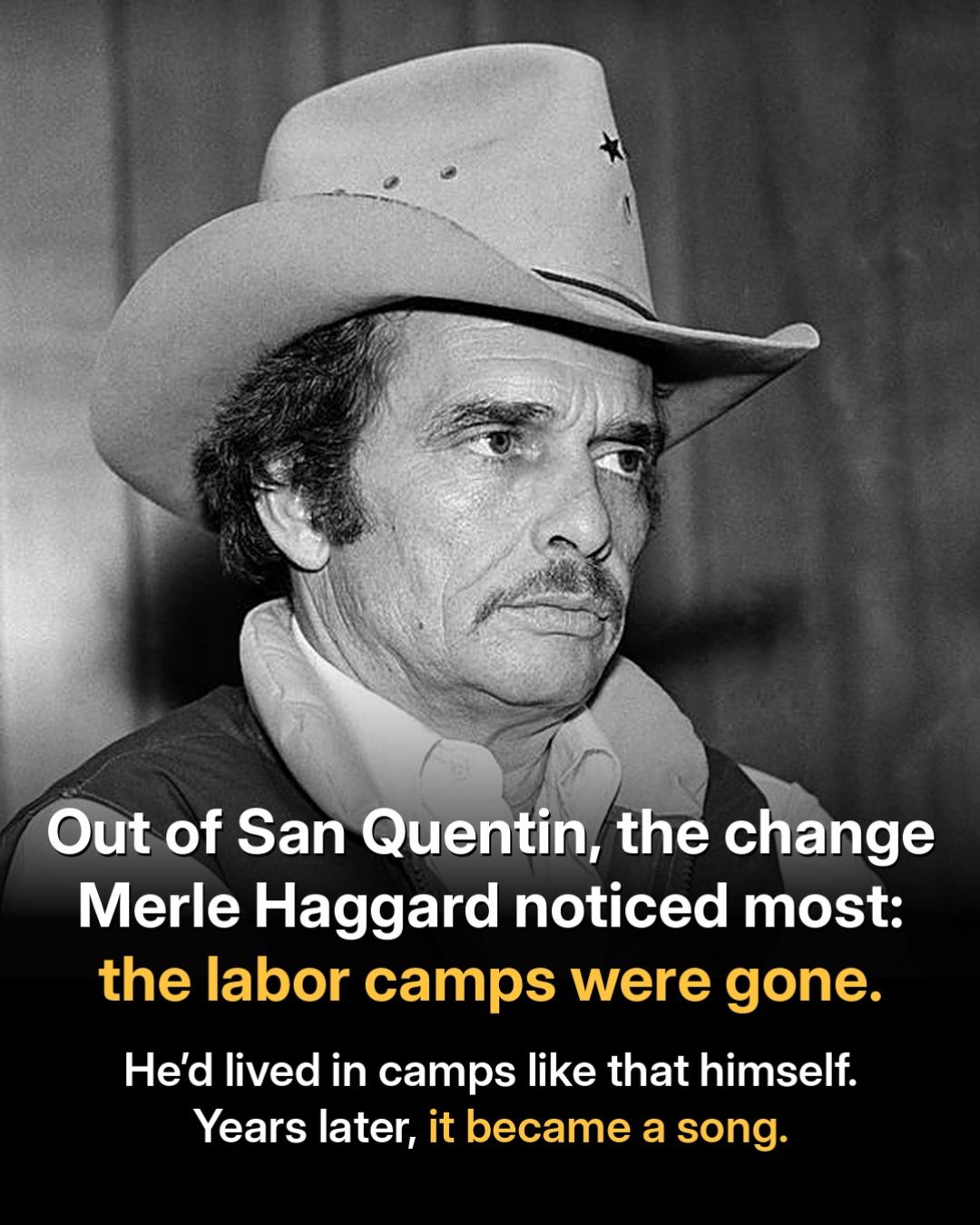
Scroll to the end of the article to hear the song.
The song is “They’re Tearin’ the Labor Camps Down,” the second track on Let Me Tell You About a Song, the album Merle Haggard and the Strangers released on Capitol Records in June 1972. It was never one of the big radio hits. But before the music starts, Merle Haggard tells you exactly where it came from, starting with the years he spent behind bars.
What he said before the music started
Merle Haggard opens the track talking, not singing. He says, almost casually, that it’s no secret he did a few years in San Quentin. He was paroled in 1960, and he describes what he found waiting for him on the outside. Women’s dresses had gotten shorter. The freeways were wider. The old steam engines were gone for good.
Then he gets to the change he says he noticed most. All down through the San Joaquin Valley, so many of the labor camps had disappeared, camps where he says he had lived himself from time to time. Some were already gone, and others were nearly cleared away. He names several of them.
From there he turns to other people. He wonders out loud what is going to happen to the farm workers and the fruit pickers, and to the man with a big family who can’t keep up with a high cost of living. Where are those people supposed to go now? He says those thoughts, together with his own memories, are what led him to write the song.
An album built on stories
That spoken opening wasn’t a one-time idea. Let Me Tell You About a Song was built around it. Merle Haggard introduces the songs with short talks about where they came from, and along the way he tips his hat to the people who shaped him, including songwriter Tommy Collins and Western swing king Bob Wills.
The album was recorded in 1971, at Buck Owens’ studio in Bakersfield and at Capitol in Hollywood, with Ken Nelson producing. It reached No. 7 on Billboard’s country albums chart, and it carried two No. 1 singles, “Daddy Frank (The Guitar Man)” and “Grandma Harp.” The labor camp song sits right after “Daddy Frank” on the record as track two, a quiet story song right next to a chart-topper.
The town he barely recognized
Once the band comes in, Merle Haggard puts himself back on his old side of town. Some of the changes he finds are for the better, he admits, but he hardly recognizes the place. The cottonwood tree that used to mark familiar ground has been cut down. The little family market has moved and taken a new name. The people he remembers are gone, and so is the cabin the narrator’s father built.
The chorus admits he feels a bit sentimental about it all, then asks the plain question underneath everything: with the camps coming down, where does a hungry working man go?
Where the memory came from
Merle Haggard’s family came to California from Checotah, Oklahoma, in 1935, part of the great Dust Bowl migration. His father, James, worked for the Santa Fe railroad and turned an old boxcar in Oildale, just north of Bakersfield, into the family’s home. Merle was born in Oildale in 1937.
That is where the sources don’t line up neatly. Country music historian Bill Malone noted that the Haggard family itself never lived in a labor camp, and another writer has said the family often visited relatives who did. In this spoken introduction, though, Merle Haggard says he had lived in those camps himself from time to time. The record doesn’t settle the difference. What it gives you is his own account, in his own voice.
He had written about the camps before. In 1969, “Hungry Eyes” went to No. 1 with its picture of a family scraping by in a crowded labor camp. Three years later, he was singing about the camps themselves being torn down, and asking what would become of the people who still needed them.