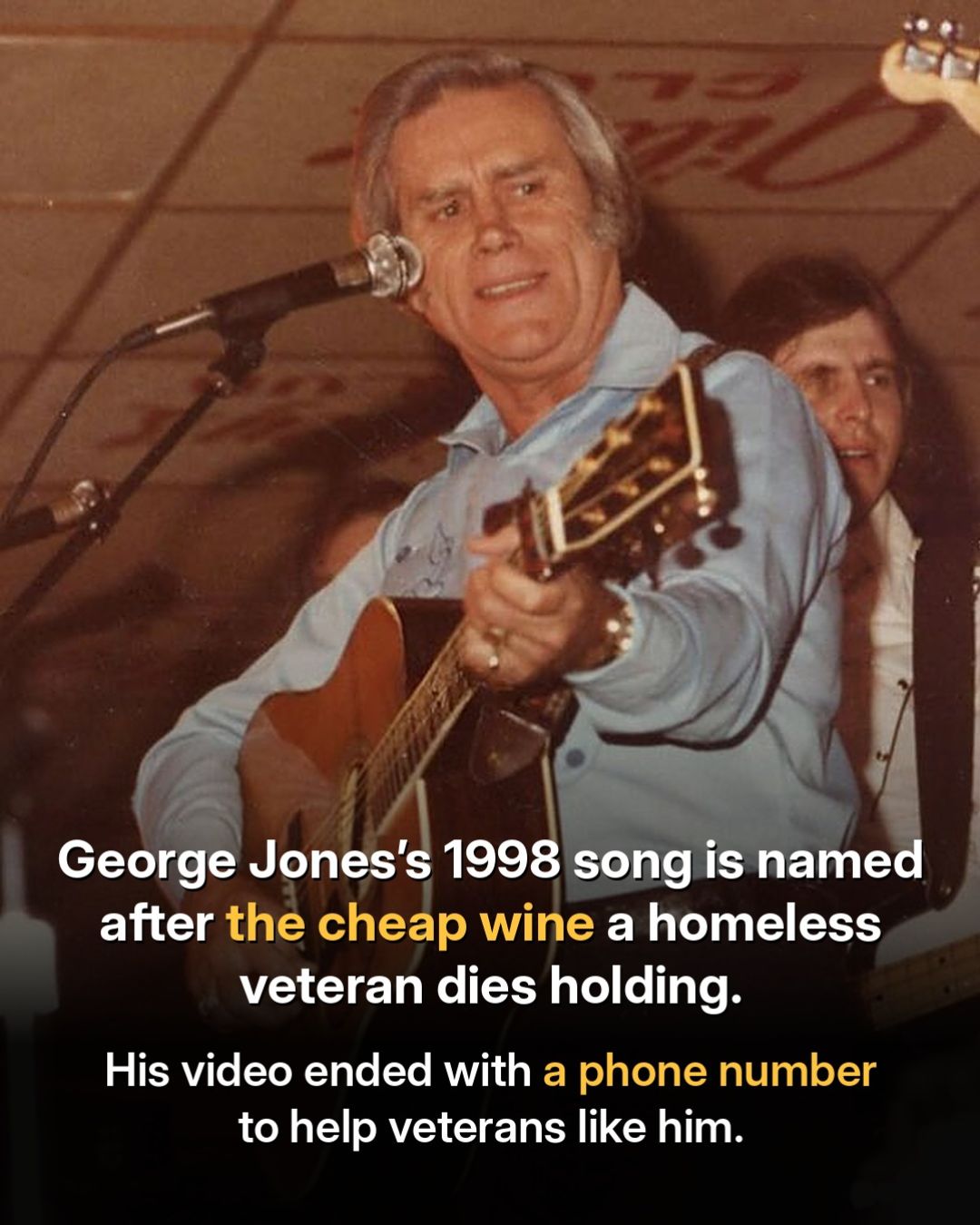
Scroll to the end of the article to hear the song.
The song was “Wild Irish Rose,” and George Jones chose it to open his 1998 album It Don’t Get Any Better Than This. It went out to radio as the album’s first single in March 1998. Jones hoped it would do more than sell records. He wanted it to make people look at the veterans who had been left behind.
A title that sounds like a love song
Bobby Braddock, the songwriter behind “He Stopped Loving Her Today,” wrote “Wild Irish Rose.” It follows a man sent to fight in Vietnam. He comes home broken, is committed to an institution, medals and all, and ends up living on the street.
The title is the twist. Wild Irish Rose is not a woman. It is a brand of cheap, sweet fortified wine that has been sold in America since 1954, the kind of bottle found in corner stores for a few dollars. When the man in the song is found dead, he is still holding a half-empty bottle of it.
Jones admitted at the time that it was another sad song in a career full of them, but he said he loved it.
Why George Jones wanted people to hear it
In interviews around the album’s release, Jones made clear the song was not just another tearjerker to him. He said many of America’s homeless were veterans who had come home damaged by war.
“…didn’t come back from the war in one piece, especially in their mind.” — George Jones, 1998
He said he wanted the nation to wake up to the fact that these veterans were still out there.
Jones knew something about military life himself. He enlisted in the U.S. Marine Corps in November 1951, at age 20, during the Korean War. Some articles over the years have said he served in Korea, but he was never sent overseas. He spent his service stationed in California, at Moffett Field near San Jose.
A video that ended with a phone number
The music video for “Wild Irish Rose,” directed by John Lloyd Miller, closed with a toll-free number that people could call to assist veterans. Most music videos exist to sell a record. This one also asked viewers to pick up the phone.
Jones went further. He recorded public service announcements for the National Veterans Foundation, a Los Angeles nonprofit founded in 1985 by Shad Meshad, who had served in Vietnam as a psychiatric officer. It began as the Vietnam Veterans Aid Foundation and later took its current name to serve veterans of every era. Its toll-free Lifeline for Vets was the first vet-to-vet crisis and information hotline of its kind in the country.
Jones also talked about hoping to put together a benefit concert with fellow country artists, at the Ryman Auditorium or the Nashville Arena.
The record radio didn’t play
By 1998, mainstream country radio had largely stopped playing George Jones, who was 66 that year. “Wild Irish Rose” failed to chart. The album reached No. 37 on Billboard’s Top Country Albums chart and would be his last for MCA Nashville.
He still sang it on the road. That summer, at a show at Indian Ranch in Webster, Massachusetts, he performed “Wild Irish Rose” as one of the new songs in his set, a ballad about how America treated the men who came home from its wars.
George Jones died in 2013. The National Veterans Foundation he recorded those messages for is still answering calls from veterans and their families through its Lifeline for Vets.