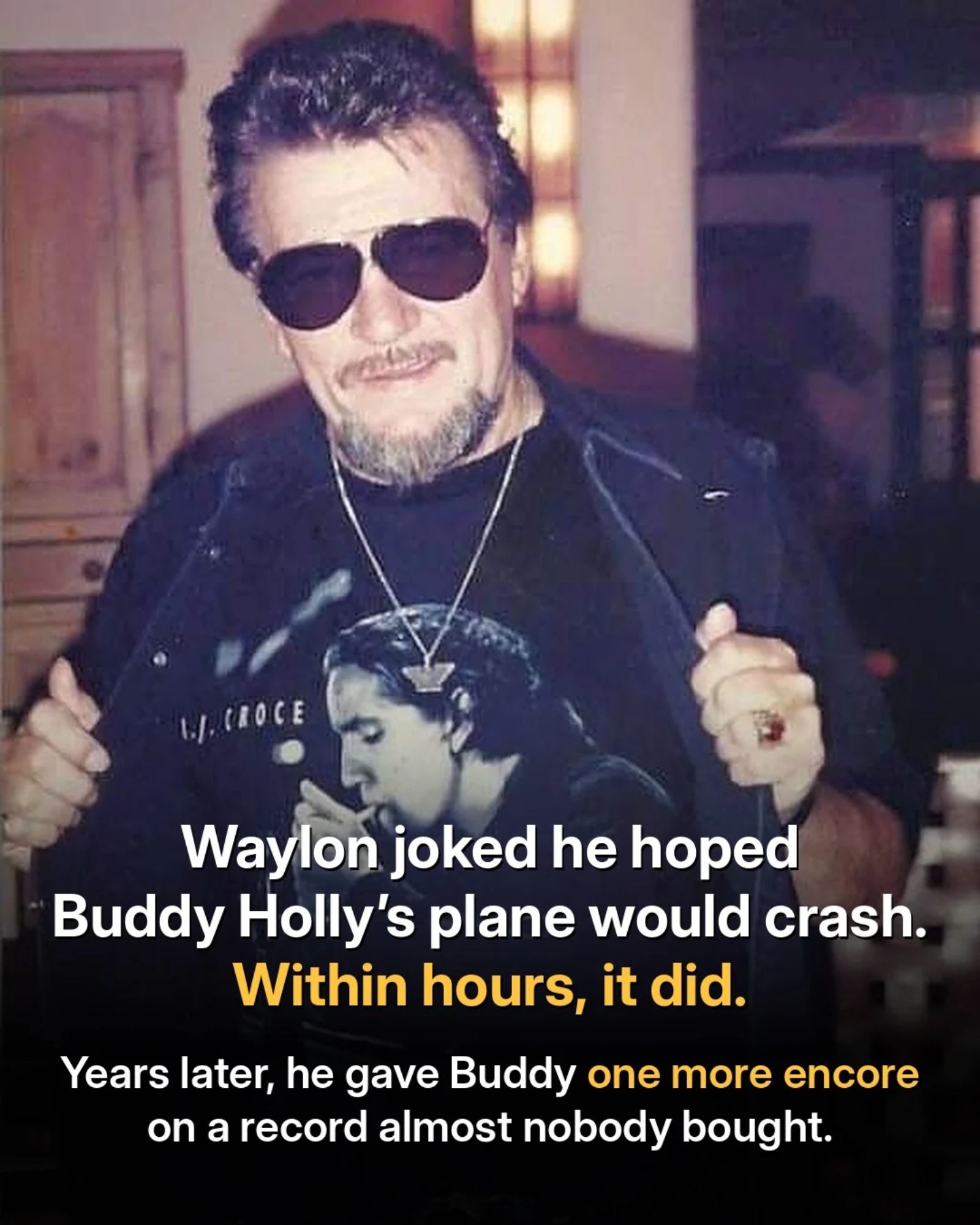
Scroll to the end of the article to hear the song.
Some songs come out of heartbreak. A few come out of guilt that someone carried quietly for years. This is the story of one of those, a strange little record that almost nobody bought, made by a man who had come very close to dying in the crash it was written about.
Two Weeks to Learn the Bass
In the late 1950s, Waylon Jennings was a young DJ at KLLL in Lubbock, Texas. He loved music, he had a big voice, and he was a long way from being famous. Then Buddy Holly started dropping by the station.
Buddy Holly was already a star, but he took the young DJ seriously. He produced Waylon Jennings’ first single, “Jole Blon,” and played guitar on it. Not long after, he made another offer: come out on tour and play bass. Waylon Jennings had never played bass. Buddy Holly handed him one anyway and gave him about two weeks to learn it.
“Buddy was the first guy who had confidence in me.” — Waylon Jennings
The Winter Dance Party
In January 1959 the Winter Dance Party tour set out across the frozen Midwest. The tour bus kept breaking down, the heating barely worked, and the musicians were tired, sick and freezing. After a show in Clear Lake, Iowa, Buddy Holly had had enough. He chartered a small plane to fly ahead to the next stop so he could get some rest and wash his clothes.
Waylon Jennings had a seat on that plane. But J.P. Richardson, the Big Bopper, was sick with the flu and dreading another night on the cold bus. Waylon Jennings gave him the seat.
When Buddy Holly heard, he teased his bass player. He said he hoped the bus would freeze up. Waylon Jennings shot back the kind of joke friends make without thinking: he hoped the plane would crash.
The Morning of February 3, 1959
The plane went down in a snowy field shortly after takeoff. Buddy Holly, Ritchie Valens, the Big Bopper and the pilot, Roger Peterson, were all killed. The world would later call it “The Day the Music Died.”
For Waylon Jennings, it was something more personal. Those last words stayed with him. He later admitted that for years he was afraid someone would find out what he had said, and that he felt guilty just for being alive.
Two Years of Silence
Waylon Jennings went home to Lubbock and went back to work as a DJ. By his own account he spent about two years grieving his friend. Years later he named one of his sons Buddy.
Eventually he moved to Arizona and started building a career of his own. Before leaving Lubbock behind, he signed with a small Lubbock label, Trend, and recorded a handful of songs in Phoenix. One of them, which he wrote himself, was unlike anything else he ever made.
One More Show
That song was “The Stage (Stars in Heaven).”
It isn’t really sung. It’s a spoken recitation over a slow military drum roll and a choir that sounds almost angelic. It never describes the crash. It imagines a stage somewhere beyond this world where the singers who died too young step out and perform one more time. Eddie Cochran, killed in a car crash in England in 1960, is there with them. Ritchie Valens and the Big Bopper take their turns. And Buddy Holly is saved for last.
All three singers from that plane are up on that stage. The one telling the story, watching from below, is the man who gave up his seat.
The Record Nobody Heard
“The Stage” was released as the B-side of “My Baby Walks All Over Me” in 1961. It sold a few copies locally and then disappeared. Critics who found it decades later have called it eerie and even a little maudlin, one of many tributes to the fallen rockers from that era. Waylon Jennings went on to RCA, to outlaw country and to legend, and the record was mostly forgotten.
Still, it’s worth hearing at least once. Leave the production aside and you have a young man who couldn’t take back a careless joke and couldn’t bring his friend back, doing the only thing left to him: giving him a stage, a crowd and one more encore.
Some people send flowers. Waylon Jennings sent a song.