Scroll to the end of the article to hear the song.
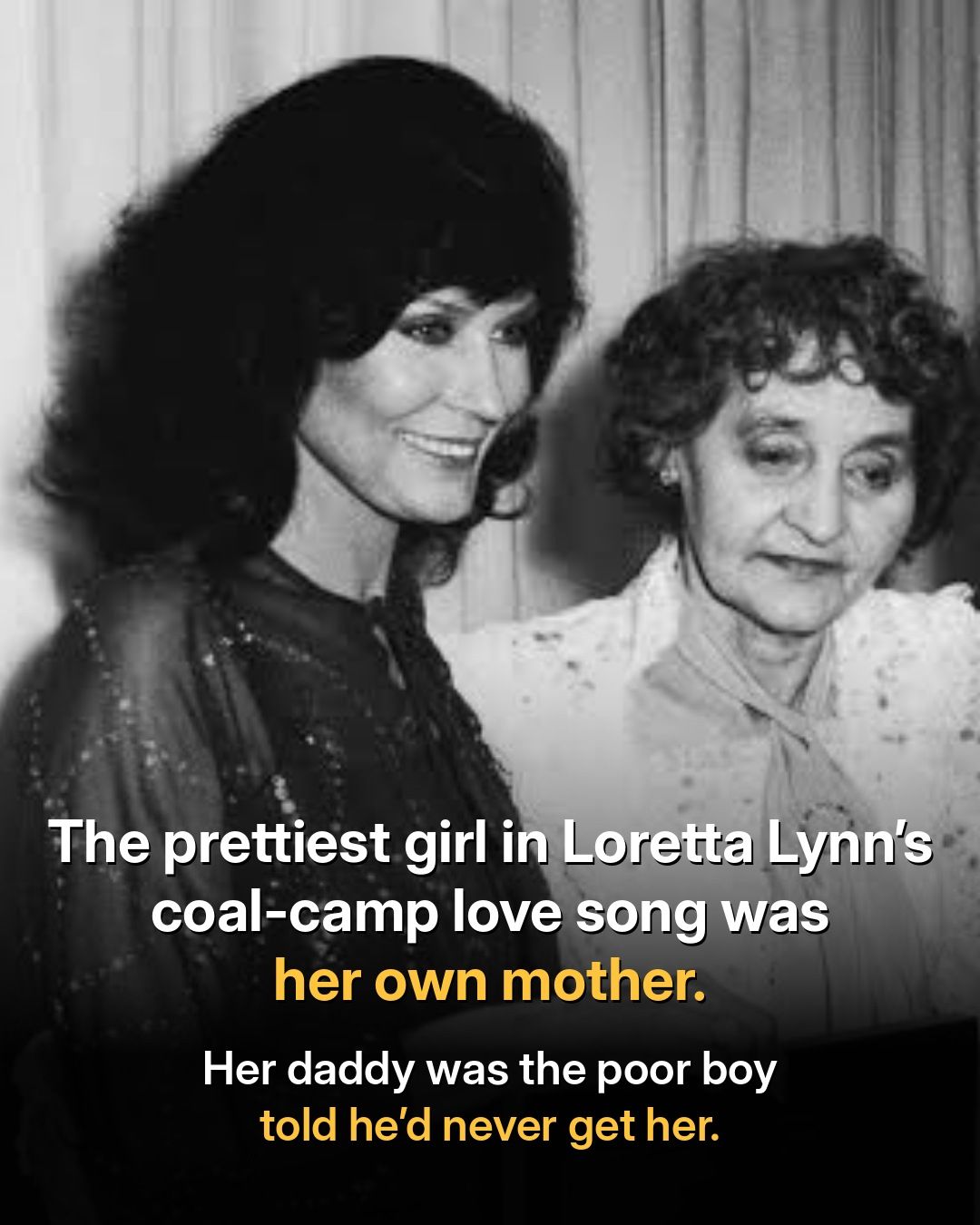
The song is “Van Lear Rose,” the very first track on Loretta Lynn’s 2004 album of the same name. Jack White of the White Stripes produced it, the album came out on April 27, 2004, and Loretta was 72 years old. Before the rockers and hard-luck tales that follow, the record introduces one woman: Clara Webb, the mother she grew up watching in Butcher Hollow, Kentucky.
The Story the Song Tells
Loretta builds the song as a childhood memory. She is a little girl sitting on her daddy’s knee, and he brings out an old photograph he treats like a treasure. The girl in the picture, he tells her, was the beauty of the coal country, a girl who could have had her pick of any fellow who saw her crossing the miners’ yard.
Everybody assumed a girl like that would end up with a man who had money. Then a poor young man caught her eye, and his friends had a good laugh at his expense. In the song they tell him he is only dreaming and that he will never hold her.
He proves them wrong. On a summer night in Kentucky, the poor boy wins her heart, and the miners are left talking about the man who took her right out from under them.
The last verse is where Loretta turns the whole story around. The father looks over at Loretta’s mother and smiles, brushes the hair out of his daughter’s eyes, and tells her the girl in the photograph is her mama. The “Van Lear Rose” was never a stranger from the past. She was the woman he had married.
The Real Van Lear Rose
Van Lear was the coal town near Butcher Hollow, built by the Consolidation Coal Company, and it was where Loretta’s father, Ted Webb, went to work in the mines. Her mother was Clara Marie “Clary” Ramey Webb, born in 1912. Ted and Clara raised eight children in a small cabin in the hollow. Loretta was the second of them and the oldest girl.
When Newsweek profiled Loretta Lynn in May 2004, the magazine explained the album title plainly: Van Lear was the mine where her daddy worked, and her mama was the rose.
Loretta Lynn never stopped talking about how lovely her mother was. In a 2011 interview with American Songwriter, she remembered Clara in her early thirties, with long black hair, very blue eyes and a dark complexion, and she said the song simply had to be about her mother. She added a line that sounds like it came straight from the little girl in the song:
“I always wanted to be as beautiful as Mommy. Never made it.”
She wrote much the same thing in her 2012 book Honky Tonk Girl: My Life in Lyrics, recalling how badly she wanted to look like her mother as a child:
“I never could be as pretty as my mommy.”
A Love Story Told Long After Both Were Gone
By the time Loretta Lynn sang this song, neither of her parents was alive to hear it. Four years after Ted Webb moved with Clara and the younger children to Wabash, Indiana, he died of a stroke on February 22, 1959. He was 52 and had been fighting black lung disease from his years underground. Clara Webb died on November 24, 1981.
That meant the young couple in the song had been gone from Loretta’s life for decades when she recorded it in January 2004. Newsweek noted that pictures of her parents were still on display in her home that year.
The Song That Opened the Comeback
Loretta Lynn recorded the album with Jack White in January 2004, working the old way, with most songs cut in one or two takes. She wrote or co-wrote every song on it. “Van Lear Rose” was never released as a single, but it set the tone for the whole record by beginning it in the coal country where she was born.
The album reached No. 2 on Billboard’s Top Country Albums chart and No. 24 on the Billboard 200. In 2005 it won the Grammy for Best Country Album, and her duet with White, “Portland Oregon,” won Best Country Collaboration with Vocals.
Loretta Lynn died on October 4, 2022, at 90. On November 13, 2026, Third Man Records brought the album back to streaming after years away, remastered from the original analog tapes. The first song fans hear is still the one about the poor boy, the old photograph, and the prettiest girl in Van Lear, who turned out to be her mother.