Scroll to the end of the article to hear the song.
Most people think they know Toby Keith. They picture the cowboy hat, the raised fist, the six-foot-four Oklahoman who never backed down from a fight. They remember one angry song from 2002 and the arguments that followed it on TV, on the radio and in the headlines.
But that song started with a funeral, and the man who sang it spent the rest of his life trying to keep a promise he never got to make out loud.
The Man Who Flew the Flag
Toby Keith was born Toby Keith Covel in Clinton, Oklahoma, in 1961. His father, Hubert “H.K.” Covel Jr., was a quiet, hard-working man who spent decades in the oil fields. In the 1950s he served as a private first class in the U.S. Army.
During a combat training mission, H.K. Covel lost his right eye.
He came home, went back to work, raised his children, and flew an American flag in the yard every day for the rest of his life. Years later, Toby Keith described his father’s attitude in a few plain words: “he never did gripe about it.”
The Favor
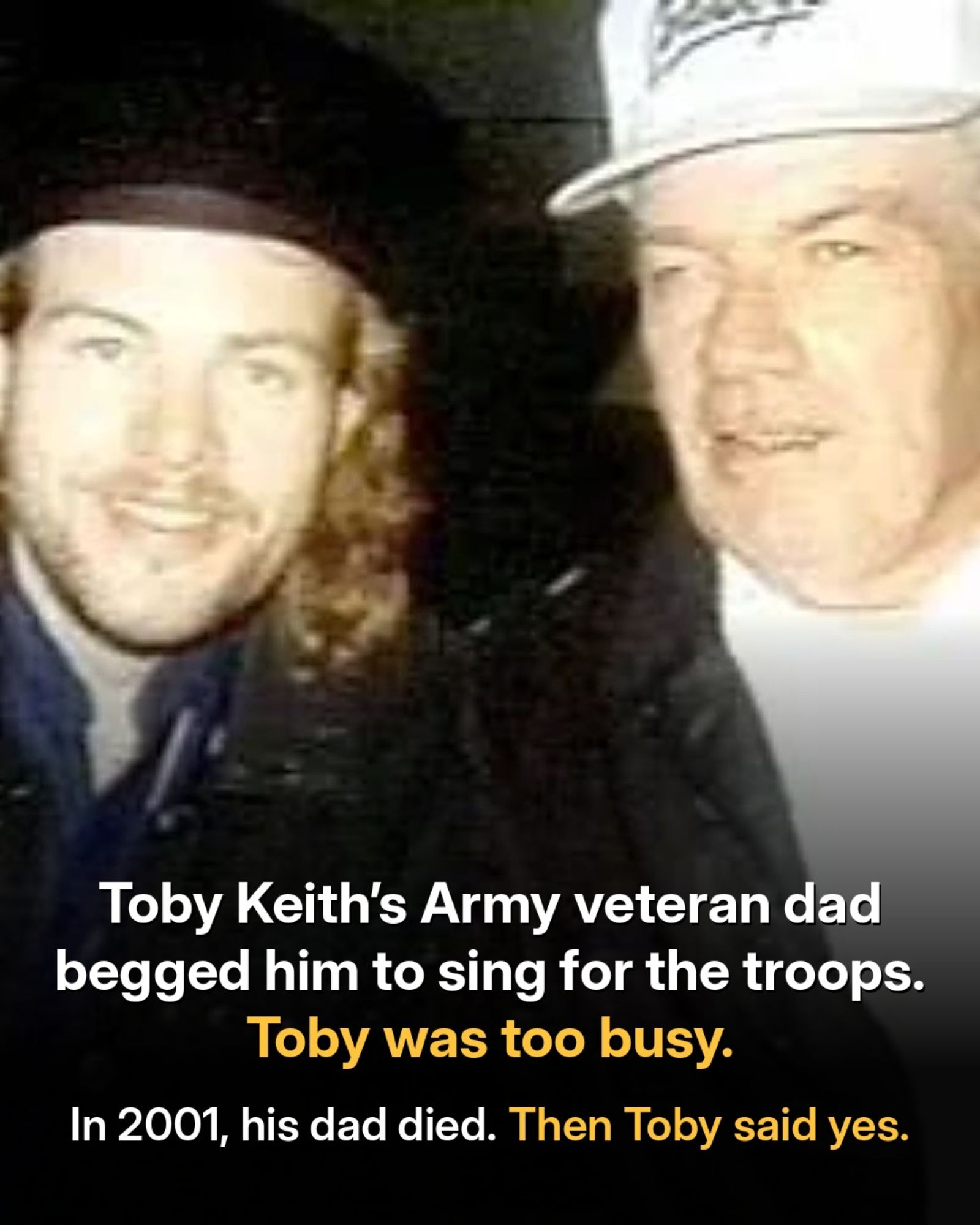
Once his son became a star, H.K. Covel had one request. He wanted Toby Keith to go overseas with the USO and sing for American troops.
Toby Keith kept saying not yet. His band was playing around 130 shows a year and his schedule was full. There would always be time later, or so he thought.
March 24, 2001
That spring, H.K. Covel was killed in a crash on the highway in Oklahoma. He was 67. Toby Keith never got the chance to tell his father, “Okay, Dad. I’ll go.”
About three and a half months later came September 11. Grief and anger landed on the same man at the same time. Toby Keith thought about the flag in his father’s yard and the eye his father lost, and in roughly twenty minutes, scribbling on the back of a fantasy football sheet, he wrote a song for him.
He never planned for the public to hear it. It was meant for the troops.
The General Who Changed Everything
Toby Keith intended the song only for USO and military shows. Then he played it for Marines, and one listener in particular would not let it stay there.
General James L. Jones, then Commandant of the U.S. Marine Corps, told Toby Keith it was “the most amazing battle song I’ve ever heard in my life.” In effect, he told him he had a duty to release it.
Toby Keith listened. The song went to No. 1, and the rest of the country has been arguing about it ever since.
Finally Saying Yes
In 2002, Toby Keith went on his first USO tour, and then he kept going. He made it an annual trip, often two unpaid weeks a year. In Baghdad in May 2005, soldiers came to his show dirty and exhausted after responding to a rocket attack. When he spoke to them, the crowd went silent: “Most Americans only see you on the news.”
In 2009 he played fifteen shows in five days at remote bases in Afghanistan. By the end, he had performed for more than 250,000 service members in 17 countries.
The Little Girl Who Started a Home
There was another chapter people rarely heard. Scott Webb, Toby Keith’s guitar player, lost his two-year-old daughter to cancer. Her mother later described how St. Jude had taken care of the family without charging them anything.
Toby Keith wanted Oklahoma families to have a place like that. After ten years of fundraising through his golf tournament, the OK Kids Korral opened in Oklahoma City in November 2013. It is a free home for children with cancer and their families, two blocks from the children’s hospital. He called it “Ritz Carlton meets Disney World.” Around 300 families a year have stayed there.
The Last Stage
In the fall of 2021, Toby Keith was diagnosed with stomach cancer. He fought it publicly and with dignity. In December 2023 he played three sold-out nights at Dolby Live at Park MGM in Las Vegas, and they turned out to be his last shows.
Toby Keith died on February 5, 2024, at 62, surrounded by his family. That same year he was named to the Country Music Hall of Fame.
More Than One Song
You can love that song or hate it. But behind it was a son who said “not yet” one too many times, and then spent more than twenty years saying yes: to soldiers far from home, to families in hospital waiting rooms, and to a father who only ever asked for one thing.