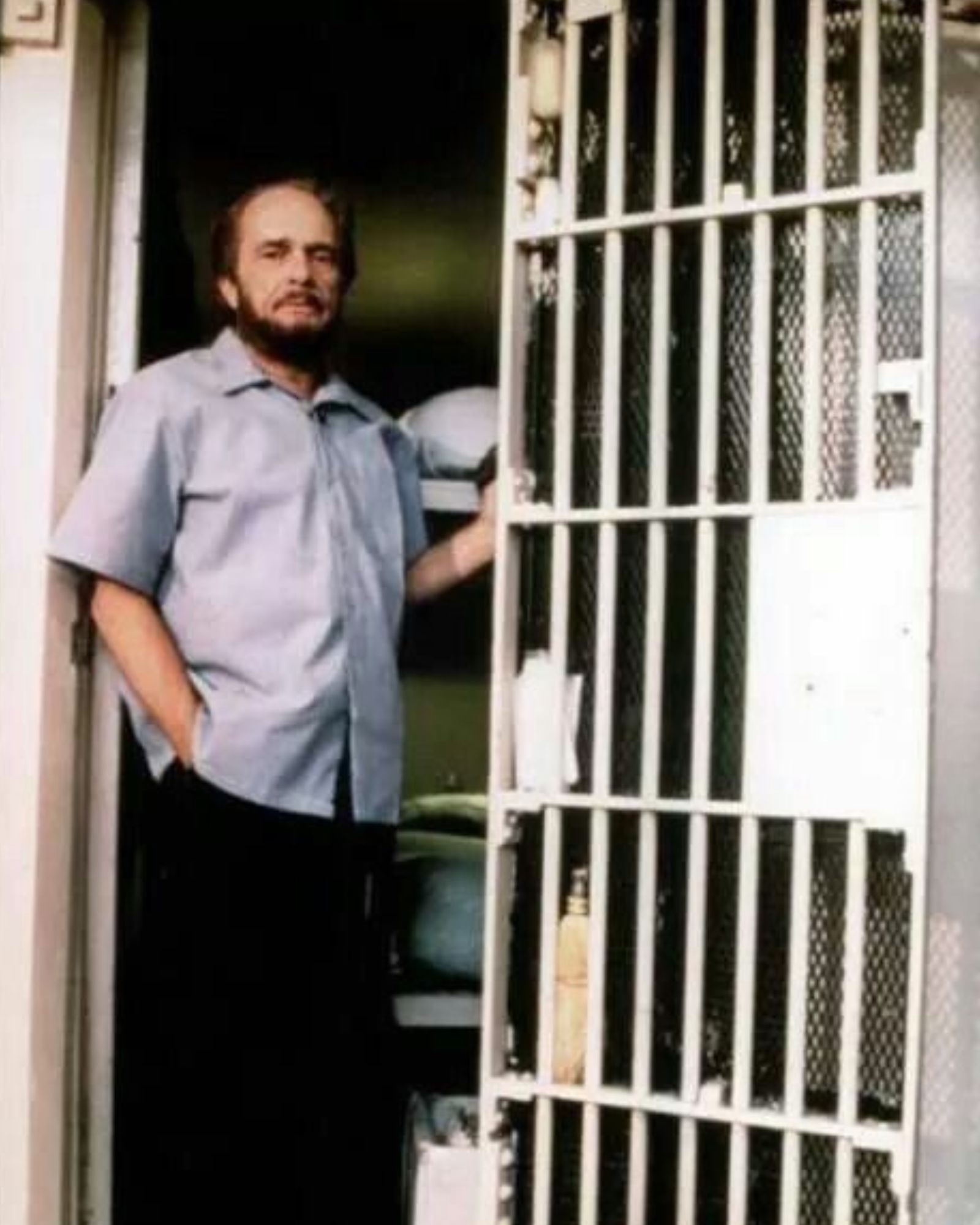
Johnny Cash made “Folsom Prison Blues” one of the most recognizable prison songs in country music. The song was partly inspired by a movie Johnny Cash watched while serving in the Air Force. Merle Haggard’s “Sing Me Back Home” came from a very different place: personal experience inside San Quentin State Prison.
Behind Merle Haggard’s 1967 classic was a fellow prisoner named James “Rabbit” Kendrick. Rabbit once offered Merle Haggard a chance to escape. Instead, Rabbit helped convince the young musician to stay behind.
What happened afterward gave Merle Haggard a story that would eventually become one of the most moving songs of his career.
A Young Musician Facing Fifteen Years
In 1958, Merle Haggard entered San Quentin as prisoner A-45200. Merle Haggard was only twenty years old, with a fifteen-year sentence hanging over a future that already seemed uncertain.
Merle Haggard had spent much of his youth getting into trouble, running away from institutions, and escaping confinement. Even San Quentin did not immediately discourage the idea of another escape.
Then Merle Haggard became involved in a plan with James “Rabbit” Kendrick.
Years later, during a 1995 interview with Terry Gross on NPR’s Fresh Air, Merle Haggard described the remarkable arrangement. Prisoners working in San Quentin’s furniture factory were building a large desk resembling something intended for a judge’s chambers. The escape plan involved concealing prisoners inside the furniture so they could be transported outside.
Merle Haggard had an opportunity to participate. But the prisoners who offered Merle Haggard that opportunity also urged him to reconsider.
They believed Merle Haggard possessed genuine musical talent and might build a worthwhile future after prison. For James “Rabbit” Kendrick, escape was a serious undertaking. For the young Merle Haggard, it risked throwing away a promising second chance.
Merle Haggard listened.
The Escape That Ended in Tragedy
James “Rabbit” Kendrick escaped from San Quentin. Merle Haggard remained behind.
On February 23, 1960, James Kendrick was driving near Victorville, California, after committing a robbery when California Highway Patrol officer Richard Duvall stopped the vehicle.
James Kendrick shot and killed Officer Richard Duvall during the encounter.
James Kendrick was arrested days later, convicted of first-degree murder, and sentenced to death. The case ultimately reached the California Supreme Court.
Merle Haggard later remembered seeing Rabbit escorted through the prison yard with guards. The sight of someone Merle Haggard knew being held under a death sentence became a powerful memory.
Merle Haggard was paroled in 1960. James Kendrick was executed in 1961, after Merle Haggard had already left San Quentin. The song that followed was therefore not a literal record of Merle Haggard witnessing the execution.
It was a songwriter’s response to the people and experiences Merle Haggard had known behind prison walls.
The Real Experiences Behind “Sing Me Back Home”
James “Rabbit” Kendrick was not the only condemned prisoner who left an impression on Merle Haggard.
During a period of disciplinary confinement at San Quentin, Merle Haggard found himself near death-row inmates and recalled recognizing the voice of Caryl Chessman, another prisoner awaiting execution.
In the documentary series Country Music by Ken Burns, Merle Haggard explained that “Sing Me Back Home” grew from what Merle Haggard knew about two condemned prisoners, including Rabbit.
The song imagines a prisoner being led away to die. Before leaving, the prisoner asks to hear familiar music, hoping the sound will bring back memories of home and earlier days.
That particular request belongs to the song’s narrative. There is no established evidence that James Kendrick actually made such a request to Merle Haggard.
But the experience behind the music was real.
A No. 1 Song Born From a Prison Memory
Released in 1967, “Sing Me Back Home” reached No. 1 on Billboard’s country singles chart in January 1968. The recording became one of Merle Haggard’s defining performances and was later interpreted by numerous other artists.
What makes the song remarkable is the connection between the imprisoned young musician and the condemned man who encouraged that musician to pursue a different future.
James “Rabbit” Kendrick never lived to hear “Sing Me Back Home” become a country classic.
Merle Haggard, however, lived long enough to tell the story behind it.
And every time “Sing Me Back Home” is played, listeners hear something that began long before Merle Haggard became famous: the memory of men Merle Haggard knew at San Quentin, and the consequences of one decision not to escape.