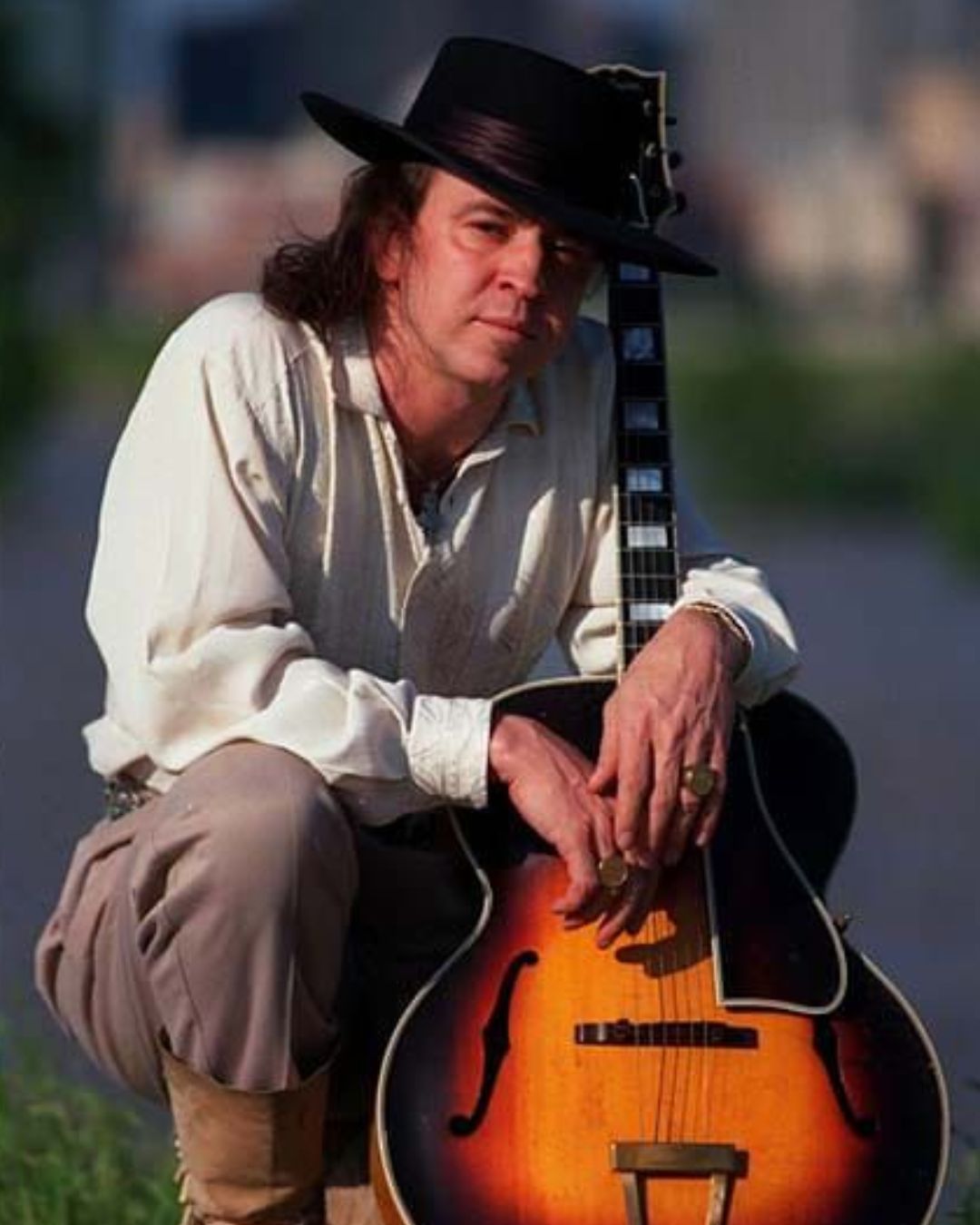
On the night of August 26, 1990, Stevie Ray Vaughan finished a jam on “Sweet Home Chicago” beside Eric Clapton, Buddy Guy, Robert Cray and his older brother, Jimmie Vaughan. Less than half an hour later, standing near a row of helicopters on a Wisconsin golf course, he asked Jimmie and Jimmie’s wife, Connie, if they would mind letting him take the only seat that was left.
The last night at Alpine Valley
Alpine Valley Music Theatre sits in the hills outside East Troy, Wisconsin, roughly halfway between Milwaukee and Chicago. That weekend it held two sold-out shows, on August 25 and 26. Clapton headlined. Stevie Ray Vaughan and Double Trouble played before him, and the Robert Cray Band opened the bill.
For Stevie, the Sunday show closed out the summer leg of the In Step tour. He was 35 and close to four years sober, after addiction had nearly killed him in 1986. He had spent much of 1990 making something he had talked about since his teenage years: a full album with Jimmie, the older brother he had followed onto guitar. It was finished and due in stores within a month.
His set that night included “Pride and Joy,” “Riviera Paradise” and a closing “Voodoo Child.” Bassist Tommy Shannon later called the two Alpine Valley nights the peak of everything the band had been building.
“Stevie just smoked.” – Jimmie Vaughan, to Guitar World
Five guitars on one stage
While Clapton played his set, Buddy Guy stood at the side of the stage with Stevie and Robert Cray. Guy later recalled that Stevie kept quietly fingering along with Clapton’s solos, playing notes on a guitar that wasn’t there.
At the end of the show, Clapton brought out Guy, Stevie, Cray and Jimmie, introducing them as the finest guitar players in the world. The five of them turned Robert Johnson’s “Sweet Home Chicago” into a jam that ran well past fifteen minutes, swapping verses and solos. Chris Layton, Stevie’s drummer for thirteen years, remembered one single note from Stevie that seemed to fill the entire amphitheater.
The jam ended to a roar at about 12:15 a.m. Cray, walking offstage behind Clapton and Stevie, heard the two of them telling each other how good the other had been.
Backstage, after midnight
Stevie sat with Layton for about half an hour afterward. He talked about the record with Jimmie as something he had needed to do, and then about the next Double Trouble album, which he imagined with strings and big horn sections.
“We’re gonna bust it wide open.” – Stevie Ray Vaughan, as recalled by Chris Layton
There was also talk backstage of playing with Clapton again, possibly for a Jimi Hendrix tribute in London. Then Clapton’s tour manager, Peter Jackson, warned that the weather was closing in and they needed to move.
One seat left
The plan had been for Stevie to ride back to Chicago by car with Jimmie and Connie. Clapton’s tour had booked four Bell 206B JetRanger helicopters from Omniflight, waiting on the resort’s golf course, and Stevie was told there were three seats for him, Jimmie and Connie.
When they reached the helicopters, members of Clapton’s team, his agent Bobby Brooks, bodyguard Nigel Browne and assistant tour manager Colin Smythe, were already aboard the third aircraft. One seat remained. Stevie said he really needed to get back to Chicago and asked if they minded. Jimmie and Connie told him to go ahead. They caught a later flight.
Fog over the ski hill
The pilot, 42-year-old Jeff Brown, lifted off into fog and darkness at about 12:40 a.m., according to most accounts; some sources put it closer to 1 a.m. The helicopter flew lower and faster than the others, turned left and struck a man-made ski slope roughly six-tenths of a mile from where it took off, about fifty feet below the top of the hill. There was no fire. No one heard the crash.
The other helicopters landed in Chicago. Only when the third one failed to arrive did anyone raise the alarm. A Civil Air Patrol plane found the wreckage around 7 a.m. All five people aboard had died instantly.
The National Transportation Safety Board found no mechanical failure. It blamed the pilot’s planning and decision-making, with darkness, fog, haze and rising terrain as contributing factors. Brown was experienced at night flying, but he was not instrument-rated for helicopters. The coroner found no drugs or alcohol in anyone aboard.
The morning in Chicago
Clapton was woken at about seven by his manager with the news that the helicopter carrying Stevie and three of his own crew had not come back.
Tommy Shannon got the call from Double Trouble’s manager and told Layton. Layton refused to believe it. He made hotel security open Stevie’s room, certain he would find him asleep. The bed was still made, the pillow turned down, with mints resting on it.
Later that morning, Jimmie Vaughan and Eric Clapton were asked to identify the bodies.
“Beyond anything that I could even describe.” – Eric Clapton on that last jam, Rolling Stone, 1993
The album he did not live to see released
Stevie Ray Vaughan was buried at Laurel Land Memorial Park in Dallas on August 31, 1990. About 1,500 people filled the service, with thousands more outside. Clapton, Buddy Guy, Stevie Wonder, Bonnie Raitt and Jackson Browne were among the mourners.
On September 25, 1990, Epic released Family Style, credited to the Vaughan Brothers. It reached No. 7 on the Billboard 200, became the best-selling record Stevie ever made outside Double Trouble, and won two Grammy Awards. Stevie sang lead on its single, “Tick Tock.”
Jimmie later wrote “Six Strings Down” in his brother’s memory. Decades after that night, he still told interviewers he had never really accepted that Stevie was gone.