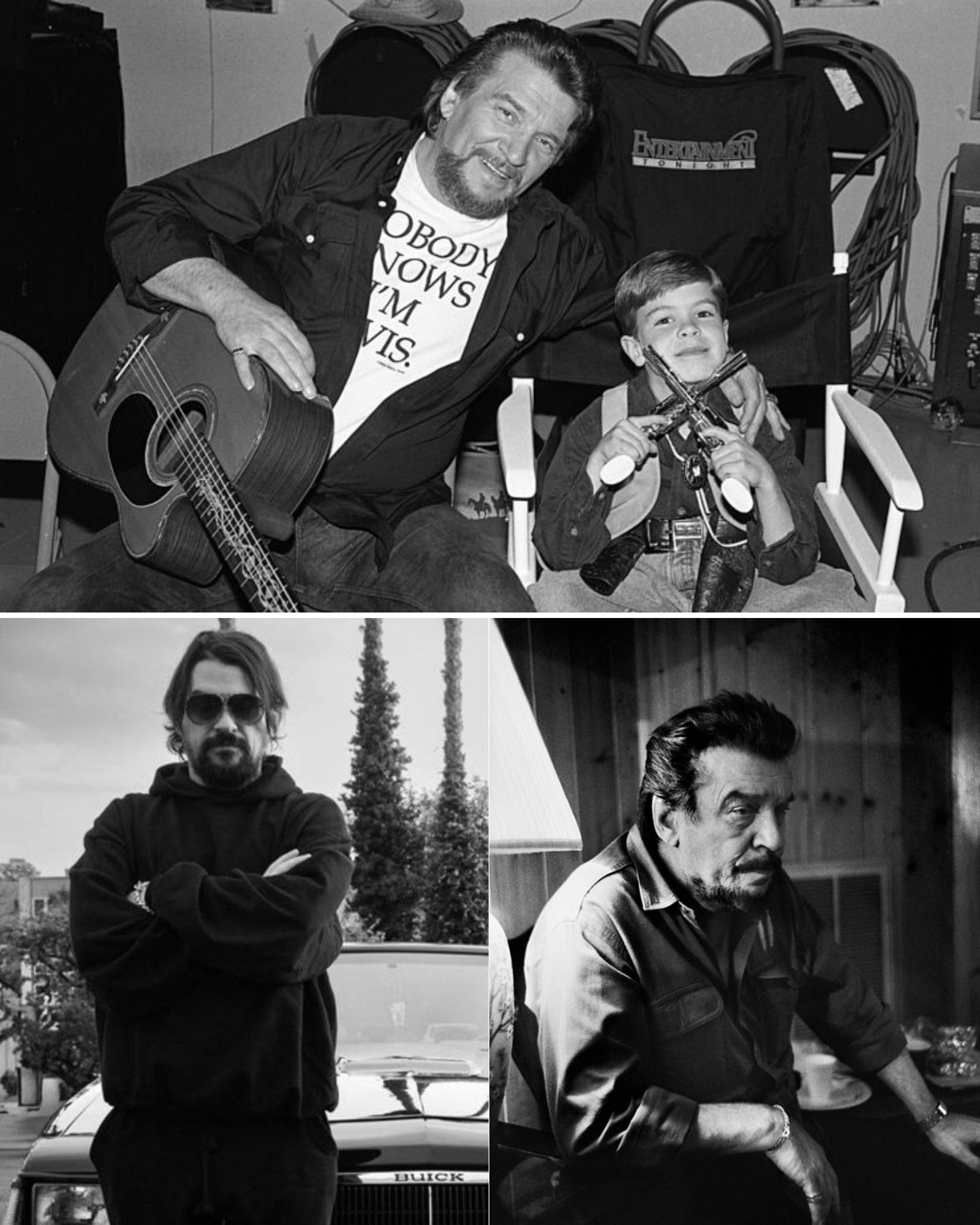
Waylon Jennings died in February 2002 at 64. More than two decades later, his son Shooter Jennings went looking through his father’s personal recordings expecting to find a song or two worth saving. Instead, he found enough finished, full-band Waylon music to fill three albums. The first, Songbird, came out in October 2025. The second, Diamonds, arrives November 13, 2026.
These are not rough sketches on a kitchen tape recorder. They are studio recordings Waylon made with his road band, the Waylors, in the 1970s and early 1980s, the stretch Shooter has called the band’s peak.
The Room That Was Always Locked
Shooter has said the story starts in the house where he grew up. One room there always stayed locked. His parents, Waylon and Jessi Colter, called it the “storage room.” In a 2024 social media post, Shooter recalled seeing dozens of grey boxes inside, tucked into cubbyholes, with notes written on them in marker. Even as a kid, he knew those boxes held his father’s work.
After Waylon’s death, that work passed to Shooter. The tapes were transferred to digital drives in 2008, and then, by Shooter’s account, they mostly sat.
Hundreds of Sessions and Not One Label
In the summer of 2024, Shooter had just started an exclusive residency at Sunset Sound Studio 3 in Hollywood, a room he has nicknamed “Snake Mountain” and where he has made dozens of records. A project he planned to produce got pushed back, and he finally had time to dig into his father’s archive.
It was not easy. Shooter told The Tennessean that when he opened the drives, he saw that nothing was labeled. The sessions had no song titles and no track names. He had to listen his way through hundreds of them, one at a time.
He had hoped to turn up a few rare cuts. What he found instead were finished recordings, made with the full band and clearly meant for release. Richie Albright, Waylon’s longtime drummer, played on them and co-produced. Ralph Mooney played steel guitar. Tony Joe White and Jessi Colter turned up as guests. Shooter said what became obvious was how constantly his father had been recording with the Waylors between tours.
He later described the work to Garden & Gun as like opening a box that held a whole chapter of his father’s life he never knew about.
Why the Songs Were Put Away
If the recordings were this good, why did nobody hear them? Shooter’s explanation is simple. By the early 1980s, Waylon and Richie Albright had gone their separate ways, and Waylon began making records with producer Jimmy Bowen. Country music was moving toward a slicker, digital sound, and the warm 1970s style of these sessions suddenly sounded out of date. As Shooter put it to American Songwriter, “the door got shut on this stuff.”
Finishing the Work the Way Waylon Did It
Some tracks were complete. Others had small gaps where a part was missing. Shooter did not reach for modern studio tricks. He called on the surviving Waylors, guitarist Gordon Payne, bassist Jerry Bridges, keyboard player Barny Robertson and backing singer Carter Robertson, to play the missing pieces.
Then he mixed the music in a purely analog way on Sunset Sound’s custom 1976 DeMedio API console, a board from the same era as the original tapes. Shooter has said he added harmonies only where needed and filled gaps sparingly, leaving most of the album untouched. The title song, “Songbird,” he left exactly as he found it.
That song is a Waylon cover of the Christine McVie ballad from Fleetwood Mac’s Rumours. Shooter admitted he did not recognize it at first. When he did, he said he was blown away.
The Man on the Tapes
Beyond the songs, Shooter was struck by who his father turned out to be on those tapes. In an interview with Holler, he said the recordings showed “what a gentle guy he was,” and that the tough-guy image was nowhere to be found. He felt it was his job to bring that side out.
He told Garden & Gun there was so much more to Waylon than the outlaw label. And speaking to CBS Sunday Morning, he admitted he cries over the project, not only because he misses his dad, but because he feels how much it matters.
“I want everybody to know the guy I know.” — Shooter Jennings, CBS Sunday Morning
The Guitar Shooter Couldn’t Place
The newest discovery is on the title track of Diamonds. Shooter kept finding pieces of the song spread across three different sessions, and the guitar sound confused him. Only after he listened to the whole thing did he realize the late Glen Campbell had dropped by the studio on a late December night in 1978 and played on it.
“This track eluded me,” Shooter said when he shared it in June 2026. It quickly became one of his favorite recordings his father ever made. On that track, the Waylors behind Waylon were Gordon Payne, Jerry Bridges, Carter Robertson, Barny Robertson and Rance Wasson, and the surviving members helped put it back together almost fifty years later.