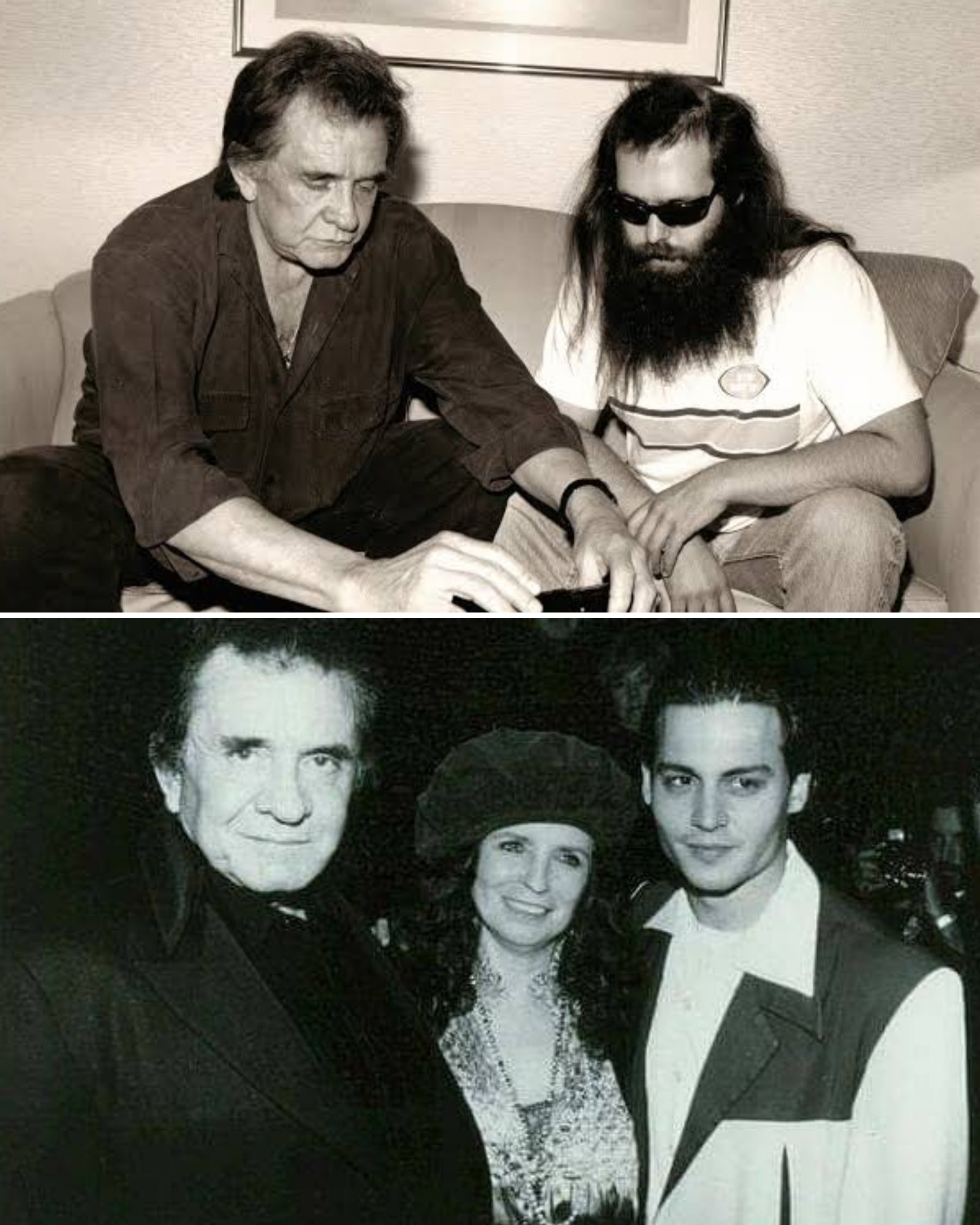
In July 1986, Columbia Records ended its 28-year relationship with Johnny Cash. Less than nine years later, in March 1995, he won the Grammy for Best Contemporary Folk Album with American Recordings, a record built almost entirely on his voice and an acoustic guitar. The man who made it happen was Rick Rubin, a producer best known for hip-hop and heavy metal, and the story of how they found each other is one of the strangest turns in country music.
A dinner show in Santa Ana
After Columbia, Johnny Cash signed with Mercury Records and released several albums between 1986 and 1991. None brought him back to the top of country radio, and by the early 1990s he was working smaller rooms and county fairs.
On February 27, 1993, he played the Rhythm Cafe in Santa Ana, California, about an hour south of Los Angeles. Rick Rubin was in the audience. Years later, Rubin remembered the crowd as maybe 150 people eating at their tables while Cash played, “like the retirement circuit.”
Rubin was 29, with a long beard and long hair, and his name was tied to the Beastie Boys, Run-D.M.C. and Slayer. After the show, Cash’s manager, Lou Robin, took Rubin backstage. Robin later admitted that Cash saw him at first as just another record company man.
What happened next was mostly silence. Rubin recalled that the two of them sat together a long time without speaking. John Carter Cash, Johnny’s son, remembered them simply staring at each other for about two minutes. When Cash did speak, his first question was blunt: why did Rubin want to make records with him?
Rubin’s reasoning, as he later explained it to Cash biographer Robert Hilburn, was that he wanted to work with someone great and important who was no longer doing his best work, and see if he could help that artist do great work again.
Two microphones in a living room
The first session took place on May 17, 1993, at Rubin’s home above the Sunset Strip. According to Hilburn, Rubin opened with a simple request:
“I’d love to hear some of your favorite songs.”
Johnny Cash signed with Rubin’s label, American Recordings, that June. The plan was to have him sit in the living room with his guitar and two microphones and sing everything he had ever wanted to record. Over the following months, Cash recorded more than 70 solo acoustic demos, many of them more than once. Rubin would send him CDs of the takes, and Cash picked the ones he liked.
Cash said the setup gave him a strong sense of déjà vu, taking him back to his first session at Sun Records in 1955. Rubin also invited songwriters in for hour-long visits. Glenn Danzig, the heavy metal singer, wrote “Thirteen” for Cash, and it made the album. In the fall and early winter, the sessions moved partly to the Cash Cabin, the small studio on Johnny’s property in Hendersonville, Tennessee.
The night at the Viper Room
Before the record came out, Rubin wanted to see how the songs held up in front of a live audience with only Cash and his guitar. On December 3, 1993, Johnny Cash played the Viper Room, the small West Hollywood club Johnny Depp had opened earlier that year. It usually booked rock and punk acts.
Invitations went out on two days’ notice. About 150 people packed in, including members of the Red Hot Chili Peppers and Tom Petty, and Depp introduced him. Cash had spent decades in front of a full band, and he was worried about carrying a show alone on his own guitar. Lou Robin said he was “nervous as a cat” until the crowd’s reaction to the first song settled him.
Rubin later described the room as dead silent while Cash sang. He played for about 45 minutes, and when the crowd still would not let him go, he asked June Carter Cash what to do. She told him to sing his hits.
Two songs from that night made the album: “Tennessee Stud” and Loudon Wainwright III’s “The Man Who Couldn’t Cry.” The cheering you hear on those tracks is the Viper Room crowd.
The record and the Grammy
American Recordings was released on April 26, 1994. Its 13 songs opened with “Delia’s Gone,” a song Cash had first recorded back in 1962, and mixed his own songs with material by Leonard Cohen, Nick Lowe, Tom Waits, Kris Kristofferson and Glenn Danzig.
It was not a big seller, but critics loved it. That June, Johnny Cash played England’s Glastonbury Festival with June, his son John Carter and his band, and festival founder Michael Eavis later called the performance “spellbinding.” In March 1995, American Recordings won the Grammy for Best Contemporary Folk Album.
The work that kept him going
Cash and Rubin kept working together for the rest of Johnny’s life. The American series grew to six albums, the last two released after his death.
June Carter Cash died on May 15, 2003. Rubin said Johnny called him the next day and asked to have something to work on every day. Sessions were booked daily at the house in Hendersonville, and on mornings when he felt strong enough, Cash would call and say he was ready.
“Johnny said recording was his main reason for staying alive.” — Rick Rubin
Johnny Cash died on September 12, 2003, less than four months after June. He had kept recording until the final weeks.