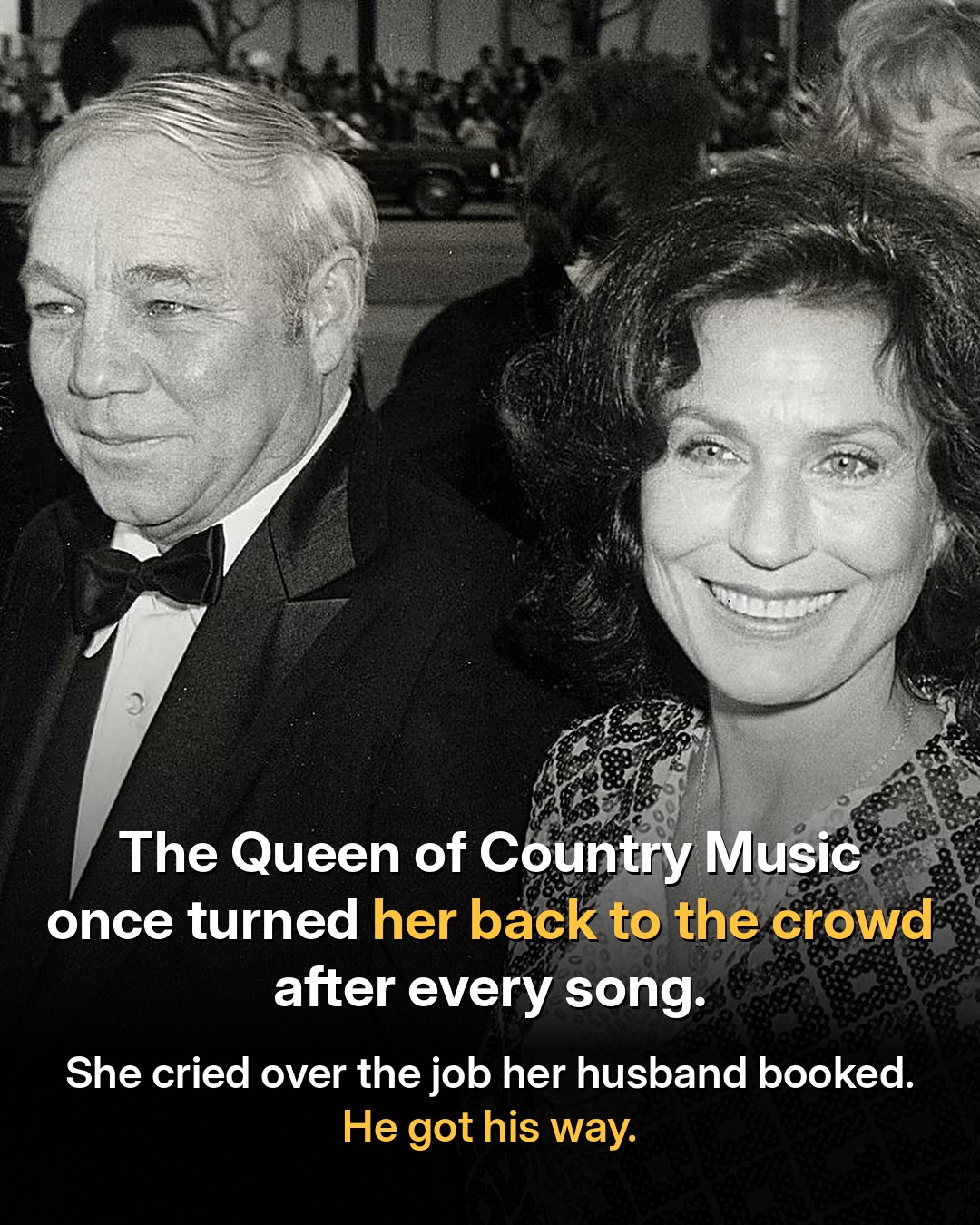
Before the Grand Ole Opry, before “Coal Miner’s Daughter,” before she became one of the most honored women in country music, Loretta Lynn stood on small stages in the far northwest corner of Washington State and could barely face the people in front of her. She looked at her feet while she sang. When the song ended, she turned around and showed the crowd her back.
She wrote about it plainly years later:
“Shy isn’t the word for what I felt onstage. Terrified is more like it.”
Those nights in the mid-1950s were not her idea. They were her husband’s.
A Mother of Four Who Only Sang at Home
Loretta Webb married Oliver “Doolittle” Lynn in January 1948, when she was 15. Before long they had left Butcher Holler, Kentucky, for the logging and farm country around Custer, Washington, close to the Canadian border. By her early twenties she had four children.
Life there was work from morning to night. Loretta later told Terry Gross on NPR’s Fresh Air that she kept a farmhouse and cleaned and cooked for 36 ranch hands, and other accounts have her picking strawberries alongside migrant workers. Singing was something she did for her babies. It was never meant for strangers.
The $17 Guitar and the Job She Never Asked For
Doolittle Lynn, whom everyone called Doo, heard something different. He listened to Loretta sing while she did her chores and decided she was as good as anyone on the radio. He bought her a $17 guitar. Accounts differ on exactly when; several date it to 1953, while others tie it to a birthday or an anniversary. Either way, she taught herself to play on it and started writing songs of her own.
Doo had bigger plans for that voice. One day he came home and told Loretta he had gotten her a job singing. She did not take the news well.
“I argued and cried and carried on, but Doo got his way, just like he always did.”
He had not asked her first. He simply told her she was going.
“Next to Kitty Wells”
Loretta told another version of how it all began in a 1971 interview with the Atlanta paper The Great Speckled Bird. In that telling, she and Doo went out to hear a local country band, a rare night out for a young mother. She said she never went anywhere because she had four children so young.
Doo had a few beers. The more he drank, the more he wanted to go talk to the band. Finally he did, and he told them, as Loretta remembered it, “Next to Kitty Wells, I have the greatest country girl singer in the world.”
The band told him they didn’t let just anybody sing. But if he brought her over on Wednesday night, they would put her on their half-hour radio show, provided she was any good. Doo remembered, and that Wednesday they went back.
Loretta was terrified of what would happen if they actually called her up. When they did, she sang the only song she knew all the way through, “There He Goes.” In her words, “They put me right on the air.”
The two stories don’t line up perfectly, and Loretta told her early years a little differently over the decades. What never changes is who did the pushing.
Eyes on Her Feet, Five Dollars a Night
The shows that followed were hard on her. Loretta Lynn remembered singing into the microphone while staring at her feet, then turning her back to the crowd after every song.
One of her early bands was the Westerners, a local group led by the Penn brothers with Howard Roedell out front. Around 1957 she began singing with them at the Delta Grange Hall in Whatcom County, a song or two at a time, for $5 a show. The daughter of Howard Roedell later recalled the band practicing at her family’s house.
The money mattered. With Loretta out singing at night, someone had to watch the children. As she put it, she and Doo were paying babysitters. After a few months, she said, the Westerners got tired of paying her five dollars, and she moved on.
From Bill’s Tavern to Buck Owens
Loretta Lynn soon formed her own band, Loretta’s Trail Blazers, with her brother Jay Lee Webb on guitar, and played regularly at Bill’s Tavern in Blaine. Doo kept pushing. He entered her in a talent contest in Lynden, which she won, then took her to a televised contest in Tacoma hosted by a young Buck Owens. That broadcast led to Zero Records, her first single, “I’m a Honky Tonk Girl,” in 1960, and a cross-country drive with Doo to every radio station they could find.
“He Put Me to Work”
Loretta Lynn never dressed up her marriage. She wrote and spoke openly about Doo’s drinking and their fights. But on this one point, she was consistent for the rest of her life.
“I have to give him credit for everything,” she told CMT in 2002. “I was so bashful and backward he had to push me on stage when I first started.”
When Terry Gross asked her in 2010 whether she would ever have written or performed if Doo hadn’t told her to, Loretta said no, because she was too bashful, and she would never have gone out in front of people.
“If it hadn’t been for him, I wouldn’t have been singing, period. Because he thought I could sing and he put me to work.”
In that same interview, she said that after cleaning and cooking for 36 ranch hands, singing felt like an easy job. Getting her to the microphone was the hard part. Doo did that.