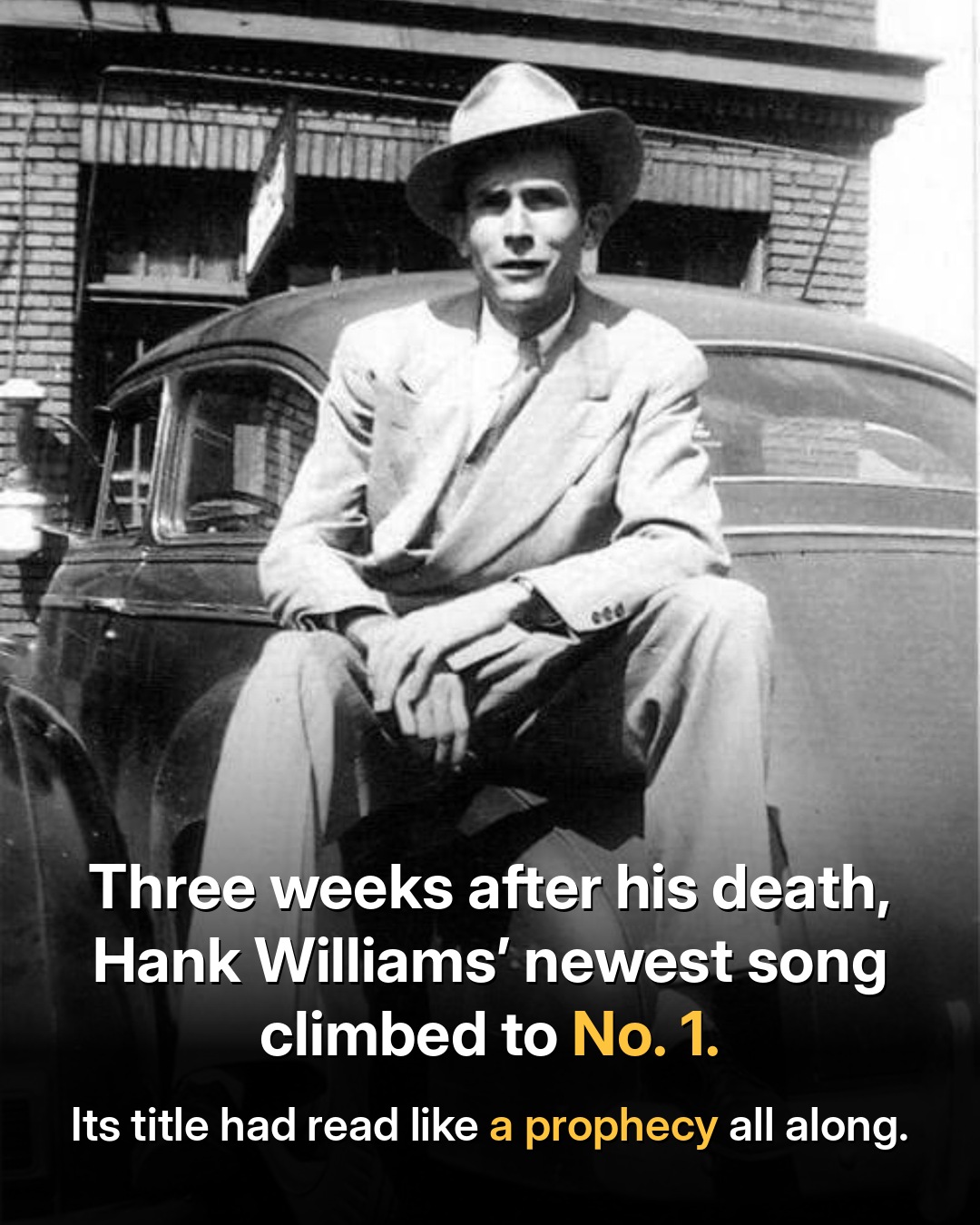
The song was “I’ll Never Get Out of This World Alive,” written by Hank Williams with his mentor Fred Rose and recorded by Hank Williams with His Drifting Cowboys. It was the last single Hank Williams released while he was alive. It was meant to make people laugh, but within weeks of its release, its title had taken on a meaning nobody wanted.
A Brutal Year for Hank Williams
By 1952, Hank Williams was the biggest name in country music, with a string of hits that had earned him the nickname the Hillbilly Shakespeare. Behind the success, his life was coming apart. Hank Williams divorced Audrey Williams that year, was dismissed from the Grand Ole Opry in August, and was struggling with chronic back pain and heavy drinking. At only 29, Hank Williams looked far older than his age.
A Friday Session at Castle Studio
On Friday, June 13, 1952, Hank Williams walked into Castle Studio in Nashville with fiddler Jerry Rivers, steel guitarist Don Helms and a young Chet Atkins on lead guitar. In that one session they cut four songs: “Window Shopping,” “Jambalaya (On the Bayou),” “Settin’ the Woods on Fire,” and finally “I’ll Never Get Out of This World Alive.”
The song itself was written as a joke. It is a list of comic misfortunes sung by a man whose luck never turns, the kind of novelty number Hank Williams could deliver with a wink. In the studio, though, nobody was winking. Chet Atkins later recalled that Hank Williams was so weak he sat down in a chair after every take, and that he could manage only a few lines at a time. Watching him, Chet Atkins remembered thinking:
“Hoss, you’re not jivin’.”
Fred Rose, the Quiet Partner
Like many Hank Williams songs, this one shares a writing credit with Fred Rose, the publisher who had believed in Hank Williams since 1946. Biographer Colin Escott has described the role Fred Rose played: sorting the strongest ideas from the weaker ones and helping Hank Williams turn rough drafts into finished, commercial songs. The combination worked again here. The song sounds like Hank Williams, with the tidy structure that Fred Rose was known for.
Twelve Days
MGM Records released the single on November 21, 1952, as catalog number 11366, with “I Could Never Be Ashamed of You” on the flip side. On December 20, “I’ll Never Get Out of This World Alive” entered the country chart, and radio stations were playing it heavily.
Twelve days later, Hank Williams was dead. He had been on his way to a New Year’s Day show in Canton, Ohio, riding in the back seat of his Cadillac while a young driver named Charles Carr took the wheel through the night. Somewhere in West Virginia, Charles Carr found that Hank Williams was no longer responsive, and he was pronounced dead in Oak Hill on January 1, 1953. Accounts still differ on exactly where along the road he died.
In Canton that evening, when the announcer told the crowd that Hank Williams had died, some people laughed because they assumed it was another excuse for a missed show. The laughter stopped when the performers on stage began to sing “I Saw the Light” in his honor.
A Number One He Never Saw
On January 24, 1953, three weeks after his death, “I’ll Never Get Out of This World Alive” reached No. 1 on the Billboard country chart. It took the top spot from another Hank Williams record, “Jambalaya (On the Bayou).” It was the first of his posthumous No. 1 hits. “Kaw-Liga,” “Your Cheatin’ Heart” and “Take These Chains From My Heart” all followed later that year.
Fred Rose died less than two years later, in December 1954. Neither man lived long after writing the song.
Why the Song Still Haunts Listeners
Hank Williams almost certainly did not write “I’ll Never Get Out of This World Alive” as a prediction. It was a comic song, built for a laugh and a shuffle on the dance floor. But the timing turned the joke into something that is hard to hear in the same way. Generations of artists have recorded the song, and in 2011 Steve Earle borrowed its title for both a novel and an album, a sign of how strongly the song stays with listeners.
Today, when the song plays, listeners hear two things at once: the playful voice of Hank Williams joking about hard luck, and the knowledge that the joke reached No. 1 only after its singer was gone.