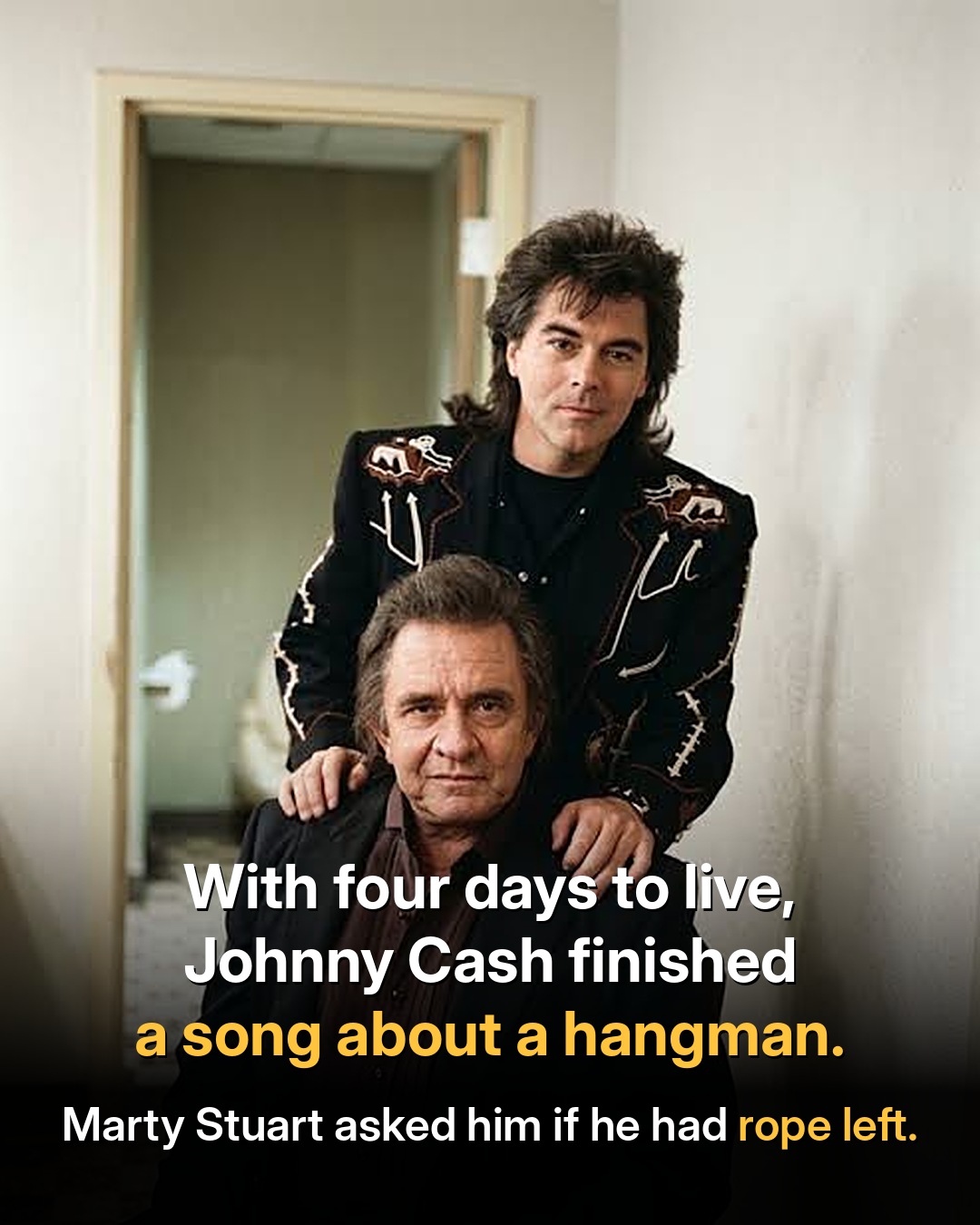
Scroll to the end of the article to hear the song.
On September 8, 2003, Marty Stuart walked next door to Johnny Cash’s home in Hendersonville, Tennessee, carrying a song he couldn’t finish. It was called “Hangman.” Cash, frail and in a wheelchair, listened and then started giving him lines, and in about ten minutes the song was done. That same afternoon, Stuart took a portrait of his old friend. Four days later, on September 12, Johnny Cash died.
A Guard’s Joke and a Gate Pass at Folsom
The song started a long way from Tennessee. Marty Stuart was playing a concert in Folsom, California, and the head of security at the show had once worked as a guard at Folsom Prison. Stuart, whose all-time favorite album is Johnny Cash at Folsom Prison, asked what it would take to get inside. The guard joked that he might think about murdering someone.
Stuart got a gate pass instead. Inside, he was shown the cafeteria where Cash recorded that famous 1968 concert, and he sat in with the prison’s own country band. Then he learned what stood behind the cafeteria’s back wall: the old hanging gallows, where men had been executed in the early part of the twentieth century. By the time Stuart saw it, the space was being used as the prison band hall. Years later, the only word he could find for that room was creepy.
All the way home, he kept thinking about what a miserable job the hangman must have had. By the time he got back, he had started a song about it.
Ten Minutes Next Door
That summer, Cash was grieving. June Carter Cash had died on May 15, 2003, and Stuart has said that not long afterward, John Carter Cash called to tell him his father wanted to record. Stuart called it the best news he had heard, and through the summer he and others helped keep Cash busy making music.
Stuart and Cash were next-door neighbors, and Stuart visited as often as he could. When he got back from California, he told Cash about Folsom and showed him the song he had begun. He had the start of it, but he had run out of words. That was where Cash came in.
“[He] just started speaking lines from his wheelchair.” — Marty Stuart, to the Minneapolis Star Tribune, 2010
Stuart said the two of them wrote the next verse in about ten minutes, and the song was finished. In several interviews since, he has called “Hangman” the last song Johnny Cash ever wrote.
Three Frames in the Afternoon Light
Marty Stuart had been photographing country music’s greats for decades, and he had his camera with him that day. Cash was sitting in the late-afternoon light, and Stuart shot three frames.
In the first two, Stuart remembered, Cash simply looked tired and worn. On the third, Stuart called out “JR!”, the initials Cash was born with. Cash sat up straight, and Stuart has described what happened next:
“…pulled on that black collar, and he became Johnny Cash.” — Marty Stuart, NPR’s Fresh Air, 2014
Stuart titled the photograph Last Portrait, September 8, 2003, and it has since appeared in his photography books and museum exhibitions. He has said Cash looked like an old president in it, and that the picture sums up how he felt about the man he called his old chief.
“I Got Rope Left”
When it was time to go, Stuart hugged Cash and asked how he was doing. Cash told him his spirit was strong. Then Stuart asked if he had plenty of rope left.
“I got rope left; I’m hanging.” — Johnny Cash, as Marty Stuart recalled to the Dallas Observer
Stuart had a trip to Washington ahead of him and told Cash he would see him when he got back. Early in that trip, someone knocked on his bunk on the tour bus and told him he had better get up. Stuart had known his friend was fragile, but he has said he did not expect him to go so soon.
The Song Comes Home to Studio B
Seven years later, Marty Stuart and His Fabulous Superlatives recorded “Hangman” for Ghost Train: The Studio B Sessions, released on August 24, 2010. The album was cut at RCA Studio B in Nashville, the same room where Stuart played his first recording session at age 13 as a mandolin player in Lester Flatt’s band. The songwriting credit reads Marty Stuart and Johnny Cash.
The song tells of an executioner troubled by the work he does, and more than one reviewer heard late-period Cash all through it. Stuart told The Boot that year that he found the song overwhelming, and that when he plays it live, the audience goes very quiet.
One note for longtime Cash fans: “Hangman” is not the only song described as his last. “Like the 309,” which Cash recorded in his final months and which appeared on American VI: Ain’t No Grave, is often given that title too. What Marty Stuart offers is a firsthand account of September 8, 2003: a frail man in a wheelchair, a verse finished in ten minutes, and a portrait taken in the afternoon light, four days before Johnny Cash was gone.