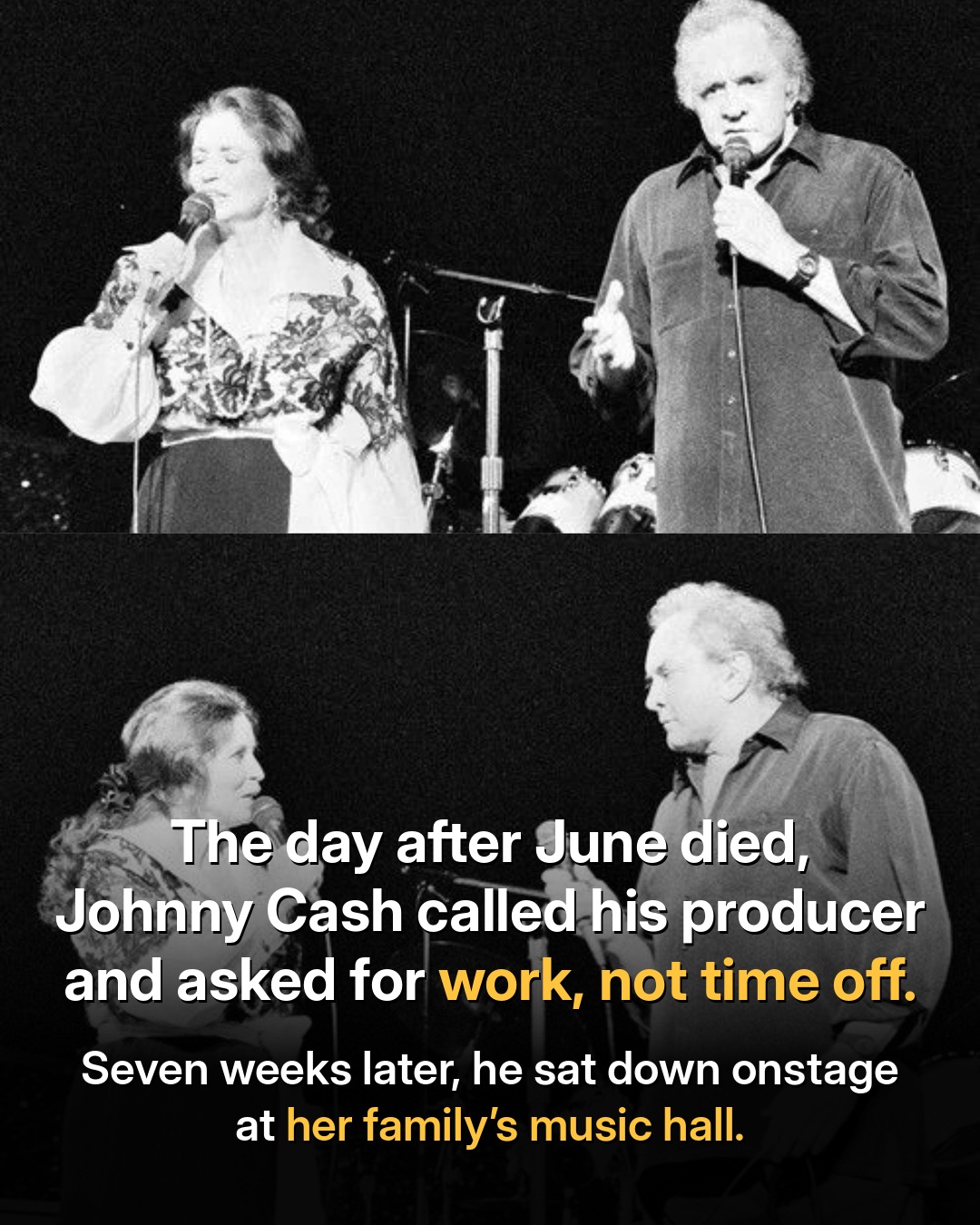
On May 15, 2003, June Carter Cash died after complications from heart valve surgery. She was 73. She and Johnny Cash had been married for 35 years, and for most of that time she had been the person who kept him steady.
Most people in Johnny Cash’s position would have shut the door and pulled the curtains. Johnny Cash picked up the phone instead.
The Phone Call
The day after June died, Johnny Cash called his producer, Rick Rubin. He didn’t call to cancel anything or to ask for time alone. Years later, Rick Rubin told Rolling Stone what Johnny Cash said to him:
“I have to get to work. If you don’t have something for me to do every day, I’m going to die.”
Rick Rubin took him at his word. By then Johnny Cash was 71 years old. Diabetes had taken much of his sight, and he needed a wheelchair to get around. He couldn’t travel to a studio in Los Angeles, so the studio would have to come to him.
A Studio in the Bedroom
Rick Rubin set up recording equipment in a bedroom of Johnny Cash’s home in Hendersonville, Tennessee, and sent an engineer who stayed on call for most of the time Johnny Cash had left. Some days they recorded in the house, and some days at the family’s Cash Cabin Studio just a short walk away.
There was no fixed schedule, only a standing offer. Sessions were booked every day, and the decision belonged to Johnny Cash. Rick Rubin later described how it worked:
“If he woke up and felt good enough to do it, he would call up and say, ‘Let’s do it.’ If he wasn’t doing well enough, he’d say, ‘Let’s do it tomorrow.'”
Rick Rubin talked with Johnny Cash every day during those months and kept sending him songs to try. Johnny Cash suggested songs of his own, and his son, John Carter Cash, encouraged him to record Bruce Springsteen’s “Further On (Up the Road).” The two men also shared a small daily ritual. They took communion together, and on the days they couldn’t be in the same room, they did it over the phone.
Rick Rubin later said that after June died, Johnny Cash was “prepared to die.” But he was careful to add that he didn’t think Johnny Cash wanted to die. He had simply reached a kind of peace about it, and in the meantime there was work to do.
One Last Night at the Carter Family Fold
On July 5, 2003, less than two months after the funeral, Johnny Cash went to the Carter Family Fold in Hiltons, Virginia. The Fold is a rustic music hall founded by Janette Carter, the daughter of A.P. and Sara Carter of the original Carter Family. Its purpose was to keep the old mountain music alive. For Johnny Cash, it was June’s family’s ground.
Janette Carter introduced him. Johnny Cash was too weak to walk to the microphone on his own, but he refused to be rolled onstage in his wheelchair. So John Carter Cash helped his father out to center stage and lowered him into a chair.
He played for about half an hour, mixing old favorites like “Folsom Prison Blues,” “I Walk the Line,” “Big River,” and “Understand Your Man.” He even told a story from an earlier visit. The Fold didn’t allow electric instruments, but Janette Carter had once told the crowd she would make an exception, because June said Johnny Cash was already “plugged in” when she met him. The room laughed, and some people cried.
Then he spoke about the woman who wasn’t there.
“The spirit of June Carter overshadows me tonight with the love she had for me and the love I have for her. We connect somewhere between here and heaven. She came down for a short visit, I guess, from heaven, to visit with me tonight to give me courage and inspiration like she always has.”
“I thank God for June Carter,” he said. “I love her with all my heart.”
He also sang “Ring of Fire,” the song June Carter co-wrote with Merle Kilgore about her feelings for Johnny Cash, back before they were ever a couple. It had been one of his biggest hits for 40 years. That night, June’s family was in the room to hear it.
Working to the End
The Carter Family Fold show turned out to be the last public performance of Johnny Cash’s life. He went home to Tennessee and kept working through the summer, laying down vocals on the days he felt strong enough and saying “tomorrow” on the days he didn’t.
Johnny Cash died on September 12, 2003, four months after June Carter Cash. The songs from those final sessions were later released on American V: A Hundred Highways in 2006 and American VI: Ain’t No Grave in 2010.
When June died, Johnny Cash had told Rick Rubin that he would die without work to do. So every morning that summer, he got up and asked whether today was a day to sing.