Scroll to the end of the article to hear the song.
On May 18, 2003, nearly 2,000 people gathered at First Baptist Church in Hendersonville, Tennessee, to say goodbye to June Carter Cash. Country music legends, family members, longtime friends, and ordinary fans came together to honor a woman whose voice had been part of American music for generations.
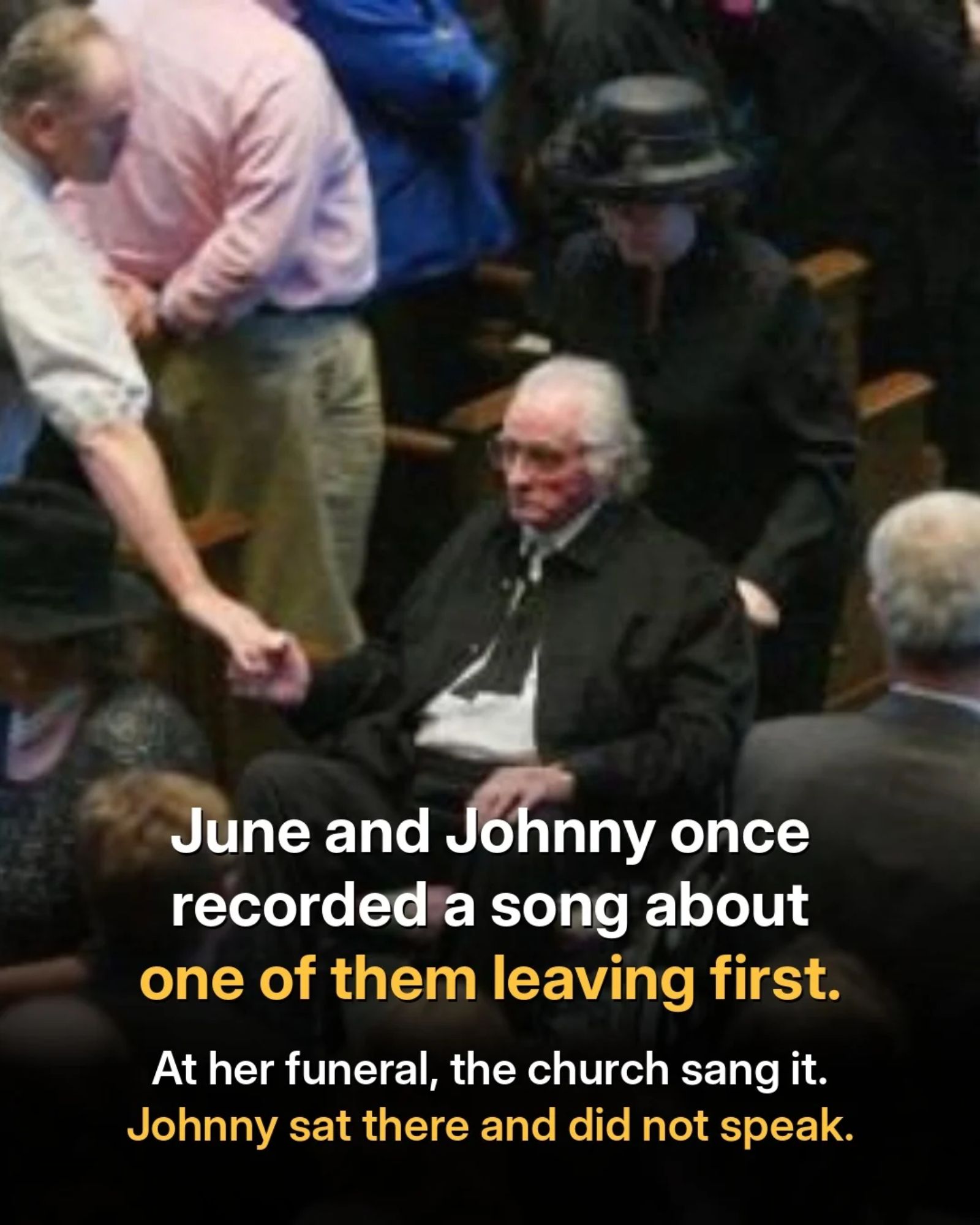
Among those gathered was Johnny Cash, the husband and musical partner who had shared 35 years of marriage with June Carter Cash. Johnny Cash was brought into the church in a wheelchair and did not speak during the service.
But near the end of the funeral, something remarkable happened. A song June Carter Cash and Johnny Cash had recorded together years earlier was sung by the people gathered to remember June Carter Cash.
And the meaning of that song was almost impossible to separate from the moment.
A Song About the One Who Must Leave First
Long before that Sunday in Tennessee, June Carter Cash and Johnny Cash had recorded a gospel duet about love, separation, and the hope of meeting again beyond this life.
The song was written by Nashville songwriter Terry Smith. Rather than describing an ordinary goodbye, the composition imagines two people who have spent their lives together and understand that one may have to face the final journey before the other.
There is sadness in that realization, but the song does not end in despair. Its central promise is that the person who leaves first will be waiting when the other eventually arrives.
For June Carter Cash and Johnny Cash, the words carried a deeply personal spiritual meaning.
In 1999, June Carter Cash included the duet on Press On, a deeply personal album released on April 20. The record marked a return to solo recording after nearly a quarter of a century and featured contributions from family members and friends.
The duet stood apart because it brought June Carter Cash and Johnny Cash together in a song about a future neither could avoid forever.
The Moment the Song Returned
June Carter Cash died on May 15, 2003, at the age of 73. Three days later, the country music community gathered for the funeral in Hendersonville.
The service included gospel performances by the Oak Ridge Boys, Emmylou Harris, Sheryl Crow, and Larry Gatlin. Friends and relatives remembered June Carter Cash not only as a performer, but also as someone whose faith, humor, and generosity had affected their lives.
Larry Gatlin had a personal connection to June Carter Cash, having credited June Carter Cash with helping provide an early opportunity in the music business.
As the funeral approached its conclusion, Larry Gatlin led the congregation in an unaccompanied performance of the very song June Carter Cash and Johnny Cash had once recorded together.
The song was “The Far Side Banks of Jordan.”
There was no instrumental accompaniment for this rendition. The voices of those assembled carried the words of a song that imagined love continuing beyond death.
Johnny Cash, who had once sung those words alongside June Carter Cash, was there to hear the congregation sing them in June Carter Cash’s memory.
Why This Particular Song Mattered
The significance of “The Far Side Banks of Jordan” had been recognized even before the funeral.
In a June 1999 profile of June Carter Cash, The Washington Post described the duet as an expression of June Carter Cash and Johnny Cash’s belief that they would be reunited after death.
Four years later, that same recording had taken on a different place in the story of June Carter Cash and Johnny Cash.
At the funeral, the song was no longer merely an imagined future. One of the two singers had died, and the other was sitting among the mourners.
No verified public account establishes exactly why the song was selected for the ceremony. But the connection between its message and the occasion was unmistakable.
A Promise That Outlived the Recording
Johnny Cash died on September 12, 2003, less than four months after June Carter Cash.
Today, “The Far Side Banks of Jordan” remains one of the most moving recordings June Carter Cash and Johnny Cash made together, not because it was their biggest commercial success, but because of what happened when the song returned at June Carter Cash’s funeral.
For listeners who know the story, it is difficult to hear the duet without remembering that Sunday in Hendersonville.
Two familiar voices had once recorded a song about the hope of meeting again. Years later, a church congregation sang that song while saying goodbye to one of those voices.
And Johnny Cash was there to hear it.