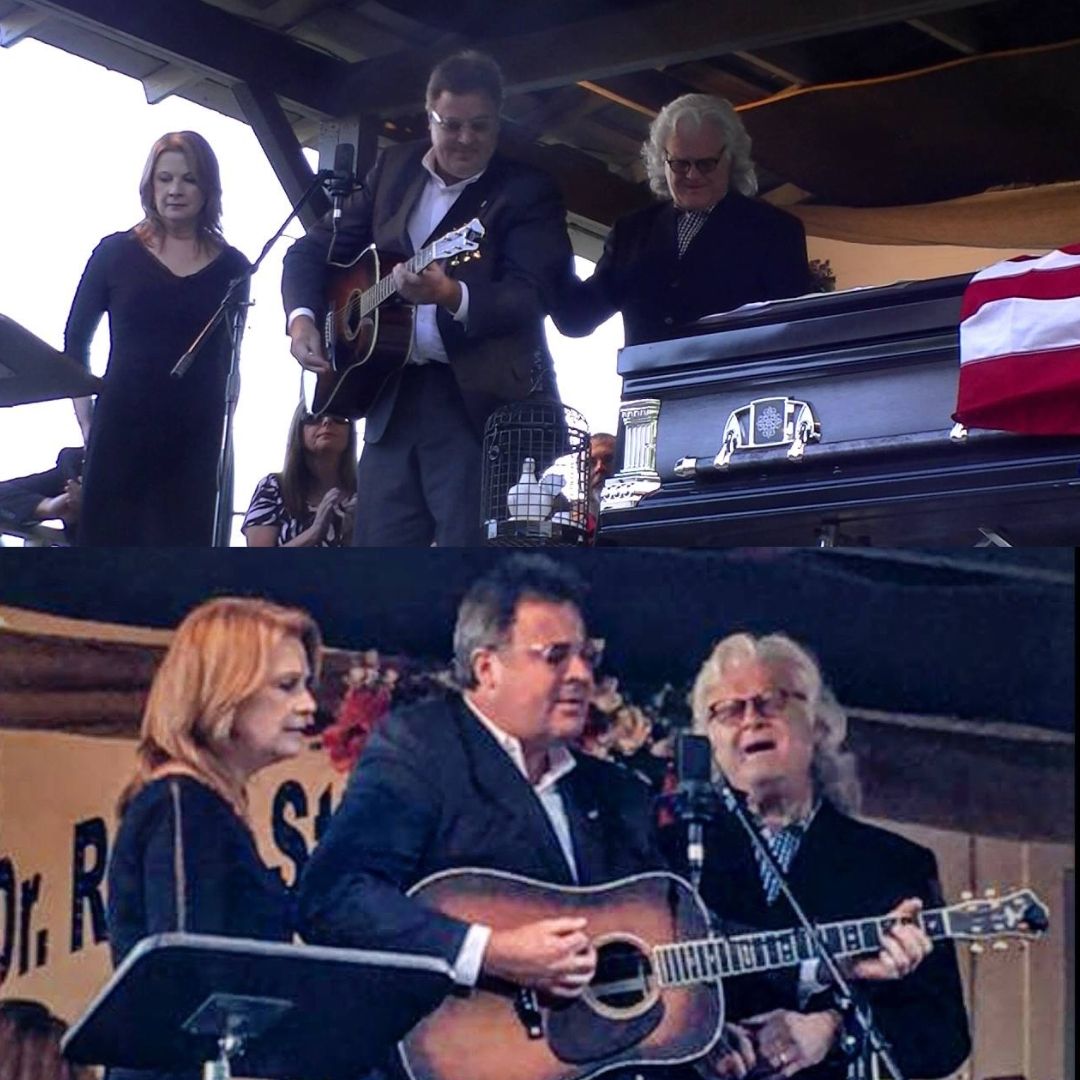
On the evening of June 28, 2016, bluegrass said goodbye to Dr. Ralph Stanley. The service was held at Hills of Home Park in southwest Virginia, on the same grounds where Stanley had hosted his bluegrass festival since 1970. His family sat near the stage, and his casket, draped in an American flag, was at the center of it all. Stanley had died five days earlier, on June 23, from complications of skin cancer. He was 89.
During the service, Vince Gill, Patty Loveless and Ricky Skaggs sang “Go Rest High on That Mountain” together. Before they did, Vince Gill told the crowd something that tied the whole night together:
“If it had not been for the music of the Stanley Brothers, especially Ralph’s voice, I wouldn’t have known how to write this song, and I wouldn’t have known how to sing this song.”
To understand why that moment landed so hard, you have to go back to two places: a Kentucky singer’s death in 1989, and a West Virginia nightclub in 1970.
A Song That Began With Keith Whitley
Vince Gill started writing “Go Rest High on That Mountain” after Keith Whitley died in May 1989. He didn’t finish it until four years later, after his older brother, Bob, died of a heart attack in 1993.
When Gill recorded it for his 1994 album When Love Finds You, he brought in two harmony singers: Patty Loveless and Ricky Skaggs. The song was released as a single in August 1995 and went on to win the CMA Award for Song of the Year. So when those same three voices stood together at Ralph Stanley’s funeral, fans were hearing the original record’s singers in person, more than two decades later.
Two Teenagers Ralph Stanley Took Into His Band
The Keith Whitley connection runs deeper than the song. Long before Nashville knew his name, Keith Whitley was a teenager in eastern Kentucky who loved the Stanley Brothers. So did his friend Ricky Skaggs. The two boys did note-perfect imitations of Stanley Brothers songs.
In 1970, Ralph Stanley and the Clinch Mountain Boys were running late to a show at a club in Fort Gay, West Virginia. According to the Country Music Hall of Fame, the club owner asked Whitley and Skaggs, who had come to see Stanley, to fill in. When Stanley arrived, he liked what he heard, and he soon hired both of them. As the story is often told, Stanley first thought he was hearing one of his own records.
Ricky Skaggs went on to become one of the biggest names in country and bluegrass. Keith Whitley left the band, came back as Stanley’s lead singer in the mid-1970s, and later became a country star with hits like “Don’t Close Your Eyes” and “When You Say Nothing at All,” before his death in 1989.
That is the circle Vince Gill’s song closed that night. A song started in grief for Keith Whitley was sung by Keith’s old bandmate, at the funeral of the man who had hired them both as teenagers.
What They Said on Stage
Ricky Skaggs, who was also listed among the honorary pallbearers, spoke about his mother, whom he described as an old mountain woman. He remembered telling Stanley, “Ralph, you sing just like my mom.”
Patty Loveless, who recorded “Pretty Polly” with Stanley, said singing it with him lifted her career even higher. “He was the one that taught me how to sing,” she said.
Vince Gill went back to when he was 16 and fell hard for bluegrass. He called Stanley’s voice the most mournful, soulful sound he knew, a voice that reached deeper inside him than any other. He also said the line that is hard to hear without a lump in your throat: “It means the world to me that, in some small way, I mattered to Ralph.”
Then the three of them sang.
Where the Song Stands Now
“Go Rest High on That Mountain” has been sung at many goodbyes since 1995, including Vince Gill’s performances at the funerals of Porter Wagoner and George Jones. In 2026, the Library of Congress added it to the National Recording Registry. Gill said then that it was probably the least charting record of his era of success, but that what the song has done for other people is what makes it special to him.
It started with Keith Whitley. It was finished for his brother Bob. And on a June evening in 2016, it went back to the voice Vince Gill says showed him how to write it in the first place.