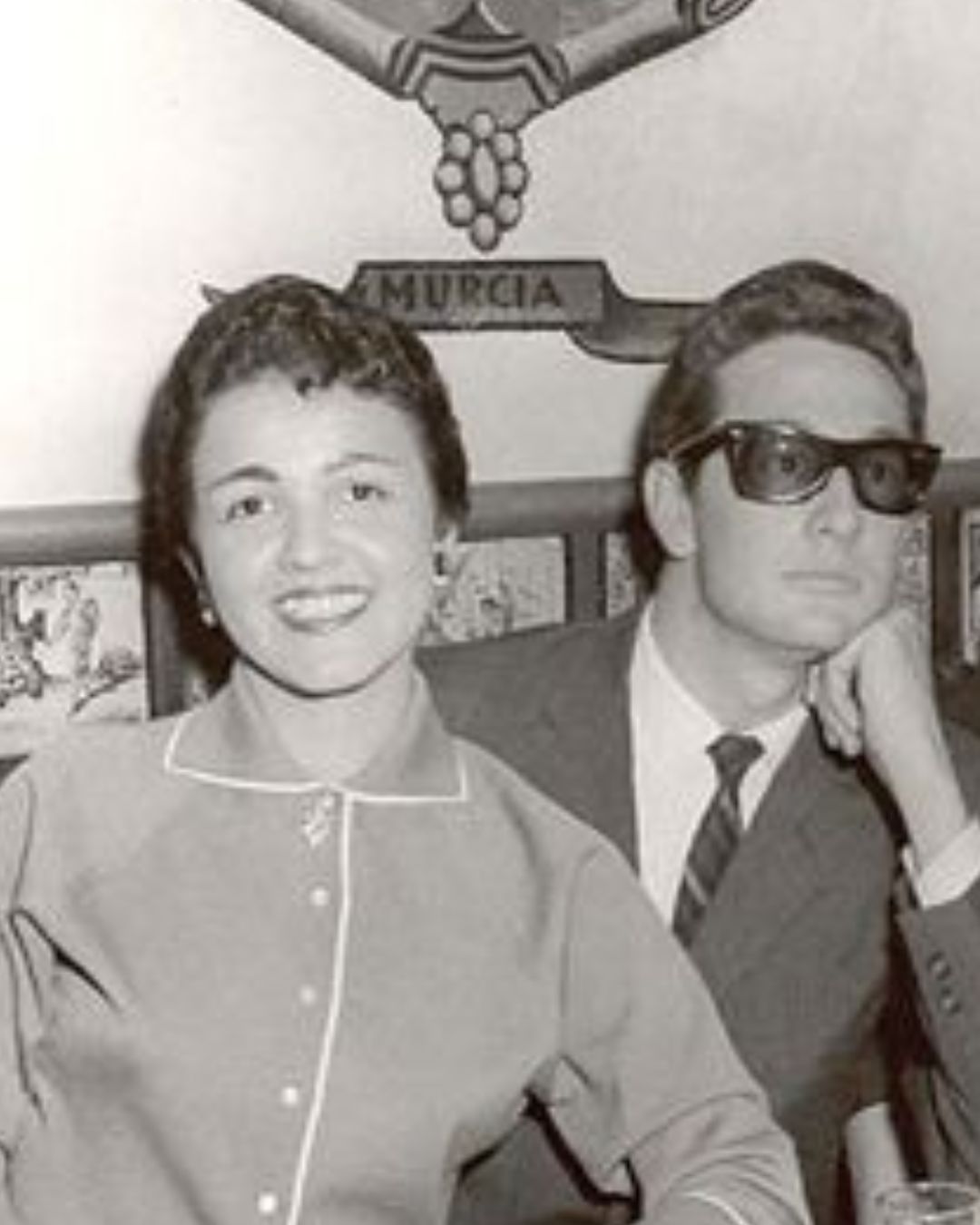
By the end of 1958, Buddy Holly had hit records on both sides of the Atlantic and a plan to stop living on a tour bus. Instead, in January 1959, he signed on for one of the hardest tours of his life. The reason was money he had already earned and could not reach: the royalties from his records were tied up with his former manager and producer, Norman Petty, in Clovis, New Mexico.
A New Life at 11 Fifth Avenue
Buddy married Maria Elena Santiago on August 15, 1958, a few weeks before his 22nd birthday. She had been working as a receptionist at Peer-Southern Music in New York, where her aunt, Provi Garcia, was an executive in the Latin American department. That fall the couple moved into apartment 4H in the Brevoort, a then-new building at 11 Fifth Avenue in Greenwich Village.
Buddy wanted to be closer to the publishing and recording business. He set up a publishing company and named it Maria Music, after his wife. He also wanted to build his own studio back in Lubbock to produce new artists.
He had already started. On September 10, 1958, at Petty’s studio in Clovis, Buddy produced the first recording session for a young Lubbock disc jockey named Waylon Jennings. Waylon cut the old Cajun waltz “Jole Blon,” with Buddy on guitar and King Curtis on saxophone.
What Buddy Found in the Books
As manager of Buddy Holly and the Crickets, Norman Petty controlled the group’s money, and their expenses were paid by him once he approved them. Petty’s name also appeared as a co-writer on many of the group’s songs, including “That’ll Be the Day” and “Peggy Sue,” which meant a share of the songwriting royalties went to him.
Maria Elena pushed Buddy to look closely at his finances. According to Holly biographer Philip Norman, Buddy eventually learned that the band’s recording royalties had not been banked under their name, but under Petty’s. Maria Elena reportedly told him she didn’t want them sitting around waiting for handouts from Petty.
In late 1958, the couple went to Petty’s studio in Clovis to end the partnership and ask for Buddy’s unpaid royalties. The break with the other Crickets was friendly. Drummer Jerry Allison and bassist Joe B. Mauldin simply didn’t want to move to New York, and they chose to keep Petty as their manager. The break with Petty was not friendly. Buddy hired a New York attorney, Harold Orenstein, to fight for control of his royalties, while Petty held on to the funds.
Petty has his defenders. Buddy and the Crickets had no hits before they recorded in Clovis, and Buddy’s brother Larry acknowledged that “Norman was responsible for getting Buddy out.” But that winter, the money was there and Buddy couldn’t get to it.
The Songs He Recorded at Home
While the lawyers worked, Buddy spent December 1958 in the apartment with a new Ampex tape recorder and his guitar. These home recordings became known as the Apartment Tapes.
On December 3 he taped “That’s What They Say” and “What to Do.” On December 5 came “Peggy Sue Got Married,” a sequel to his 1957 hit. “That Makes It Tough” followed on December 8, “Crying, Waiting, Hoping” on December 14, and “Learning the Game” on December 17. He kept taping into January.
“I Can’t Bring You With Me”
By then, Maria Elena was newly pregnant. Buddy needed cash, and promoter Irving Feld offered him a package tour of ballrooms across the Upper Midwest called the Winter Dance Party.
Maria Elena had traveled with Buddy before, including a tour that October, when she handled promotional duties. In a 2011 interview, she recalled that she was “packing for both of us” when Buddy stopped her and reminded her she couldn’t come because she was pregnant. She said she was already sick from the pregnancy.
She also said they had both had troubling dreams before he left. In hers, a ball of fire came down out of the sky and made a hole in the ground. In his, he left her on top of a building. By her account, though, the reason he went alone was the baby.
Her earliest account, given days after the crash, adds a layer: she said she had wanted Buddy to stay home with her, but the tour was already booked.
Twenty-Four Cities in Twenty-Four Days
Without the Crickets, Buddy put together a new band: Waylon Jennings on bass, Tommy Allsup on guitar and Carl Bunch on drums. Waylon had never played bass on a tour before. The Winter Dance Party opened on January 23, 1959, at the Million Dollar Ballroom in Milwaukee, with Ritchie Valens and the Big Bopper also on the bill. It was booked for 24 Midwestern cities in 24 days.
Temperatures dropped well below zero, and the buses kept breaking down. On one leg, every heater on the bus had frozen. Carl Bunch’s feet swelled with frostbite. Buddy kept calling home, and Maria Elena later said the tour was going badly, with people getting sick and the bus breaking down.
Clear Lake
After the show at the Surf Ballroom in Clear Lake, Iowa, on February 2, Buddy chartered a small plane so he could get to the next town ahead of the bus. It crashed in a cornfield shortly after takeoff in the early hours of February 3, killing Buddy Holly, Ritchie Valens, J.P. “The Big Bopper” Richardson and pilot Roger Peterson. Waylon Jennings had given up his seat.
Maria Elena learned of her husband’s death from a television report. Not long afterward, she suffered a miscarriage. On February 7, 1959, she told the Lubbock Avalanche-Journal that she blamed herself in a way, and added:
“It was the only time I wasn’t with him.”
The tapes Buddy had made that December were found afterward in apartment 4H at 11 Fifth Avenue, where he had planned to spend the winter.