Scroll to the end of the article to hear the song.
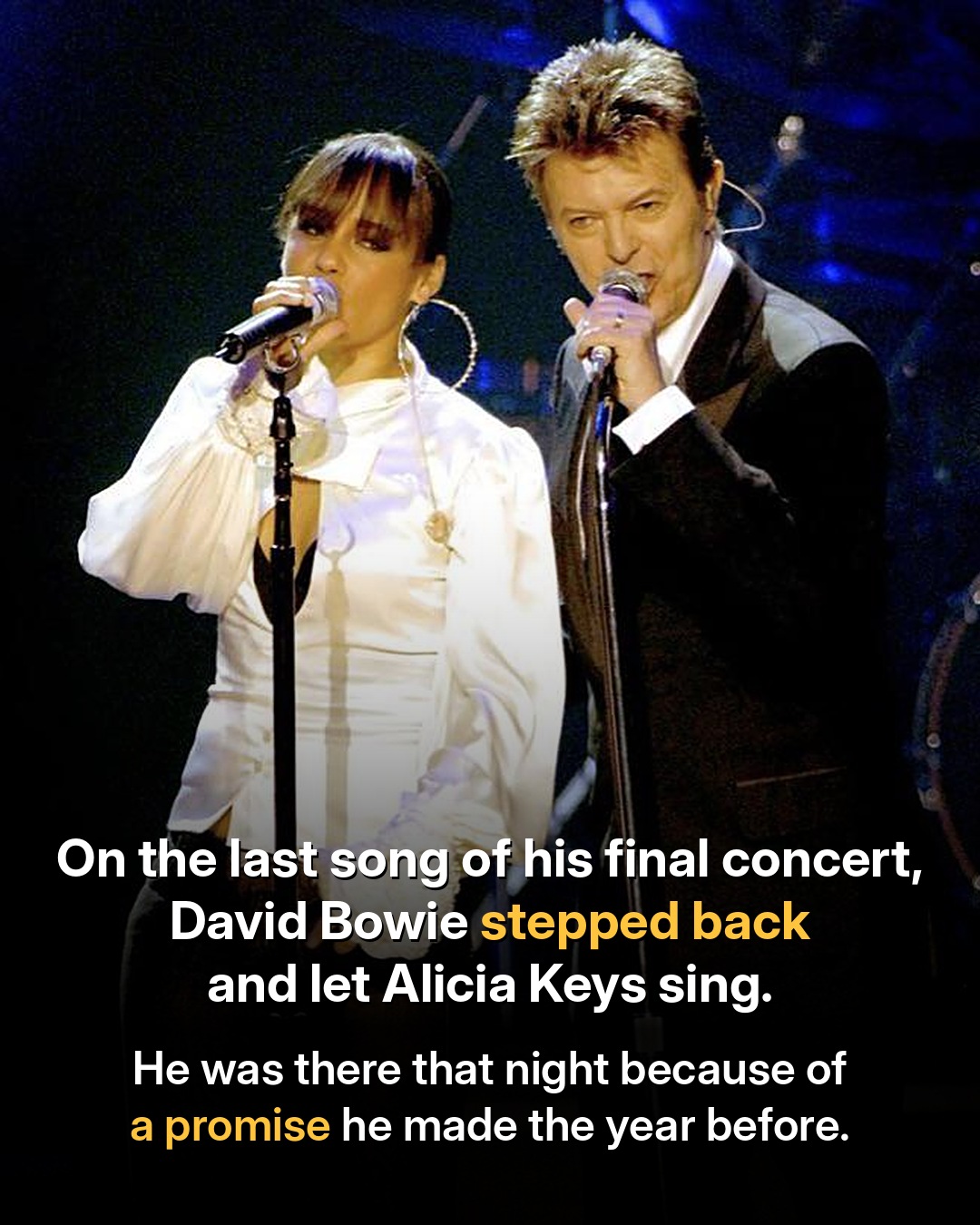
On November 9, 2006, David Bowie walked onto the stage of the Hammerstein Ballroom in New York and sang three songs. The last of them was “Changes,” and partway through it he stepped back so Alicia Keys could sing the second verse. Nobody in the room knew it at the time, but that was the end of David Bowie’s life as a concert performer. He never sang a full set in front of an audience again.
He was only there because he had given his word.
A promise from the year before
The occasion was the Black Ball, the yearly fundraiser for Keep a Child Alive, the charity Alicia Keys co-founded to bring HIV treatment and care to children and families in Africa. Keys hosted it alongside Iman, Bowie’s wife and a longtime supporter of the cause.
Bowie had not been able to take part in the 2005 Black Ball. According to his official website, which posted the news the day of the 2006 show after talking with him about the night, he promised Keys that he would definitely join her the following year. He kept that promise, and then some. When his appearance was announced that September, it was for “a couple of songs.” By the night of the ball, the plan had grown to three: one with his longtime pianist Mike Garson, and two with Keys’ band, one of those with Alicia herself.
The pianist who had been there at the start
The man at the piano that night closed a circle that went back 34 years. In September 1972, Mike Garson, a jazz pianist from Brooklyn, auditioned for Bowie’s band in a New York studio. Guitarist Mick Ronson handed him the chord chart for “Changes,” and Garson has said he played only a few seconds of it before Ronson stopped him and told him he had the job. He went on to play Bowie’s first American concert that fall.
At the Black Ball, Alicia Keys could easily have played piano on “Changes” herself. Garson has told the story a little differently over the years, but the heart of it stays the same: Keys wanted Garson at the keyboard, and she would simply sing with David. Looking back, Garson put it this way:
“So that’s a complete circle, right? It is a little eerie.”
Three songs at the Hammerstein
Fans who were there wrote up the night for David Bowie’s website. They described the room going quiet as Alicia Keys introduced him, then the loudest ovation of the evening as he walked slowly to center stage in a dark suit, hands folded, nodding to Garson before turning to the crowd.
He opened with “Wild Is the Wind,” the old Johnny Mathis song he had recorded in 1976, with nothing but Garson’s piano under his voice. One fan said it brought tears to their eyes. Then Keys’ band came in for “Fantastic Voyage,” from his 1979 album Lodger, which another fan called the surprise of the night.
For the finale, Bowie brought Alicia Keys back out. He sang the first verse of “Changes,” then stepped back and let her take the second, the verse about the children, at a benefit held for children. They shared the choruses, and by then the whole ballroom was on its feet. Guests in the best seats left their tables and crowded the front of the stage, holding up their phones. Bowie left soon after the song ended.
Why almost no one has seen it
There is no professional film of that night. Mike Garson later said Bowie did not allow it, explaining that it was a charity show and Bowie wanted to stay in the background. What survives is grainy footage shot by someone in the crowd.
Garson also remembered that Bowie was perhaps still a little shaky. It had been barely two years since a heart scare forced him to cancel the rest of his Reality Tour in 2004, and he had made only a handful of guest appearances since. He was 59 years old.
The stage he never went back to
In May 2007, Bowie turned up at Madison Square Garden to introduce his friend Ricky Gervais, joking his way through a few lines of a comic song from the TV show Extras. It was a cameo, not a concert. He never toured again and never gave another full performance.
He did not stop making music. In 2013 he surprised the world with The Next Day, and on January 8, 2016, his 69th birthday, he released Blackstar. Two days later, David Bowie died after a private 18-month battle with cancer.
When he was gone, Alicia Keys remembered the night he kept his promise. He had graciously performed three songs at the Black Ball, she wrote, and she had never seen an audience so enraptured.