Scroll to the end of the article to hear the song.
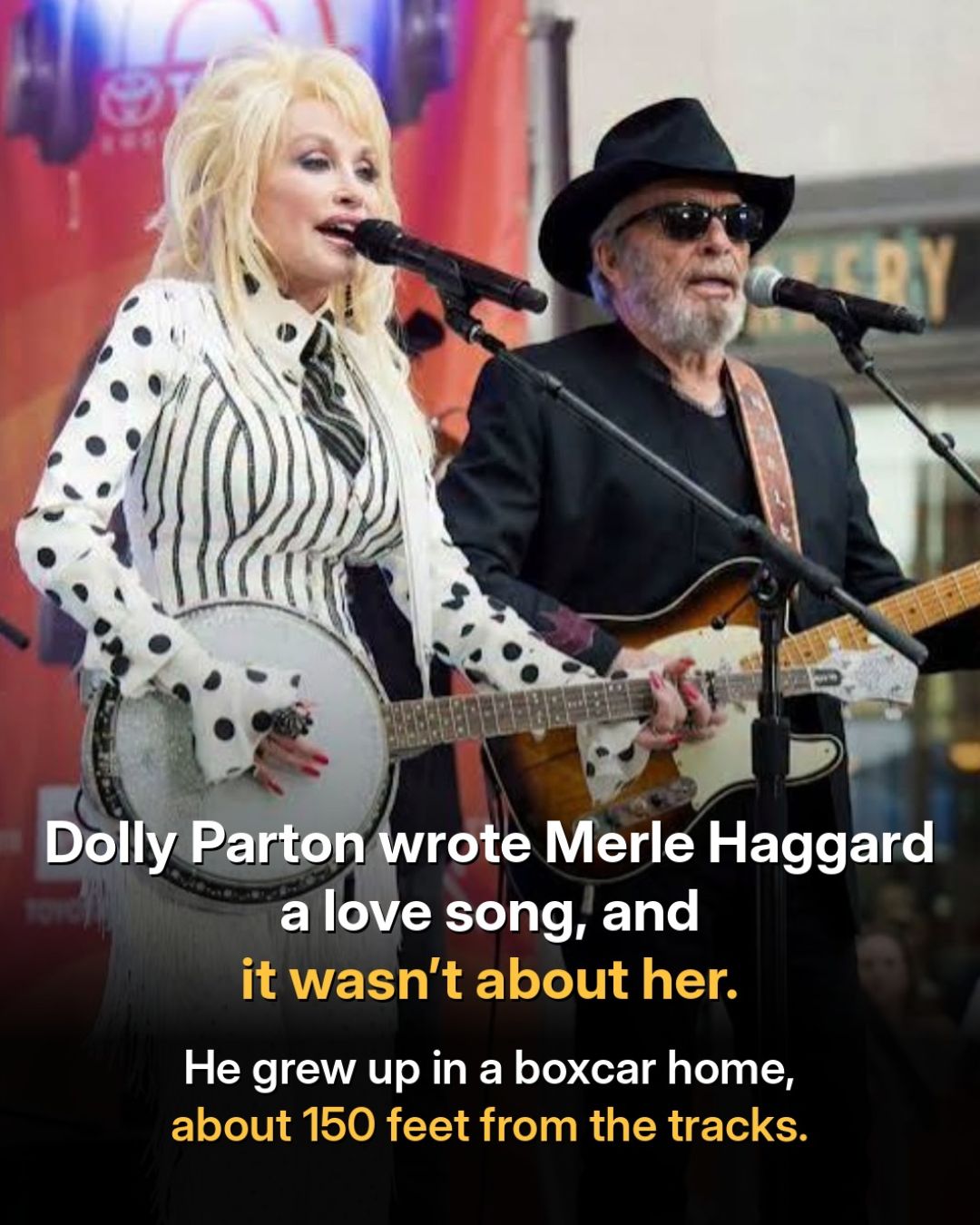
The song was called “My Love Affair With Trains.” Dolly Parton wrote it, Merle Haggard recorded it, and in 1976 it opened his twentieth studio album, which carried the same name. Of all the loves a song could have handed Merle, Dolly picked the one he had carried since he was a little boy: trains.
A Boy Raised Beside the Tracks
Merle Haggard did not come to trains as a hobby. They were the backdrop of his whole childhood. His father, James, worked for the Santa Fe Railroad, and the family lived in a converted boxcar in Oildale, California, that James had bought in 1935 and turned into a home. Merle’s mother planted fruit trees and climbing roses around it.
Talking with Terry Gross on NPR’s Fresh Air in 1995, Merle said the railroad track ran maybe 150 feet from his back door. His father died when he was 9. Merle said he was about 5 the first time he climbed up on a train, and that his mother would have died if she had known. As a young man he hopped freights for real. He told Gross that railroads were “very influential in my life.”
The Song Dolly Gave Him
Dolly and Merle toured together in the early 1970s and became close friends, riding each other’s buses and playing cards between shows. Along the way she came to know how much trains meant to him, and she wrote him a song about it.
“My Love Affair With Trains” is told by a working man who hears a train coming down the track and gets the urge to drop everything and head for some distant town. Then he thinks about his children, his job and his wife, and how much she would miss him. He loves them more than anything, but the pull of the train never quite goes away. It is a song about restlessness and responsibility living in the same man, which is a fair description of a lot of Merle Haggard’s own music.
According to American Songwriter, Dolly never released a recording of the song herself. It belonged to Merle.
An Album Built Around It
Merle recorded the album in Nashville in April 1976 with his band, The Strangers, and Capitol released it that July. He made Dolly’s song the first track and the title of the whole record. The rest of the album stayed on the rails, with songs like “Union Station,” “No More Trains to Ride,” which Merle wrote himself, and “Where Have All the Hobos Gone.” It was a tribute to the railroads and to their fading place in American life.
My Love Affair With Trains rose to No. 7 on the Billboard country albums chart. Its single, “Here Comes the Freedom Train,” reached No. 10.
A Friendship, Not a Romance
Merle never made a secret of how he felt about Dolly. In his book Sing Me Back Home, he wrote that he didn’t think there was a man on earth who wasn’t in love with her. Dolly saw it differently. In her 2020 book Dolly Parton, Songteller: My Life in Lyrics, she said she had heard he had a crush on her, but that she never thought of him romantically.
“We were just buddies, as far as I was concerned.” — Dolly Parton, Songteller
She also wrote that Merle reminded her of her brother Denver, which helped her relate to him. That is what makes the train song so telling. It was not a love song about the two of them. It was a song from a friend who had paid attention to what mattered most to him.
Trains All Through the House
Merle’s love of trains only grew once he could afford it. In the mid-1980s he leased a 1948 Western Pacific observation car called the Silver Palace, and he even wanted to live in it. That dome car is now part of the Virginia Scenic Railway, where passengers can ride in it through the Shenandoah Valley.
Dolly saw that side of him up close. Sitting down with Dan Rather in 2014, talking about train songs, she said she had written several herself and that she knew Merle Haggard loved trains. Then she remembered a visit to his home.
“His whole house, he’s got these trains that run… run through… it’s just spectacular.” — Dolly Parton, 2014
Merle Haggard died in 2016, on his 79th birthday. Dolly Parton died in August 2026, at 80. The song she wrote him is still sitting at the top of that 1976 album, right where he put it.