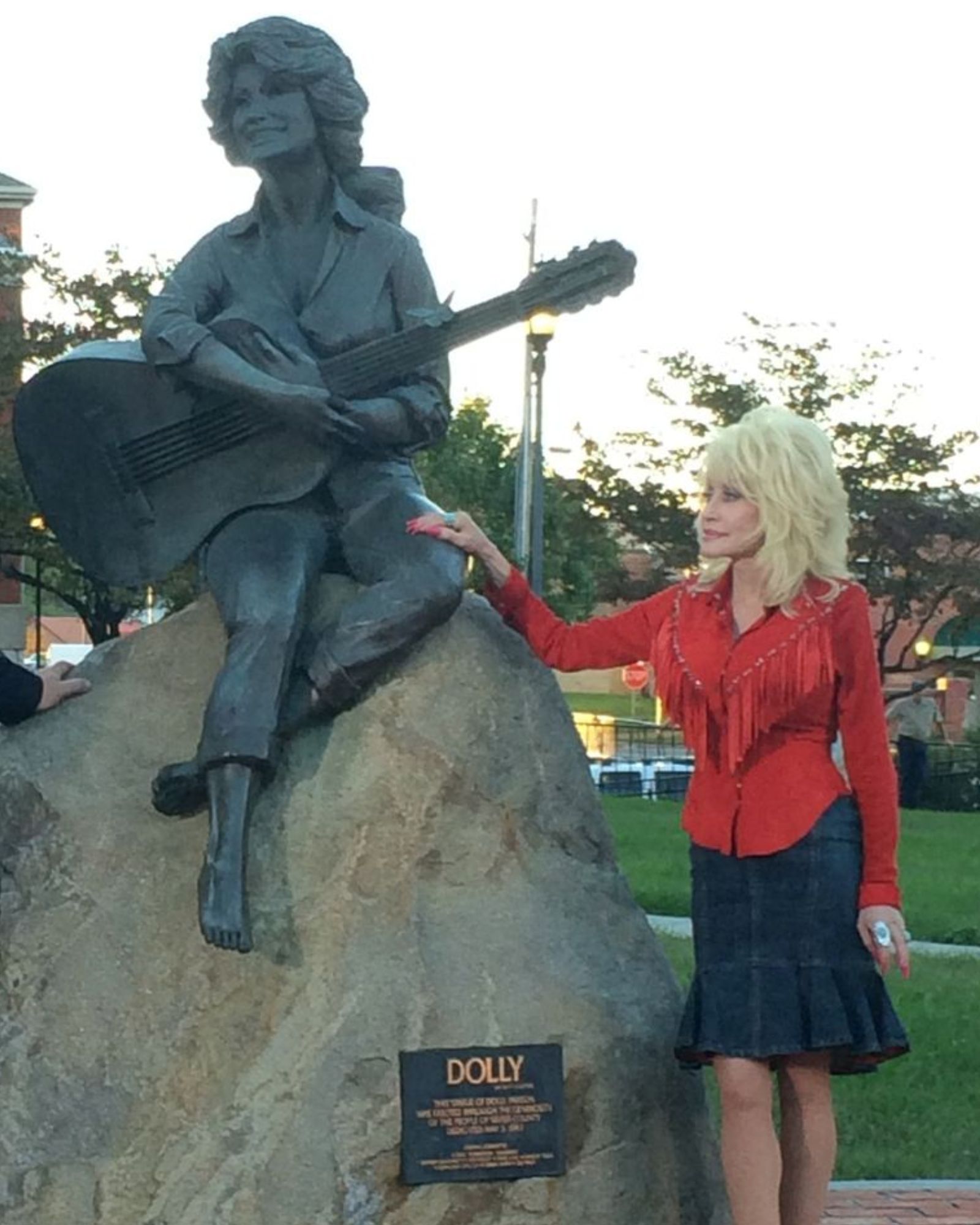
In 1987, Dolly Parton received an honor that few country singers could ever imagine. The people of Sevierville, Tennessee, decided to place a bronze statue of Dolly Parton outside their county courthouse. But when Dolly proudly shared the news with her father, Robert Lee Parton, he had a rather unexpected response.
He joked that Dolly might be an idol to her fans, but to the pigeons around the courthouse, the statue would be nothing more than another outhouse.
It was the kind of teasing Dolly knew well. Robert Lee Parton was a hardworking Tennessee mountain man who had raised twelve children with his wife, Avie Lee Parton. His daughter had become one of the most recognizable entertainers in America, but he still knew how to keep Dolly grounded.
What Dolly Parton didn’t know was that her father would eventually take that joke much more seriously than anyone imagined.
A Hometown Honor That Meant Everything
On May 3, 1987, approximately 500 people gathered outside the Sevier County Courthouse to witness the unveiling of Dolly Parton’s bronze statue.
The monument was created by sculptor Jim Gray, who spent more than 2,000 hours working on the project. Standing six and a half feet tall, excluding its base, the statue depicted a younger Dolly Parton sitting barefoot on a rock, holding a guitar.
The sculpture had required a steel framework, approximately 300 pounds of clay, and careful bronze casting at a foundry in Virginia. It was a major undertaking, supported by the people of Sevier County.
Dolly Parton attended the ceremony alongside family members, including Robert Lee Parton. During the dedication, Dolly spoke about how much the recognition meant coming from the people of her hometown.
For someone who had grown up in the Smoky Mountains and dreamed of making a living through music, the courthouse statue represented something deeply personal. This was not simply another entertainment industry award. It was recognition from the community where Dolly’s story began.
And although Robert Lee Parton had joked about the pigeons, his actions would reveal just how much the monument meant to him, too.
The Secret Late-Night Visits
Years later, Dolly Parton discovered something about her father that she had never known during his lifetime.
After Robert Lee Parton died in 2000, one of Dolly’s brothers revealed that their father had been making trips to the courthouse late at night.
Robert Lee Parton would load a large container of soapy water and a broom into the back of his pickup truck. Then he would drive into Sevierville and clean the bird droppings from his daughter’s bronze statue.
He wasn’t attending a public ceremony or receiving recognition for his work. According to Dolly’s account, these were quiet visits made long after the statue had been unveiled.
The detail was almost comical, considering his original joke. The same man who had teased Dolly about the pigeons was now personally cleaning up after them.
But for Dolly Parton, discovering what her father had done was anything but a joke.
The Story Dolly Finally Told in 2016
During an October 2016 appearance on Jimmy Kimmel Live!, Dolly Parton shared the story with viewers.
Dolly explained how her brother had told her about the water, the broom, the pickup truck, and the nighttime trips to the courthouse after their father passed away.
Remembering the moment Dolly first learned the truth, Dolly said:
“I cried my eyes out.”
The revelation gave Dolly a new understanding of an honor that had already meant so much to her.
Robert Lee Parton had not needed to make a speech about his daughter’s accomplishments. His pride had appeared in a much more ordinary task: keeping the statue clean so other people could continue enjoying it.
Why That Bronze Statue Remains So Special
In 2017, Sevierville marked the statue’s 30th anniversary with a special exhibition displaying materials connected to its creation, including sculptor Jim Gray’s preliminary models and the stool Dolly Parton had used while posing for the monument.
Over the decades, the statue became a familiar destination for visitors exploring Dolly Parton’s hometown. Yet behind its public history remained a private family story that only became widely known because Dolly chose to share it.
Today, the bronze likeness still sits outside the Sevier County Courthouse, guitar in hand, just as it did when the community unveiled it in 1987.
For many visitors, it represents the extraordinary career of Dolly Parton. For Dolly, it also carries the memory of Robert Lee Parton, the father who teased his famous daughter about pigeons and then quietly brought a broom and soapy water to take care of her statue.