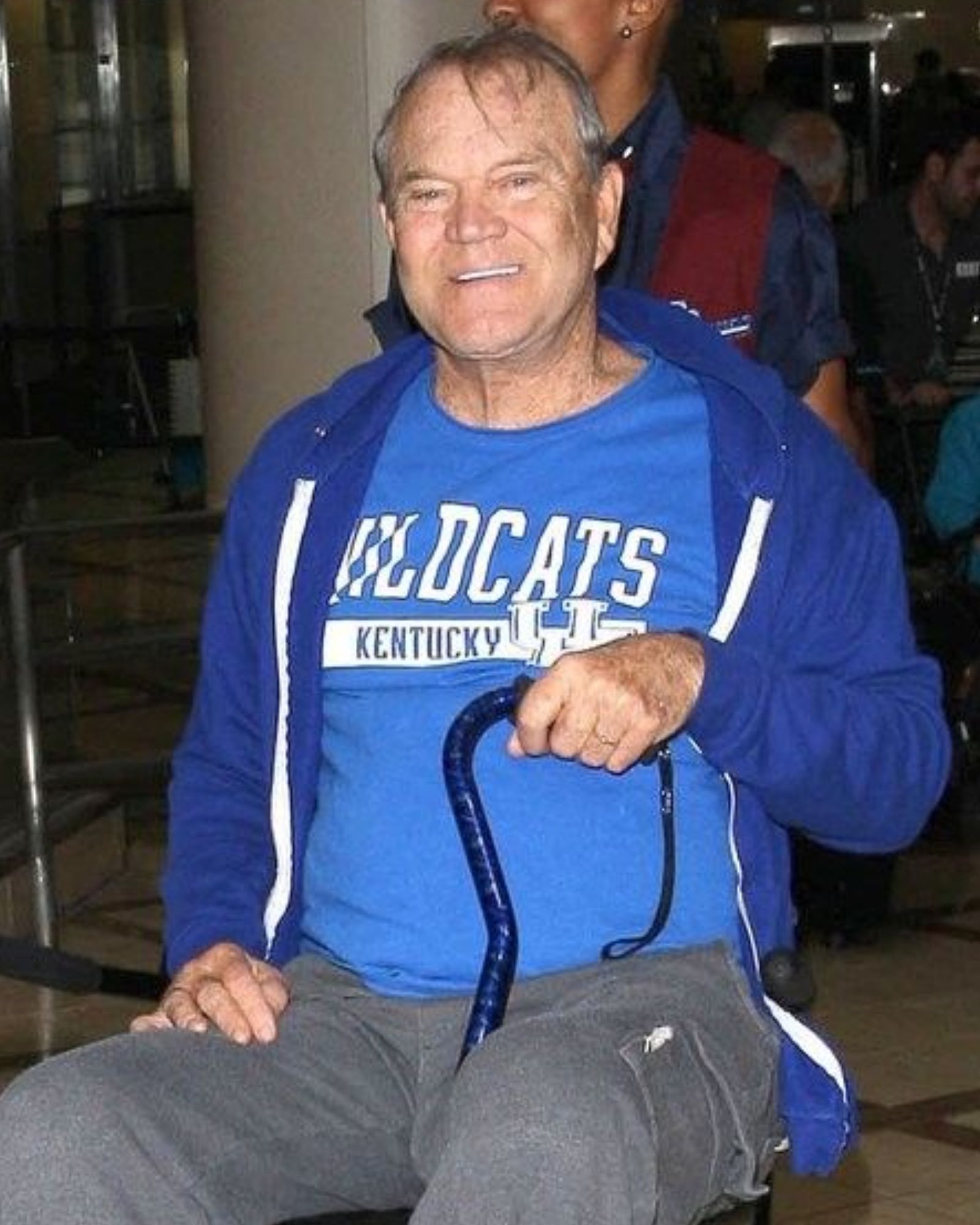
In June 2011, Glen Campbell told the world he had Alzheimer’s disease. He was 75. Most people expected him to step quietly out of sight. Instead, he and his family booked a farewell run of concerts, the Goodbye Tour, which ran from August 2011 into November 2012.
The disease was taking the words first. To get through the shows, Glen sang with a teleprompter at the foot of the stage showing the lyrics to songs he had sung for half a century. His children played in his band and helped him through the songs, singing with him when the words slipped away. Fans sang along to carry him through the hard spots and cheered louder when he struggled.
But something strange and beautiful kept happening. Whenever the guitar solos came around, the old Glen came back.
“Play solo, Glen”
The tour was filmed for the documentary Glen Campbell: I’ll Be Me, directed by James Keach. Keach later told NPR about one detail that delighted him. The prompter didn’t just show lyrics. When it was time for a guitar break, the screen would tell him so, and Glen would read the cue right out loud, “Play solo, Glen,” and then rip into it.
He could read the cue. He didn’t need anything to tell him which notes to play. Reviewers on the tour noticed it too, writing that his playing was still sharp, still inventive, still unmistakably his.
That made sense to anyone who knew where he came from. Before he was the “Rhinestone Cowboy,” Glen Campbell was one of the busiest session guitarists in Los Angeles, part of the group of studio players later known as the Wrecking Crew. He played on Frank Sinatra’s “Strangers in the Night” and on the Beach Boys’ Pet Sounds.
The night the teleprompter went dark
One of the most striking scenes in the film comes at the Ryman Auditorium in Nashville. Glen is in the middle of “Gentle on My Mind,” one of his signature songs, when the teleprompter he had leaned on all tour suddenly goes out.
He stumbles. Then, instead of freezing, he turns it into a joke with the crowd, telling them he needs one of those screens because he has forgotten everything he ever learned. The audience laughs with him, not at him.
Moments like that run all through the film. “I’ll play one now,” he says at one point, and he does.
Keach said Glen never hid from what was happening. “He didn’t have shame for having Alzheimer’s,” the director told NPR. As his family described it to NPR, music had always just flowed out of him, and it kept flowing through the whole tour.
One last session with old friends
After the tour ended, there was one more thing to do. In January 2013, Glen went into a studio in Los Angeles to record a song he had written with producer Julian Raymond. It was called “I’m Not Gonna Miss You.”
Raymond reportedly built the song from things Glen said to him as the disease progressed. It is Glen talking about Alzheimer’s in his own plain way, and about the people he loved. Backing him were members of the Wrecking Crew, the same studio musicians he had worked beside decades earlier.
It was not easy. Keach recalled that Glen recorded it sometimes a line at a time, sometimes a word at a time. Kim later said he was determined to preserve whatever magic was left. Around the same period, he also recorded the songs that became his final album, Adiós, with help from his children Ashley, Shannon, and Cal, and a guest turn from Willie Nelson.
“I’m Not Gonna Miss You” was the last song Glen Campbell ever recorded. In February 2015, it won the Grammy for Best Country Song, and it was nominated for an Academy Award for Best Original Song. Tim McGraw sang it at the Oscars.
By then, Glen was living in a care facility in Tennessee. Reports at the time said he did not know his last song had won.
Two guitars in his room
Even then, the music didn’t leave entirely. Kim told NPR that he kept two guitars in his room. Friends from the Nashville music community came by regularly to sit and play for him. Then they would hand him the guitar, and he would try to pick a little.
Glen Campbell died on August 8, 2017, at an Alzheimer’s facility in Nashville, with his family around him. He was 81. Adiós had come out that June.
He was laid to rest in the family cemetery in Billstown, Arkansas, the tiny community where he was born in 1936, one of 12 children of a sharecropper. The family grew up poor, without electricity or running water, and all the children helped pick cotton. His uncle taught him to play the guitar.
The words went first. The guitar stayed with him almost to the end.
What’s the first Glen Campbell song you remember hearing? Share it in the comments.