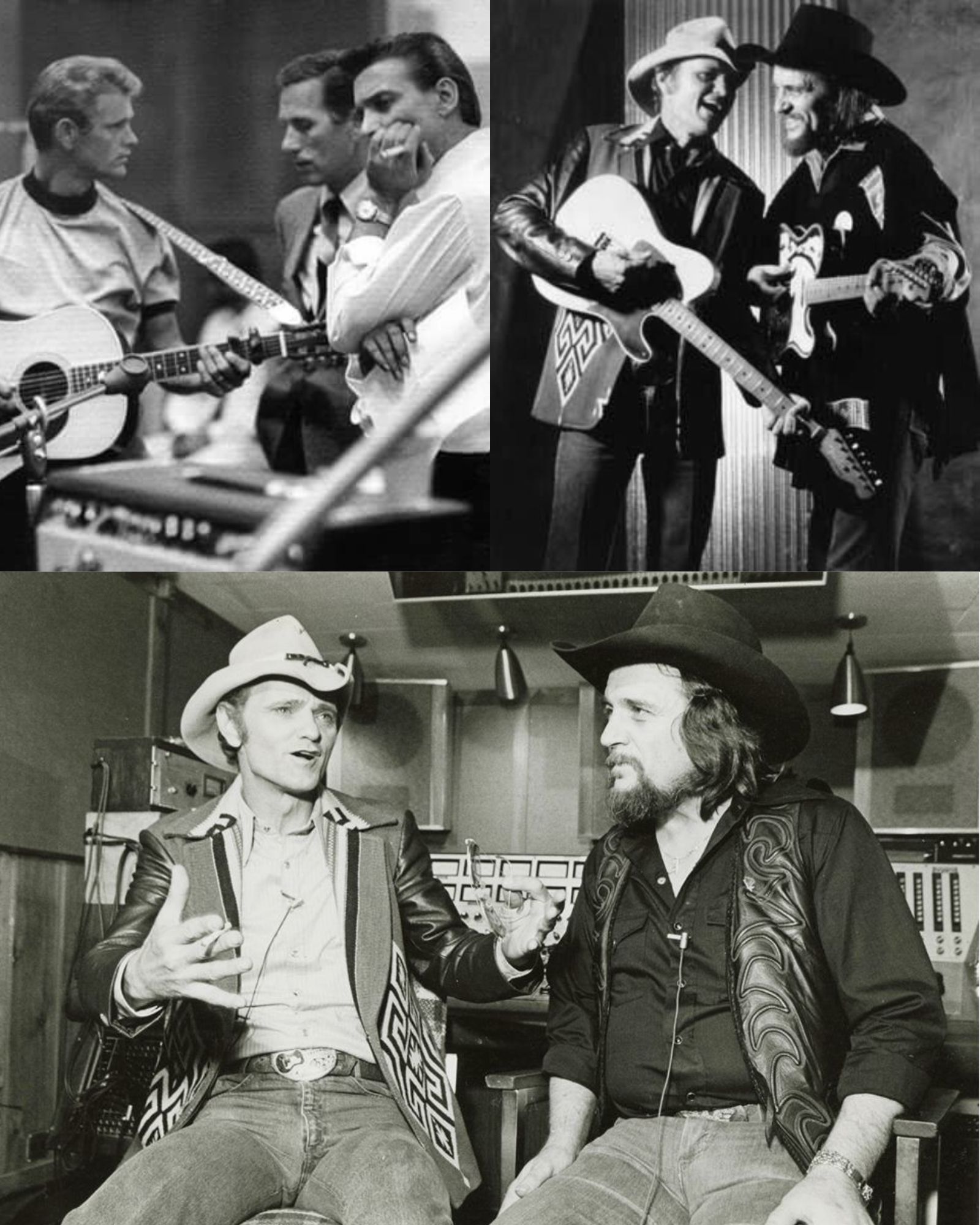
By the summer of 1983, Waylon Jennings had spent years building a reputation as one of country music’s most independent performers. Waylon Jennings had shared records and stages with some of Nashville’s biggest names, but when the opportunity came for another major tour, the singer had someone particular in mind.
The organizers presented Waylon Jennings with several possible touring partners. Instead of simply accepting one of the suggested names, Waylon Jennings asked for Jerry Reed.
That decision wasn’t about finding the biggest star or creating an unlikely pairing. It came from a musical connection that had begun nearly twenty years earlier, when Waylon Jennings was still finding a place in Nashville.
A Friendship That Started in the Recording Studio
During the mid-1960s, Waylon Jennings was recording for RCA under the guidance of legendary producer Chet Atkins. Among the musicians Chet Atkins brought into those early sessions was a talented guitarist named Jerry Reed.
Jerry Reed hadn’t yet become the television and movie personality millions would recognize from films such as Smokey and the Bandit. Jerry Reed was already earning respect in Nashville for an extraordinary guitar style and a seemingly endless supply of musical ideas.
In a 1983 interview with Country Music magazine, Waylon Jennings recalled how much those early recording sessions meant. Waylon Jennings remembered sensing that Jerry Reed genuinely enjoyed the music being recorded. That encouragement helped Waylon Jennings feel more comfortable in the studio.
One particular memory involved the recording of “Stop the World (And Let Me Off).” Waylon Jennings remembered playing guitar alongside Jerry Reed, with the musicians using different picking techniques.
According to Waylon Jennings, Jerry Reed worked so hard to squeeze an additional guitar lick into the performance that Chet Atkins began laughing. Jerry Reed was determined to get the part exactly right, even if the effort left Jerry Reed sweating.
It was a humorous memory, but it also revealed something about the musicians. Both cared deeply about their playing, and both could enjoy the friendly challenge of making a recording sound better.
Why Waylon Jennings Wanted Jerry Reed in 1983
Nearly two decades later, the music business looked different for both artists.
Waylon Jennings had become a defining figure of outlaw country. Jerry Reed had enjoyed major recording success with songs including “When You’re Hot, You’re Hot,” “She Got the Goldmine (I Got the Shaft),” and “The Bird.”
Yet the connection formed during those early Nashville sessions had endured.
When plans emerged for a sponsored concert tour in 1983, Waylon Jennings explained that the organizers had approached Waylon Jennings with other artists’ names. Waylon Jennings specifically requested Jerry Reed because of the comfort and trust that came from working together.
Jerry Reed welcomed the invitation. In the same Country Music magazine interview, Jerry Reed recalled returning to the recording studio with Waylon Jennings and finding the experience just as enjoyable as their earlier sessions.
What had started as a guitarist accompanying a developing country singer had grown into a partnership between two established entertainers.
The 27-City Tour That Brought Them Together
The resulting tour was called “Give ‘Em A Hand,” sponsored by Maxwell House Coffee. The 27 scheduled appearances began July 1, 1983, in Asheville, North Carolina, with the final concert planned for September 18 at Opryland in Nashville.
The tour also had a charitable purpose. Maxwell House offered to contribute two dollars to local charities for each qualifying empty coffee bag brought to the concerts, with donations potentially reaching $10,000 per city.
At the August 13 performance in Huntsville, Alabama, the Downtown Rescue Mission was among the organizations benefiting from the event.
During the same period, Waylon Jennings and Jerry Reed returned to the recording studio. The collaboration produced a lively remake of “Hold On, I’m Comin’,” the soul classic made famous by Sam & Dave in the 1960s.
The pair also recorded versions of “Mystery Train” and “Fadey-Do,” demonstrating how naturally their musical personalities could come together.
A Partnership That Continued Beyond 1983
For Waylon Jennings, the appeal of working with Jerry Reed went beyond guitar playing or record sales. Waylon Jennings explained in the 1983 interview that the two musicians encouraged one another without turning every performance into a competition.
That connection remained part of their musical history. In 1998, Waylon Jennings and Jerry Reed joined Bobby Bare and Mel Tillis in the country supergroup Old Dogs, recording songs written by Shel Silverstein.
The 1983 tour remains especially memorable because of the decision that started it. When Waylon Jennings was given the opportunity to choose another performer, Waylon Jennings reached back to a friendship formed long before outlaw country became a household phrase.
Waylon Jennings had worked with some of the finest musicians in American country music. But in that 1983 interview, Waylon Jennings made clear that sharing a stage with Jerry Reed was something special.
Nearly twenty years after their first recording sessions together, Waylon Jennings still believed Jerry Reed brought out the best in the music.