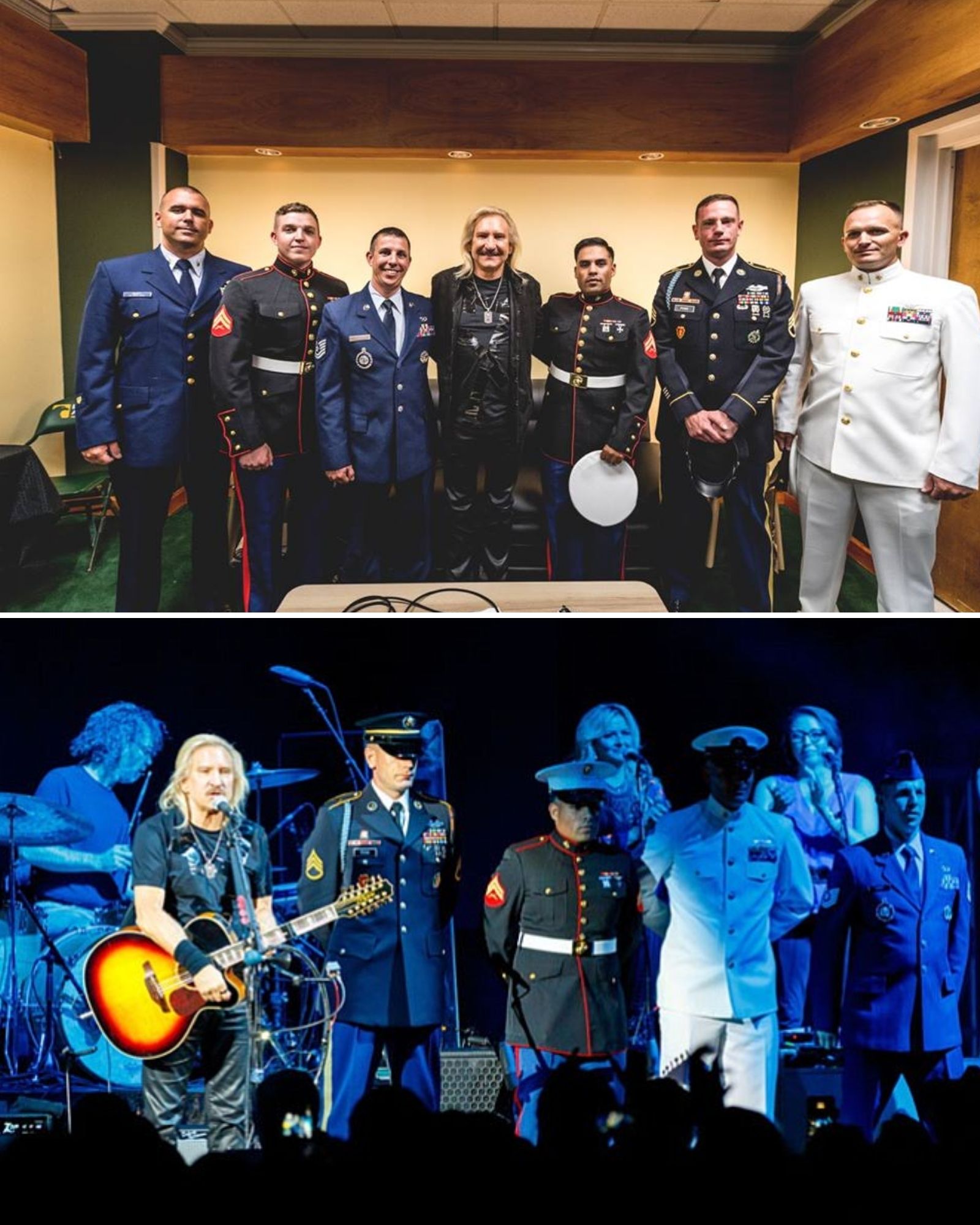
Long before “Rocky Mountain Way,” before the James Gang and the Eagles, Joe Walsh was a toddler living on Okinawa with his parents. In the summer of 1949, his father went up in one of the newest airplanes the American military had and did not come home. Joe was 20 months old. He would grow up with no memory of the man at all, and he would spend much of his life trying to honor him anyway.
A 24-year-old instructor in a brand-new jet
Lt. Robert Newton Fidler was 24. He taught other pilots to fly the Lockheed F-80 Shooting Star, the first jet fighter the United States put into operational service.
Joe Walsh has described just how new that plane was. His father’s job as an instructor was close to that of a test pilot. His flight logs went back to Lockheed so engineers could study them, because there were maneuvers the jet would not respond to, and pulling out of a high-speed dive could be tricky.
On July 22, 1949, during maneuvers over Okinawa, Lt. Fidler was killed in a mid-air collision.
“One day he didn’t come back. He was 24.”
That is how Walsh put it decades later, speaking to The VVA Veteran, the magazine of Vietnam Veterans of America.
A young widow comes home to Wichita
Joe’s mother, Helen, was about 20 years old. She took her baby back to Wichita, Kansas, and started over. Helen was a classically trained pianist who filled the house with music, and Walsh has credited her with giving him what he needed to become a musician.
There was little help waiting for them. The term “Gold Star family” was not in use for families like theirs. Walsh has said the official attitude amounted to sympathy and a flag for the coffin, and not much more.
When Joe was five, Helen remarried. His stepfather adopted him, and the boy took the last name Walsh. He kept his father’s name as his middle name, and to this day he is Joseph Fidler Walsh. He has spoken warmly of the stepfather who stood behind him, but he has never hidden that part of him kept wondering what his real father was like. On his VetsAid page, he says he lost his father as a baby, “before I could even make a memory of him.”
The visits to Walter Reed
Decades later, long after he became famous, a friend suggested Walsh visit soldiers recovering from serious wounds at Walter Reed Army Medical Center in Washington. He thought it would be a one-time visit. Instead, he kept going back nearly every time he was in the capital.
He spent time in the wing where survivors of roadside bombs were learning to use prosthetic limbs. At first, he admitted, he had no idea what to say to them. So he listened, and he later decided that was exactly the right thing to do.
What struck him most was their attitude. He found them upbeat rather than bitter, focused on getting their new limbs working so they could get back to their lives, and looking after one another like family.
On later trips he came with a guitar and offered free lessons to anyone who wanted one. A few soldiers worked up the nerve to ask for “Hotel California.” Walsh warned them that Don Henley had always sung that song and he only knew the choruses, so they would have to handle the words. The soldiers sang, and Joe Walsh played. He said the whole room lit up.
From a hospital ward to an arena
Those visits, along with his own childhood as what is now called a Gold Star kid, pushed him toward something bigger. In 2017, he told his son, Christian, that he wanted to put on a benefit concert for veterans. Christian pictured a theater show. His father wanted an arena.
On September 20, 2017, VetsAid held its first concert at EagleBank Arena in Fairfax, Virginia, just outside Washington. Keith Urban, Zac Brown Band and Gary Clark Jr. played alongside Walsh, who modeled the idea on his friend Willie Nelson’s Farm Aid. Tickets were set aside for Gold Star families, and that first night sent nearly $400,000 in grants to veterans organizations.
A room for the kids
As the show moved to a new city each year, it became more than a concert. VetsAid held job fairs for veterans the day before. It flew in Gold Star families. And at the concerts, it set aside a room just for their children, where kids who had lost a parent in service could play video games, meet each other and share what they had been through.
Walsh told AARP that the point was for those kids to find out they were not alone, and that they were part of a bigger family.
No one had arranged anything like that for a toddler in Wichita in 1949.
Home again
In November 2025, the ninth VetsAid concert came to Wichita, the city where Helen had brought her baby home. Vince Gill, Ryan Bingham, Susan Tedeschi, Derek Trucks and Nathaniel Rateliff joined Walsh at Intrust Bank Arena on November 15. Christian said the show set out to honor the 20-year-old war widow who raised Joe on her own, and the struggles Gold Star mothers face when a husband does not come home. By then VetsAid had raised about $4 million, and the Wichita show added roughly $600,000 more in grants.
Walsh has said he grew up proud of a father he never knew, and that all his life he hoped to earn that man’s approval.
“My whole life was trying to do something that he would approve of.”
He said that to Wichita public radio a few days before he walked onstage in the town where his story began.