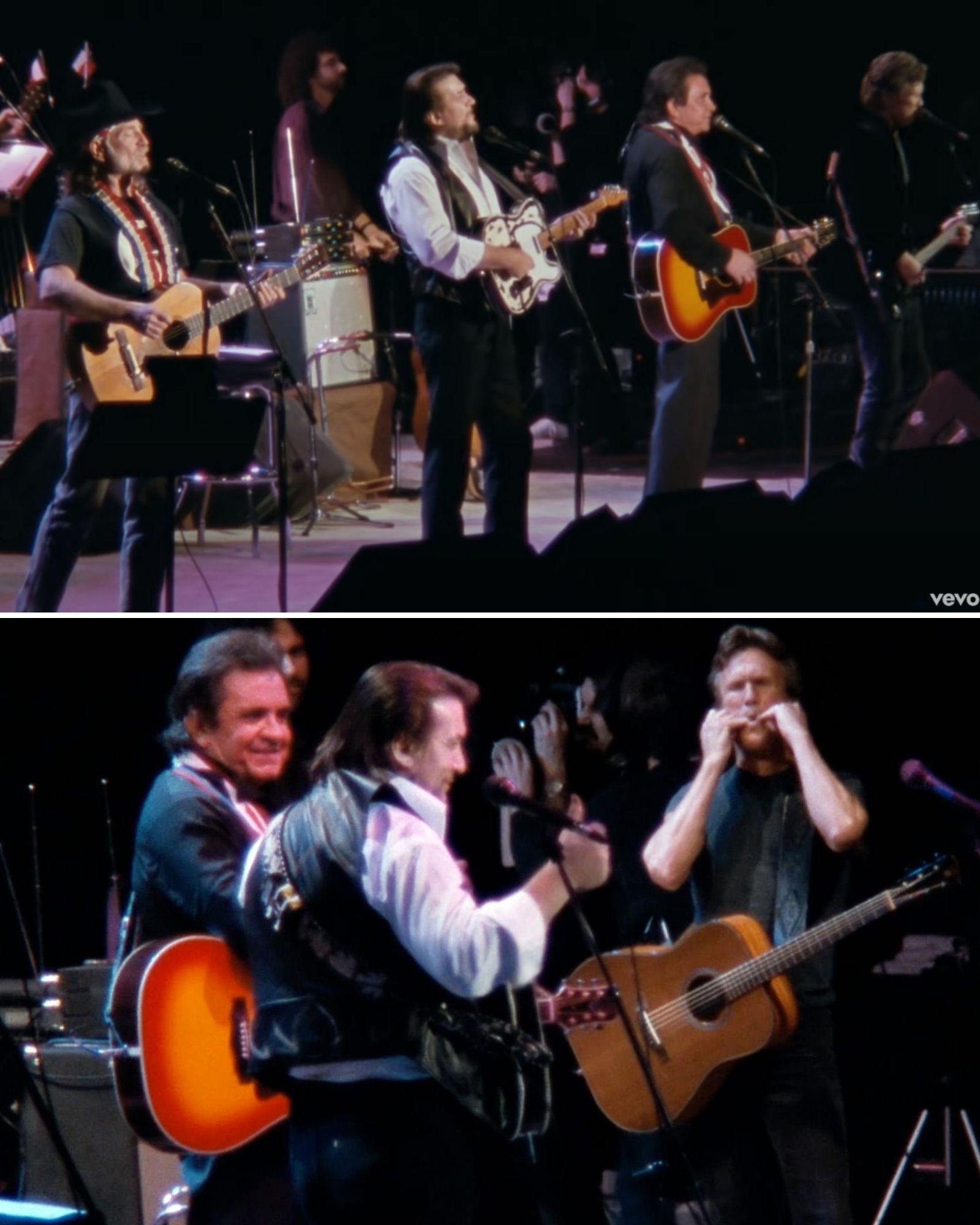
On March 14, 1990, Johnny Cash, Willie Nelson, Waylon Jennings and Kris Kristofferson walked onstage at Nassau Coliseum in Uniondale, New York, on Long Island. The Highwaymen were less than two weeks into a tour behind their second album, Highwayman 2, released that February. The tour had opened on March 3 at the Houston Livestock Show and Rodeo in front of more than 55,000 people.
Nassau was the night they chose to film. It was also a night Johnny Cash spent in serious pain. Lou Robin, his longtime manager, later recalled that Cash “was suffering from immense jaw pain throughout the night.” It was so bad that the crew could only film him from one side of his face.
Cash was 58. Accounts of that 1990 tour say he played it while dealing with a broken jaw, and the shows still drew near sell-out crowds. On the Nassau film he stays with the show from start to finish, singing “Ring of Fire,” “Folsom Prison Blues,” “Big River” and “A Boy Named Sue” along the way.
Why That Night Was the One They Filmed
Robin’s explanation was simple. The band had been playing together long enough to be locked in, the crowd was going to be big, and everyone on the team agreed this was the show to put on film. As for why the night clicked the way it did, his best guess was the moon, the night, the sound system and everybody’s energy lining up at once.
Jessi Colter, Waylon’s wife and singing partner, saw it the same way. She remembered the four of them being fully on their game that night, and called the Nassau performance fantastic.
Four Voices on One Song
One of the most telling moments comes midway through the set. Kris Kristofferson’s “The Pilgrim: Chapter 33,” his portrait of a wayward, worn-down songwriter, gets passed around the stage, with Kristofferson, Cash, Jennings and Nelson each taking a turn. When the song ends, Kristofferson points at each of the other three and smiles. In the liner notes for the 2016 release, writer Mikal Gilmore described it as the moment that brings the group’s fellowship into focus.
Two Heart Patients, Fifteen Months Earlier
The crowd in New York was watching two men who had been heart patients in the same Nashville hospital not long before.
In December 1988, Waylon Jennings had triple bypass surgery at Baptist Hospital in Nashville. Johnny Cash came to see him there and ended up a patient himself. In his 1996 autobiography, Jennings remembered it this way: “They checked him in and put him across the hall from me.”
Cash, then 56, had a double bypass about a week after Waylon’s operation. Contemporary reports said that on December 20, 1988, the day Jennings checked out, Cash was in critical but stable condition and expected to stay 10 to 12 more days. Jennings, 51, told reporters he was quitting cigarettes and going to eat right. He also said he had stopped in to see Cash twice that day, and passed along what he told his old friend:
“Next time, you’re going first.”
The two had been close since the mid-1960s, when they shared an apartment just outside Nashville. Fifteen months after that hospital stay, they were standing side by side on a Long Island stage.
How the Full Show Finally Came Out
The film, directed by Jon Small, did not disappear entirely. An edited version came out on home video in 1991 as Highwaymen Live! But most of the footage stayed on the shelf until May 20, 2016, when Columbia/Legacy released The Highwaymen Live – American Outlaws. That box set carried two discs of audio from the Nassau show and the complete concert film, transferred from the original reels and running about two hours and 39 minutes. PBS stations aired a broadcast edit of the concert in June 2016.
By the time the complete show came out, Waylon and Johnny had been gone for more than a decade. Waylon Jennings died in February 2002, and Johnny Cash followed in September 2003. Kris Kristofferson died in September 2024, at 88. Willie Nelson, now 93, is the last Highwayman, and he is still on the road.