Scroll to the end of the article to hear the song.
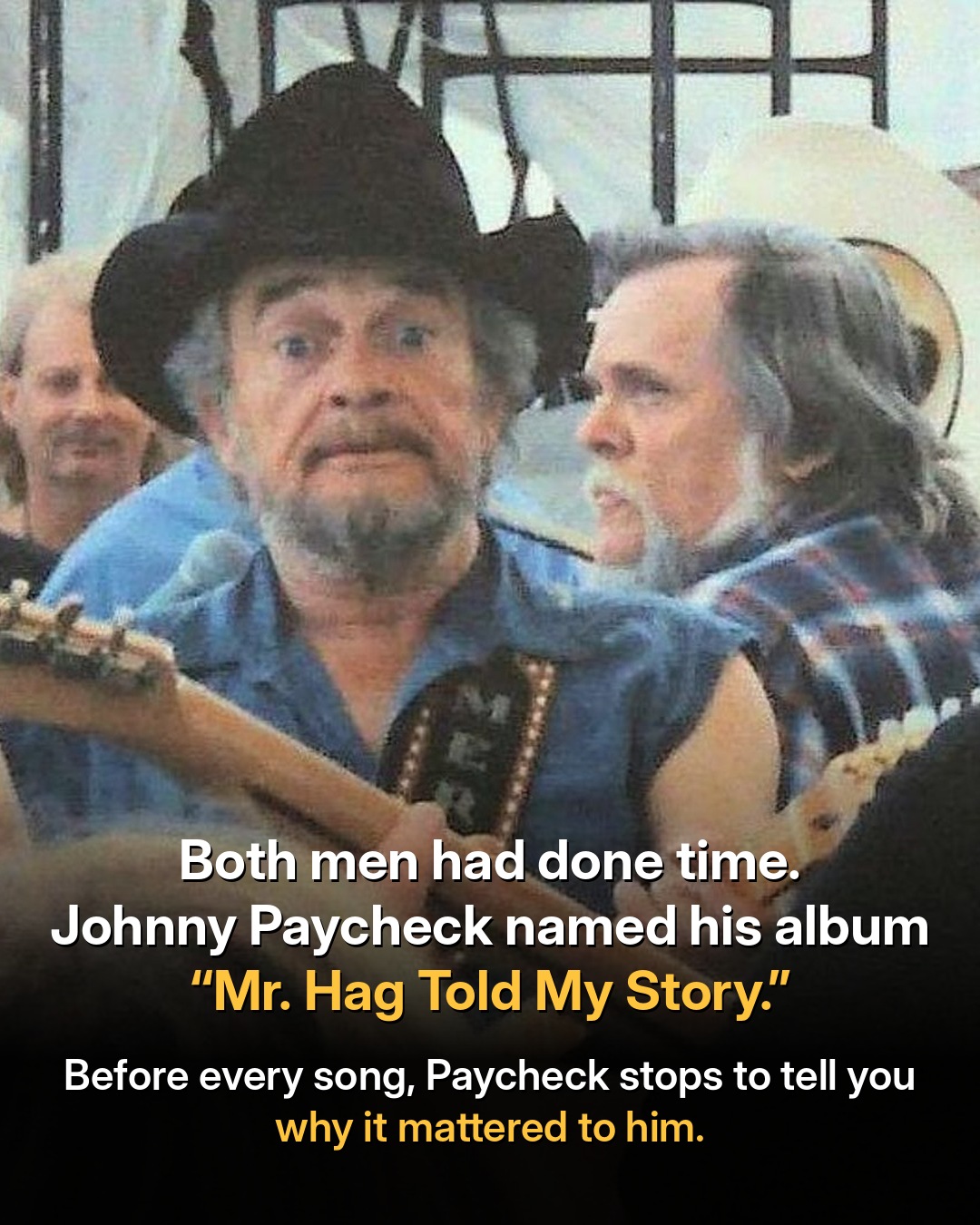
In 1981, Johnny Paycheck released an entire album of Merle Haggard songs and gave it a title that sounded like a confession: Mr. Hag Told My Story. It was not a tribute made from a distance. Haggard himself sang on it, played electric guitar on it, and brought his longtime band, The Strangers, to back Paycheck through the whole record.
Paycheck explained what the songs meant to him in the liner notes. He had been listening to Haggard’s writing for 15 years, and he put it simply:
“They’ve helped me make it through many a night.”
Paycheck Talks Before Every Song
The detail that sets this album apart is Johnny Paycheck’s own voice between the songs. Before each track, he speaks directly to the listener and explains why the Haggard song coming next matters. In one of those spoken passages, he calls Haggard a “master painter whose songs paint a perfect picture of life itself.”
Not every critic loved the idea. Roberta Penn, reviewing the album for The Rocket in August 1981, counted the spoken intros as a small flaw, even while praising the record as a living tribute that lifted both men. When the album was reissued on CD in 1998, George Hauenstein of Country Standard Time saw it differently, calling it a concept record that works on every level and writing that Paycheck’s affection for the songs comes through as genuine.
A Tribute Built From the Deeper Cuts
Paycheck could have made an easy greatest-hits record. He did not. There is no “Mama Tried” here, no “Okie From Muskogee,” no “Sing Me Back Home.” Instead, he leaned mostly on Haggard songs that casual radio listeners might not have known, songs like “I’ve Got a Yearning,” “All Night Lady,” “I’ll Leave the Bottle on the Bar,” “No More You and Me,” and “You Don’t Have Very Far to Go,” which Haggard wrote with Red Simpson.
Of the ten songs, Haggard wrote or co-wrote nine. The one exception was “Carolyn,” a Tommy Collins song that Haggard had taken to the top of the country chart years earlier.
Merle Haggard and The Strangers in the Studio
The album was produced by Billy Sherrill and recorded in September 1980, with sessions at Britannia Recording Studio in Hollywood and at Columbia Recording Studio and Sound Emporium in Nashville. Merle Haggard joined Paycheck on three duets: “Turnin’ Off a Memory,” “Carolyn,” and “I Can’t Hold Myself in Line.”
Behind them stood The Strangers, including Roy Nichols on electric guitar, Norm Hamlet on steel, Ronnie Reno on acoustic guitar, Dennis Hromek on bass, Gordon Terry on fiddle, Mark Yeary on piano, Don Markham on horns, and Biff Adams on drums. Paycheck’s own steel player, Jim Murphy, also played on the record.
The Song at the Center: “I Can’t Hold Myself in Line”
Merle Haggard first recorded “I Can’t Hold Myself in Line” in 1968 for his album Pride in What I Am, released in February 1969. It was an album track, not a single. The song is a blunt, almost wry self-portrait of a man who does not like the way he is living, knows it could cost him the woman who stands by him, and still admits he cannot straighten up.
Twelve years later, it became the duet that introduced Johnny Paycheck’s new album. Epic Records released Paycheck and Haggard’s version as a single on March 28, 1981. It climbed to No. 41 on the Billboard country singles chart.
Both men who sang it had seen trouble up close. Merle Haggard had served time in San Quentin before he ever had a hit record. Johnny Paycheck had been court-martialed in the Navy in 1956 for assaulting an officer and spent two years in military prison. When Paycheck named the album Mr. Hag Told My Story, he was singing songs written by a man who, like him, had once been locked up.
What Happened Next
Commercially, the album barely made a dent. It peaked at No. 40 on Billboard’s Top Country Albums chart, and a second single, “Yesterday’s News (Just Hit Home Today),” reached only No. 57.
The reviews were kinder. Bob Claypool of the Houston Post wrote that it was fitting for Haggard to be honored this way, and the Richmond Times-Dispatch singled out the duets with Haggard as fine performances. Over the years, the album’s reputation kept growing. AllMusic later called it a “sterling example of what a tribute album can be,” and when Paycheck died in 2003, the roots music magazine No Depression called it a masterpiece of his Epic years.
The record closes with a Haggard song that sounds like the album title turned into music. It is called “Someone Told My Story.”