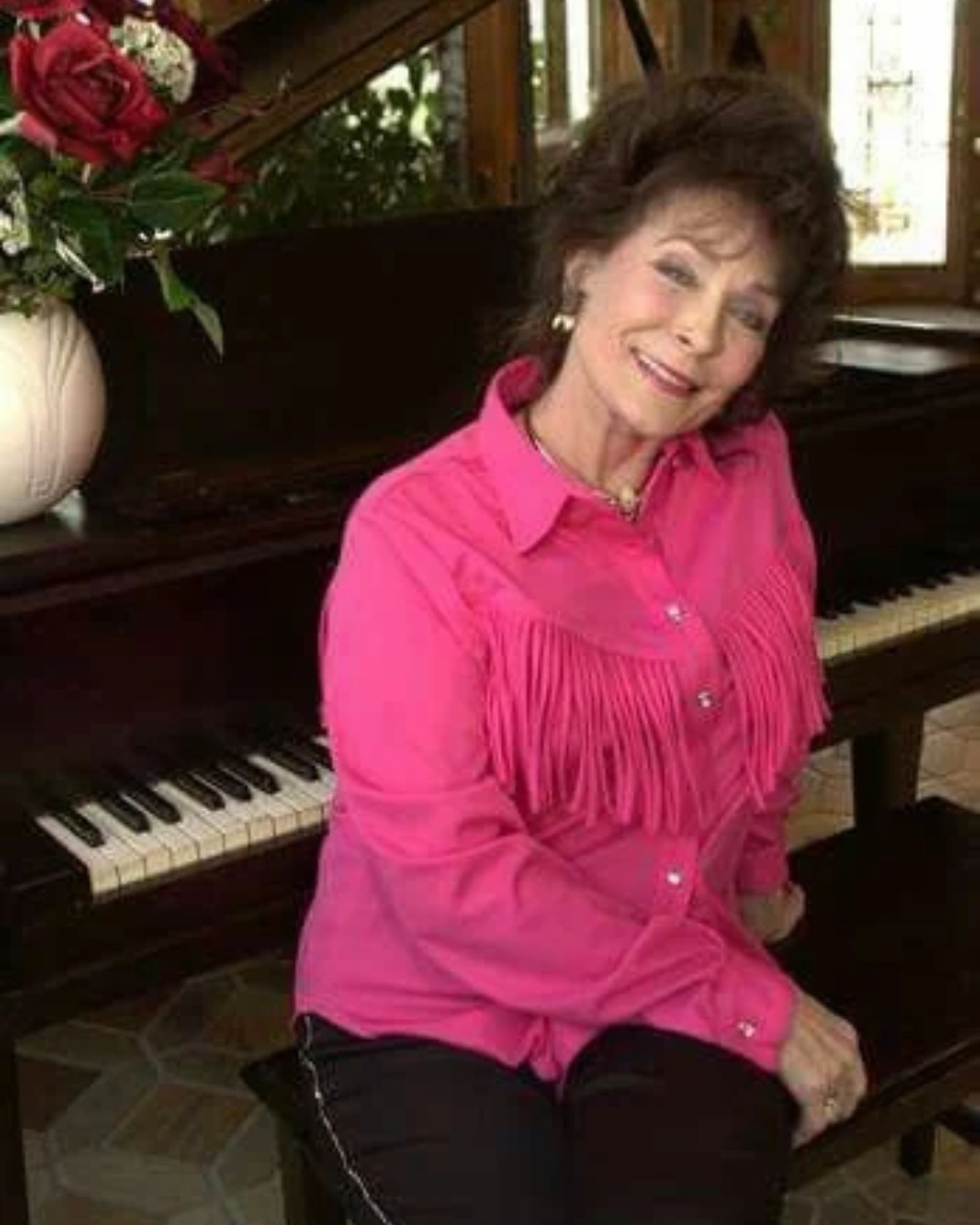
Years before Dolly Parton released “Jolene,” Loretta Lynn encountered a woman facing a painfully similar situation. But where Dolly Parton would later sing a desperate plea to another woman, Loretta Lynn chose a completely different response. The remarkable part is that the idea came from an actual conversation backstage, and the song took only ten minutes to write.
The woman who inspired the recording was not a songwriter, a performer, or anyone famous. According to Loretta Lynn’s own recollection, she was simply a young wife who had come to a concert and discovered something she never expected to see.
A Woman in Tears and a Husband in the Second Row
Loretta Lynn was preparing for a performance when a young woman approached backstage. The singer still had curlers in her hair and a headscarf on, but Loretta Lynn stopped to find out why the visitor was crying.
The woman explained that her husband had refused to bring her to the concert. Yet when she arrived, she discovered that her husband was sitting in the second row with another woman.
Imagine the embarrassment of that discovery. The woman had come expecting an evening of country music. Instead, she found herself watching her husband enjoy the show with someone else.
Rather than dismissing the woman’s concerns, Loretta Lynn accompanied the visitor to the curtain and looked into the audience.
In a 2016 interview with Vice, Loretta Lynn remembered seeing the husband and the other woman sitting together. Loretta Lynn also recalled the contrast between the worried wife’s modest appearance and the other woman’s heavy makeup.
Then came the response that would change the course of the evening.
“Honey, she ain’t woman enough to take your man.”
It was a simple statement, delivered with the confidence that would eventually become one of Loretta Lynn’s musical trademarks.
But the encounter did not end at the curtain.
Ten Minutes That Became a Country Music Classic
After speaking with the young wife, Loretta Lynn returned to the dressing room. The phrase was still fresh, and Loretta Lynn began turning the exchange into a song.
According to Loretta Lynn’s account featured in the PBS documentary Loretta Lynn: Still a Mountain Girl, the writing took approximately ten minutes.
There was no elaborate songwriting session or lengthy search for inspiration. A real woman’s predicament had provided the central idea, and Loretta Lynn knew exactly what to say.
The result was “You Ain’t Woman Enough (To Take My Man).”
Released as a single in 1966, the recording climbed to No. 2 on Billboard’s country chart, becoming Loretta Lynn’s biggest hit up to that point. The album bearing the same title also reached No. 1 on the country albums chart.
For Loretta Lynn, the success helped establish something important: audiences were ready to hear women sing about difficult relationships without always accepting the role of helpless victims.
Why This Song Was Different
Country music had never been short of songs about heartbreak, jealousy, and unfaithful partners. But Loretta Lynn brought a distinctive attitude to those familiar subjects.
The song was not about surrendering or begging someone to stay. Its narrator confronted the possibility of losing a husband and refused to be intimidated by the rival.
That confidence reflected what made Loretta Lynn such an unusual voice in Nashville during the 1960s. Loretta Lynn was willing to write directly about situations many women understood but rarely heard discussed so openly in popular songs.
The Country Music Hall of Fame identifies this period as an important turning point in Loretta Lynn’s career, when her self-written material became increasingly assertive and helped define her musical identity.
What makes the backstage story especially memorable is that the song did not begin as an abstract statement about relationships. It began with one troubled woman asking someone she admired to look into the audience and see what was happening.
The Lasting Power of One Honest Conversation
Loretta Lynn never publicly established what happened to the couple after that concert. The available account does not tell us whether the marriage survived or whether the woman ever realized how far her story would travel.
What we do know is that a brief conversation became one of Loretta Lynn’s defining recordings.
And decades later, the song remains a reminder of why Loretta Lynn connected so strongly with country music listeners. Loretta Lynn did not need to invent an extraordinary situation. Sometimes an ordinary person’s difficult evening was enough to inspire something unforgettable.
One woman came backstage in tears. Loretta Lynn listened, offered a few fearless words, and carried those words into country music history.