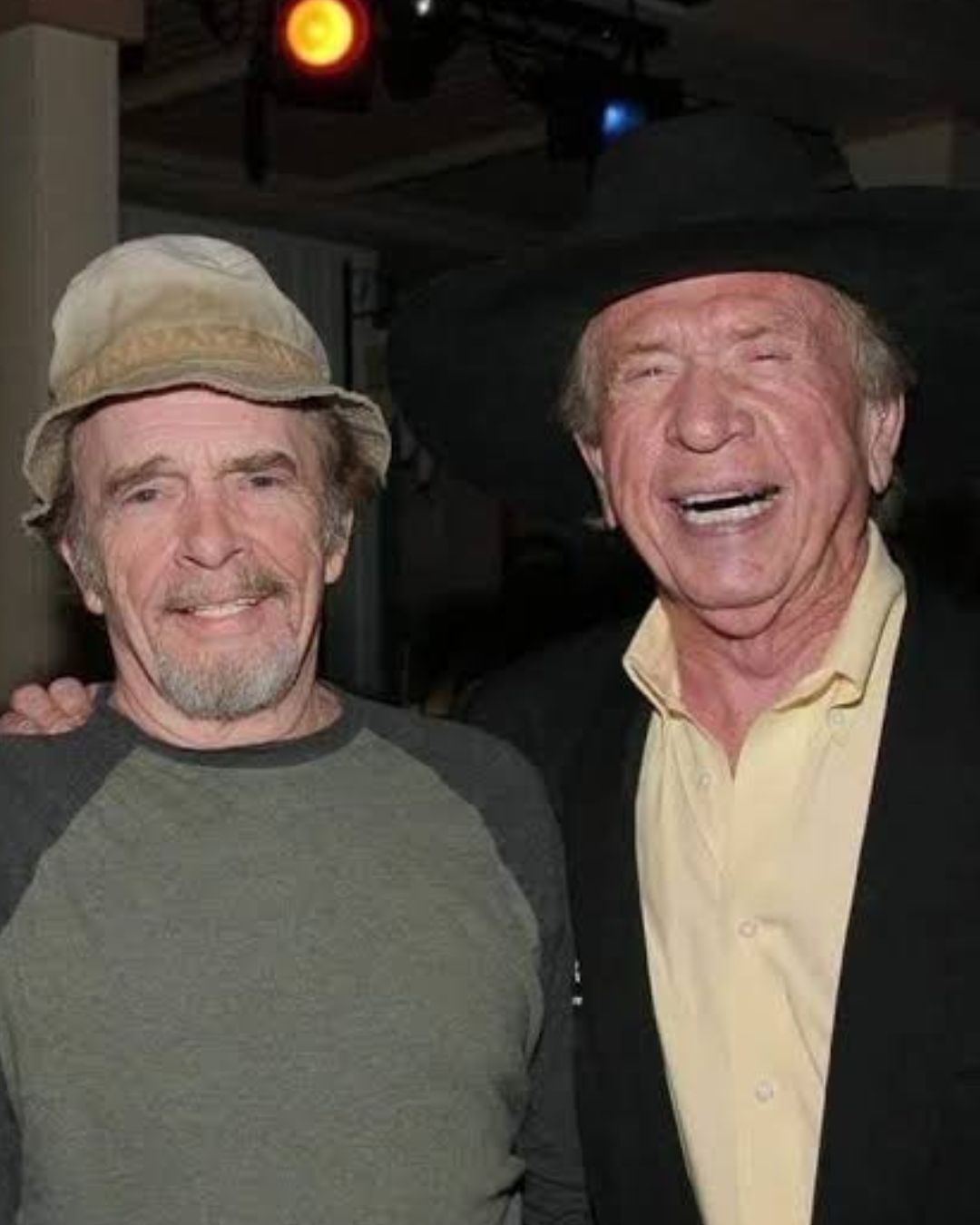
It is one of the stranger twists in Bakersfield history: the man who named the Buckaroos was Merle Haggard. Before he ever had a hit of his own, Haggard spent a short stretch playing bass behind Buck Owens and gave the band its name. A few years later, that bass player was a star in his own right, and Bakersfield had a second giant.
Fifteen Dollars and a Bus Ticket
Merle Haggard left San Quentin in 1960. Talking to Time years later, he put it simply: when he got out, they gave him $15 and a bus ticket home. Back in Bakersfield, he went to work for his brother Lowell, digging ditches and wiring houses, and he sang in the local honky-tonks at night.
A second-place finish in a local talent contest led to a job at the Lucky Spot, one of the town’s top clubs, and eventually the music paid enough to get him out of the ditches.
Buck Owens, meanwhile, was already the first real country star Bakersfield had produced. When Buck built his road band in the early 1960s, Merle Haggard was one of its first bass players. He suggested the name “Buckaroos,” and it stuck. When he left to chase his own career, Doyle Holly took over the bass.
Touring the Bakersfield Sound exhibit at the Country Music Hall of Fame in 2012, Haggard joked that he had spent much of his early career filling jobs Buck Owens had just vacated.
Learning From the Man Ahead of Him
Haggard also played bass for Wynn Stewart in Las Vegas, where he talked Stewart into giving him “Sing a Sad Song.” It reached No. 19 on the Billboard country chart. “(My Friends Are Gonna Be) Strangers” went to No. 10, and he named his new band the Strangers after it. He never hid where his sound came from.
“Wynn’s sound was what influenced Buck and me both.” — Merle Haggard
Buck Owens was the other teacher. As the liner notes to Haggard’s box set Down Every Road recall, Buck was the only person Haggard’s circle knew personally who had real success, so they patterned much of their work on his advice, down to how a harmony part should accent a line.
The Song Buck Wanted
The turning point came with a song Merle Haggard had written himself, “Swinging Doors.” According to Haggard’s official biography, Buck Owens asked to record it. That request made Merle take a hard second look at his own song. If Buck Owens wanted to cut it, he reasoned, it had to have real merit.
So he kept it. Released in February 1966, “Swinging Doors” went to No. 5. His next single, “The Bottle Let Me Down,” went to No. 3, and the album that carried both songs topped the Billboard country albums chart for two weeks, his first No. 1 album.
Buck did get his turn eventually. Years later he cut his own “Swinging Doors” at his Bakersfield studio, and it finally surfaced on a 2013 collection of previously unreleased Buck Owens covers.
The Rumors About Bonnie
Most of the gossip ran through Bonnie Owens. She married Buck Owens as a teenager, had two sons with him, and the marriage was over by the early 1950s. She married Merle Haggard in 1965, roughly a dozen years after her divorce from Buck, and became his harmony singer.
Randy Poe, who built Buck’s posthumous autobiography Buck ‘Em! from nearly 100 hours of Buck’s taped recollections, called the idea that Merle took Buck’s wife one of the old wives’ tales. Buck and Bonnie had been divorced for years when Merle came along, and all three stayed on friendly terms.
What was real was business, and two very different personalities. Buck’s publishing company signed Merle as a writer. Merle, for his part, could needle Buck in public. Talking about playing Buck’s Bakersfield club, the Crystal Palace, in 2000, he laughed that Buck was “awful gosh darn cheap” and called him “a real tough businessman.” In the recollections he taped for his book, Buck admitted the friendship had never been easy.
“I really tried really hard to be Merle’s friend, but I just don’t know if he really wanted me to.” — Buck Owens
Then he added that Merle would probably say the same thing about him.
One Night at the Fairgrounds
On June 16, 1995, the two men finally shared a hometown stage at the Bud Light Country Jam, Kern County Fairgrounds. The Bakersfield Californian put the gap at nearly three decades; photographer John Harte, who covered the night, wrote 25 years. The pavilion held hundreds, not thousands, and people packed in.
Before the show, a reporter from The Nashville Network interviewed them on Merle’s bus and asked them to define the Bakersfield Sound. Buck answered, “It’s what Merle and I do.” Merle nodded and said, “Good answer.”
The night was not smooth. It doubled as a video shoot for Merle’s “Beer Can Hill,” and the repeated takes tested the crowd. Buck and the Buckaroos played first. According to Los Angeles Times writer Peter H. King, Merle hit the stage 45 minutes late and got a cooler welcome than Buck. His answer, King wrote, was the music. Then Merle called Buck Owens and Dwight Yoakam up to join him.
Yoakam told the crowd the two men had a profound effect on his musical life. The three of them sang “Streets of Bakersfield” together. One local singer in the audience remembered Buck laughing as he helped Merle with a new verse Buck had written for the song. Bakersfield musician Monty Byrom, who was there, said Buck had clearly mellowed and had tremendous respect for Merle.
The Letter
Buck Owens died in March 2006. According to Randy Poe, near the very end of his life Buck wrote Merle Haggard a letter about how much Merle had meant to him, and it was something Merle was very proud to have received.