Scroll to the end of the article to hear the song.
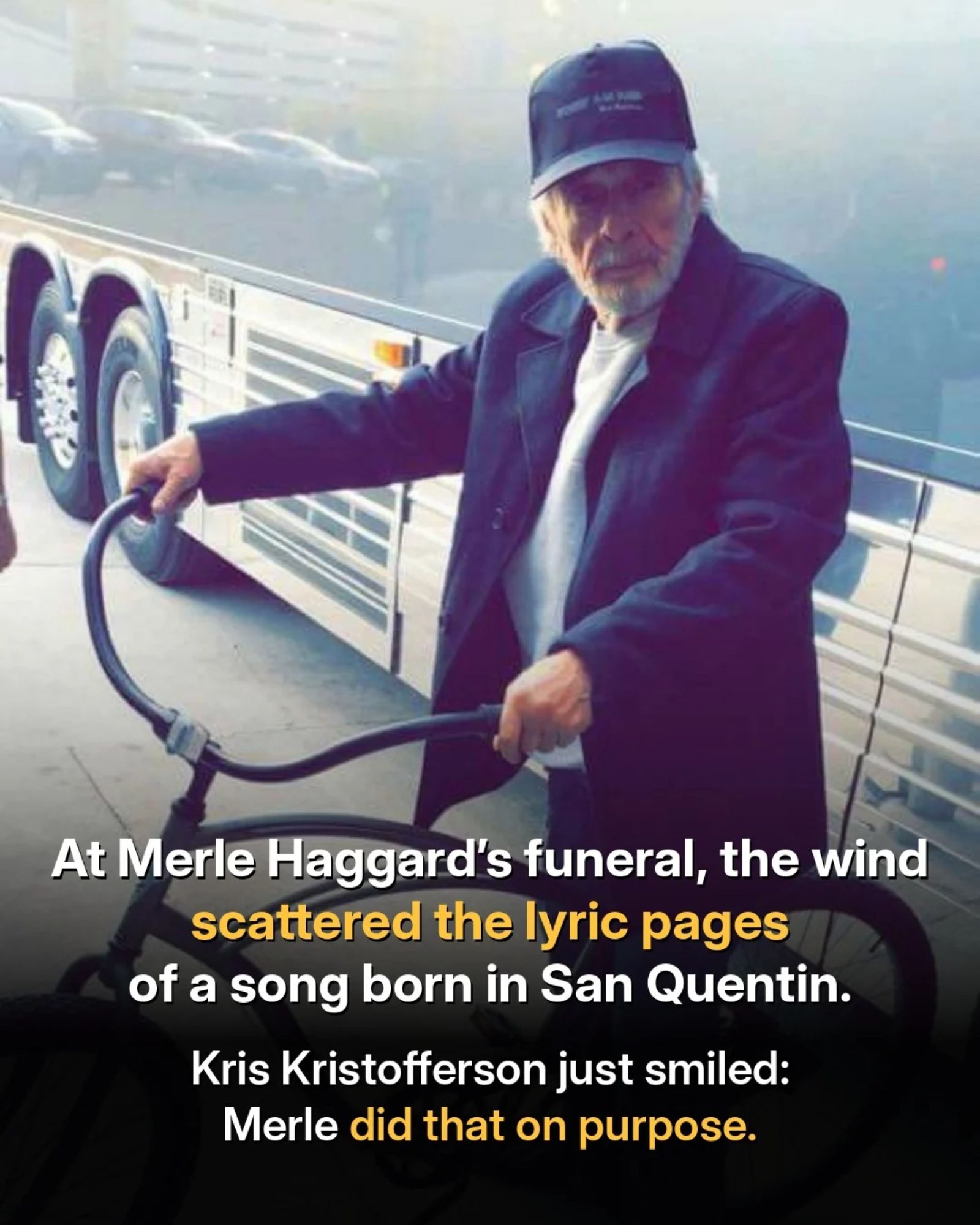
On April 9, 2016, family and old friends gathered at Merle Haggard’s ranch near Palo Cedro, California, to say goodbye. Merle Haggard had died three days earlier, on his 79th birthday, and he had planned the service himself. His beloved tour bus, the Silver Chief, stood behind the crowd. Marty Stuart led the ceremony. Then Kris Kristofferson stepped forward to sing “Sing Me Back Home.”
As he sang, a gust of wind scattered the pages holding the lyrics. Kris Kristofferson smiled and said Merle had done that on purpose.
Anyone who knew where that song came from understood why the moment hit so hard. “Sing Me Back Home” was never just another hit. It was a song Merle Haggard wrote for a friend he lost inside San Quentin.
A Young Man in San Quentin
In the late 1950s, Merle Haggard was a restless kid from Bakersfield who kept running into trouble with the law. After a failed robbery, he ended up in San Quentin, California’s oldest prison and the home of its death row. There he met an inmate everyone called Rabbit, a man named James Kendrick who was serving time for bank robbery.
The two became friends. As Merle Haggard recalled in his 1981 autobiography, Rabbit told him he could be somebody someday.
The Escape Merle Haggard Didn’t Join
Rabbit had a plan to get out, and he offered Merle Haggard a place in it. In Merle Haggard’s telling, the plan involved hiding inside a large desk that inmates were building for a judge, which would be carried right out of the prison. In the end, the two agreed it was better for Merle to stay behind.
Rabbit made it out, but his freedom did not last. On a highway near Victorville, California Highway Patrol officer Richard Duvall pulled his car over. Rabbit shot and killed the 26-year-old officer. Six days later, he was captured at a motel in Shell Beach.
A Walk Merle Haggard Never Forgot
Rabbit was brought back to San Quentin, this time to death row. As Merle Haggard told it, he went out to the prison yard to be there when his friend returned. It was all he could do.
Merle Haggard was paroled in 1960. On November 3, 1961, Rabbit was executed in the San Quentin gas chamber. He was 31.
In a 1977 Billboard interview, Merle Haggard said that seeing someone you know make that last walk leaves a feeling you never forget.
Turning a Hallway Into a Song
Back in Bakersfield, Merle Haggard poured his past into his music. Released in late 1967, “Sing Me Back Home” became the title track of his 1968 album and reached No. 1 on the country chart.
The song follows a condemned man as the warden leads him down the corridor. He stops and asks a friend who plays guitar for one more song, one last trip back to the life he lost. Later, visiting singers come to the prison on a Sunday, and he asks them for a song his mother used to sing.
That guitar-playing friend was Merle Haggard. In the song, he gave himself the one role he could not play in real life: the man who could still offer comfort at the end.
“It’s still for Rabbit and all those like him.” Merle Haggard
The Song Comes Back for Merle Haggard
For decades, Merle Haggard sang “Sing Me Back Home” on stages across America, and he said it was always for Rabbit.
Then, on a windy afternoon in 2016, it was sung for Merle Haggard himself. A song about a man asking for one last tune before the end had become the farewell for the man who wrote it.
Maybe it was only the wind that carried those pages away. Kris Kristofferson chose to believe it was Merle Haggard, getting the last word one more time. Either way, the song had come full circle, from a prison yard in 1960 to a quiet ranch in Northern California.