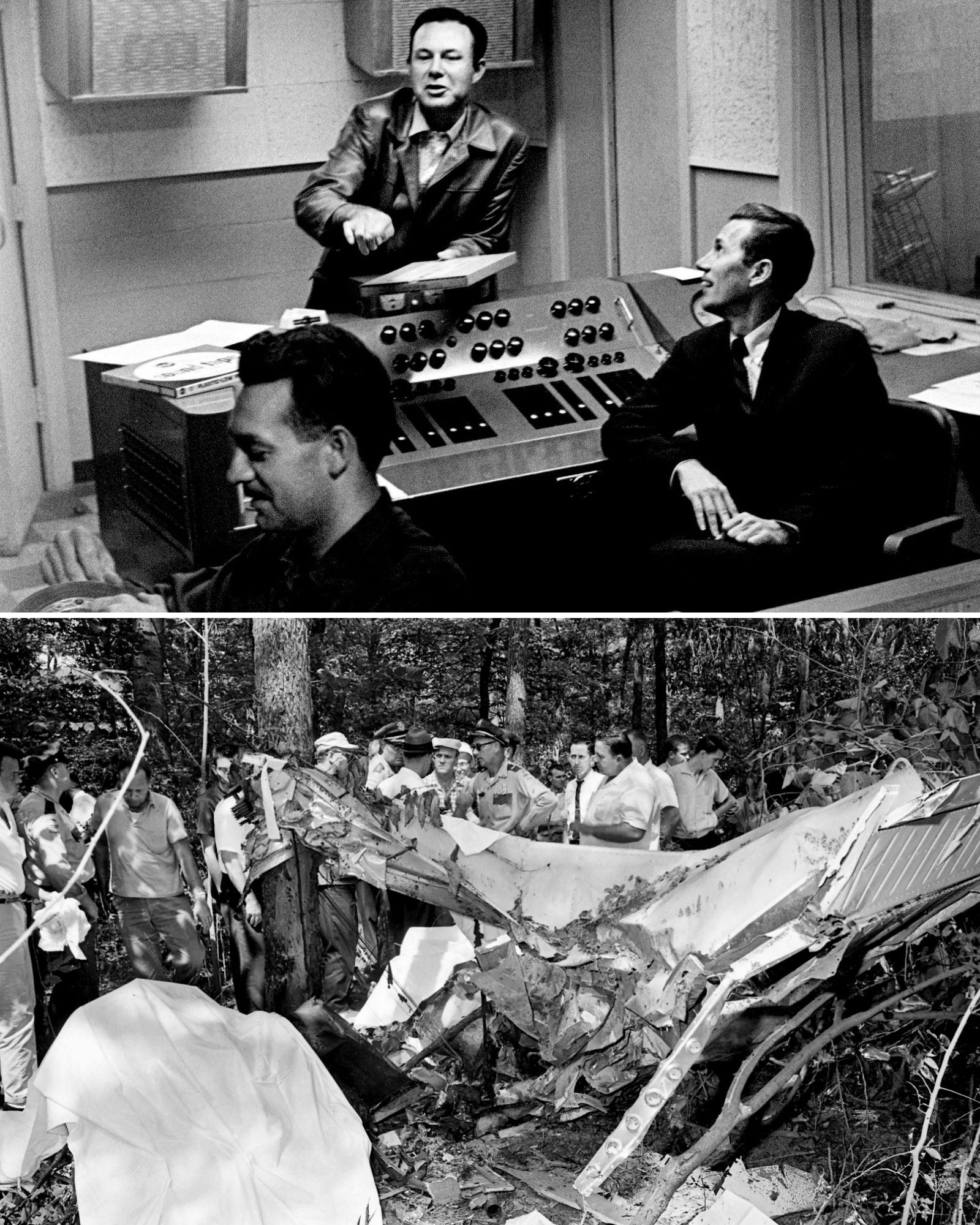
In 1966, two years after Jim Reeves was killed in a plane crash outside Nashville, “Distant Drums” reached No. 1 in Britain and stayed there for five weeks. It also spent four weeks at the top of the American country chart. Reeves had never planned to release it. He recorded it at home, as a favor to a friend, after his own producer decided it was not a hit.
A Song His Producer Passed On
The friend was Cindy Walker, the Texas songwriter behind “You Don’t Know Me” and “Dream Baby.” Reeves had already recorded several of her songs, and “Anna Marie” had been a hit for him in 1957.
In October 1961, Walker came to Nashville for the annual country music disc jockey convention, hoping to place some new material. She played Reeves two songs, “A Letter to My Heart” and “Distant Drums.” He liked both and took them to Chet Atkins at RCA. Atkins agreed to record “A Letter to My Heart.” He was not sold on “Distant Drums” and decided not to cut it.
The Demo He Gave Away
Reeves still believed in the song. He recorded a demo of it in his home studio, with members of his band, the Blue Boys, backing him. Then he gave a copy to Walker and told her she should have no trouble getting someone else to record it.
He was right. Roy Orbison heard the demo while going through a batch of Walker’s songs in the Nashville office of publisher Wesley Rose. Orbison later remembered the moment simply.
“Distant Drums just jumped out at me.”
Orbison recorded it on January 4, 1963, and it came out as a B-side. As far as Reeves was concerned, his part in the song was over.
The Last Flight
On Friday, July 31, 1964, Reeves was flying home from Batesville, Arkansas, where he had been working on a land deal. He was at the controls of his own single-engine Beechcraft Debonair. His only passenger was Dean Manuel, 30, his pianist and road manager.
Over Brentwood, Tennessee, a few miles south of Nashville, the plane flew into a violent thunderstorm. Radio contact was lost a little before 5 p.m. The usual explanation is that Reeves lost sight of the ground in the rain and became disoriented, though some later accounts, including Larry Jordan’s biography, have questioned parts of that version. The plane came down in thick woods only about five miles from the airport.
Hundreds of volunteers searched the woods for two days, among them Eddy Arnold, Chet Atkins, Ernest Tubb, Marty Robbins and Stonewall Jackson. On the morning of Sunday, August 2, about 42 hours after the crash, a Civil Defense searcher found the wreckage a few hundred feet from a house near Franklin Road. Reeves was 40.
Only days before the flight, Reeves had made one last recording in that same home studio, alone with an acoustic guitar. The song was called “I’m a Hit Again.” It was not released until 2003.
What Mary Found
The charts did not wait. “I Guess I’m Crazy,” a single released in June, reached No. 1 on August 29, less than a month after the crash, and held the top spot for seven weeks.
Reeves’ widow, Mary, began going through what he had left behind with RCA. According to CMT, he had put aside a store of demos, promotional recordings and unreleased sides, as a kind of insurance for her. Fans wanted anything new, and the search turned up the old home demo of “Distant Drums.”
Atkins, the producer who had passed on the song years earlier, now worked on it, adding new accompaniment and lush strings in sessions in March 1965 and February 1966. The album notes at the time suggested it had been a studio recording Atkins had simply shelved. As writer Alan Cackett later pointed out, RCA’s own files show no such session, only the demo and the version built on top of it.
Number One in 1966
“Distant Drums” was released on March 8, 1966. In the song, a young man hears war coming and asks the woman he loves to marry him before he is called away. Her name in the song is Mary, the same name as his widow.
RCA judged that the Vietnam War gave the song a ready audience, and it was right. The single went to No. 1 on the country chart for four weeks. In Britain it reached No. 1 on September 22, 1966, held the top for five weeks and stayed on the chart for 25. The BBC named it song of the year, and Reeves became the first American artist to receive that honor. It was his only No. 1 in Britain.
Twenty More Years
“Distant Drums” was one of six posthumous No. 1 country singles for Reeves, out of 11 in his career. Even after the supply of unreleased songs slowed, Mary kept finding ways to bring his voice back. She approached Owen Bradley, Patsy Cline’s producer, with the idea of pairing her husband with Cline, who had died in a plane crash in 1963. Their electronically joined “Have You Ever Been Lonely?” used a vocal Reeves had recorded in November 1961. It reached No. 5 on the country chart in January 1982. The last Jim Reeves single to chart, “The Image of Me,” arrived in 1984, twenty years after the crash.
Mary Reeves ran the Jim Reeves Museum in Nashville from the mid-1970s until 1996. On the 15th anniversary of his death, she summed up her work in one line to a country music magazine.
“Jim Reeves my husband is gone; Jim Reeves the artist lives on.”
She died on November 11, 1999. By then, the song he had once handed away was the one much of the world remembered him by.