Scroll to the end of the article to hear the song.
In October 2001, the Country Music Hall of Fame inducted twelve new members at a dinner in Nashville. One of them didn’t come. Waylon Jennings, the original outlaw of country music, sent his son Buddy Jennings to accept the honor for him.
Officially, Waylon Jennings was sick. Some people in town said he felt the honor had come far too late. When reporters asked him about it, he didn’t pretend.
“Absolutely nothing, if you want to know the truth about it.”
That was what the Hall of Fame meant to him, he said. Waylon Jennings did care deeply about one achievement, though, and it never showed up on a chart or a trophy shelf. It came from a high school equivalency test he took at 52, and from a little boy who sat beside him at the kitchen table.
The Boy Who Was Told to Leave
Long before the black hat and the leather, Waylon Jennings was a restless teenager in Littlefield, Texas. By 16 he had piled up so many disciplinary run-ins that the school superintendent talked him into dropping out. He went to work at his father’s store, took odd jobs, and chased music on local radio.
The music worked. Over the next few decades Waylon Jennings collected 16 No. 1 country hits, won Grammy and CMA awards, and helped invent a sound that Nashville never managed to tame. He was also the voice of The Dukes of Hazzard, heard in living rooms across America.
The Outlaw Years
The outlaw image wasn’t only marketing. Waylon Jennings later said he spent 21 years on drugs, and at the worst point his cocaine habit cost him about $1,500 a day.
On August 23, 1977, federal agents raided a Nashville studio during one of his recording sessions after a package of cocaine was traced there. In the confusion the drugs disappeared, and the charges were later dropped because the warrant was faulty. Waylon Jennings turned the whole mess into a hit song: “Don’t You Think This Outlaw Bit’s Done Got Out of Hand.” The title said what plenty of people were already thinking.
A House in the Desert
In April 1984, Waylon Jennings rented a house in Arizona for himself, his wife Jessi Colter and their young son, Shooter Jennings. Then he quit cocaine cold turkey, with no clinic and no farewell tour. He later said Shooter was the main reason he never went back.
Being clean didn’t make life easy. His health was failing, and heart surgery forced him to slow down for the first time in years. While he recovered, he had time to think, and one thing kept bothering him.
Practicing What He Preached
He had been telling Shooter Jennings, over and over, that quitting school was the worst mistake he ever made. Yet here he was, a famous man without a diploma. He felt the advice was just words.
“I never did like folks who didn’t practice what they preached.”
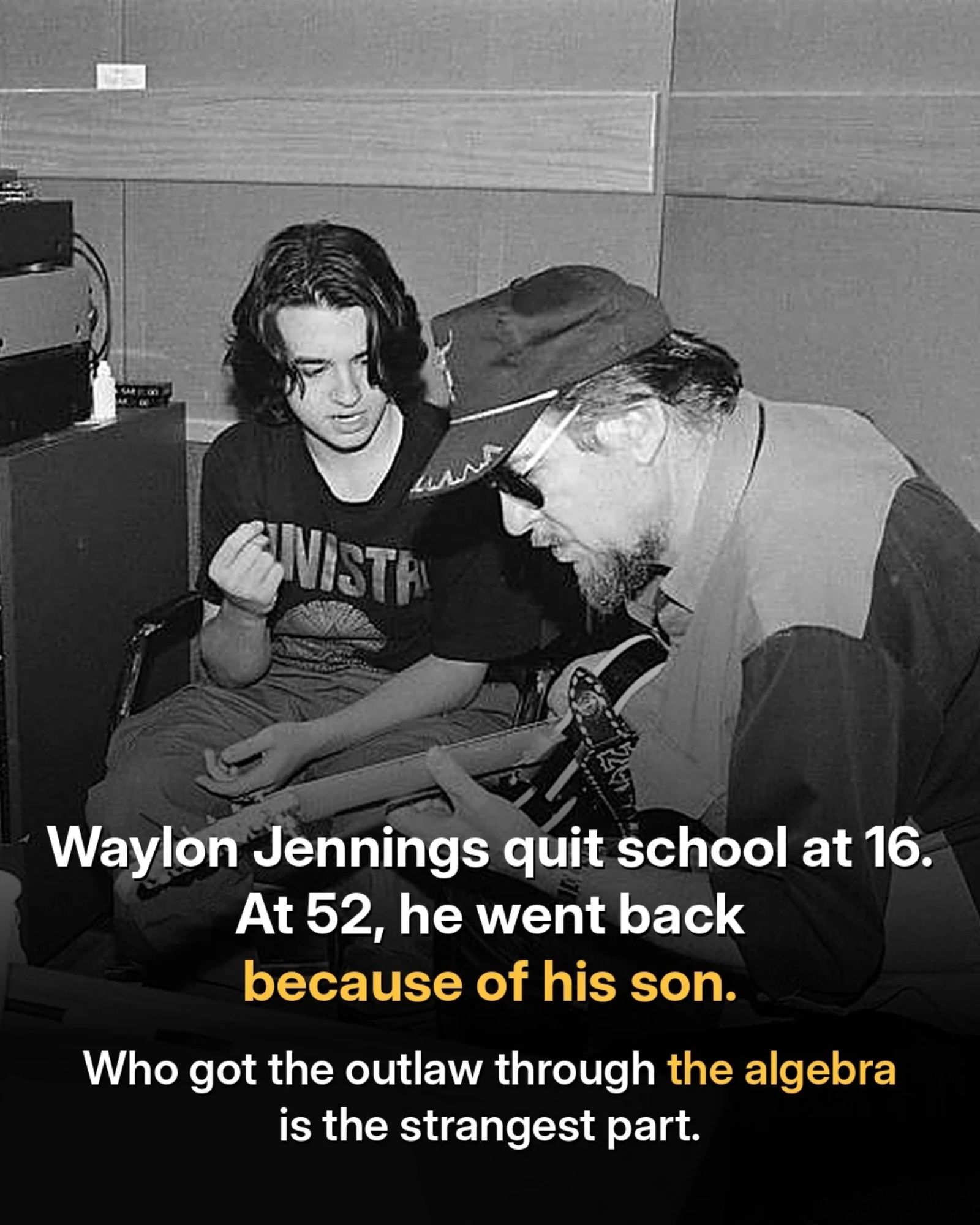
So in 1989, at 52 years old, Waylon Jennings sat down to earn his GED.
The surprising part is who helped him. When he got stuck on fractions and algebra, his tutor was Shooter Jennings, then about 10 years old. The boy he was trying to set an example for ended up helping his father through the math.
“I did it for me and I did it for my son.”
He called it one of the biggest accomplishments of his life. Afterward he became a spokesman for the GED program and encouraged kids to stay in school. In 1993 he released Cowboys, Sisters, Rascals & Dirt, a children’s album, and he had already sung alongside Big Bird on “Ain’t No Road Too Long.”
The Last Nights
By 2000, diabetes had made walking hard. On January 6 of that year, Waylon Jennings played the Ryman Auditorium in Nashville sitting on a stool, and he joked with the crowd about it.
“I guess y’all noticed I’m sittin’ on this chair, and that ain’t all old age.”
It turned out to be his last full concert. In December 2001, doctors in Phoenix amputated his left foot. On February 13, 2002, Waylon Jennings died peacefully at his home in Chandler, Arizona. He was 64.
More Than One Chapter
Years later, Shooter Jennings played his father in the film Walk the Line, and he went on to build his own career in music.
Most people remember Waylon Jennings for the raid, the attitude and the empty seat at the Hall of Fame dinner. He was also a dropout who went back to school at 52 because he didn’t want to tell his son one thing and do another. The outlaw who never cared for awards was proud of a certificate he earned with a 10-year-old helping him through the algebra.