Scroll to the end of the article to hear the song.
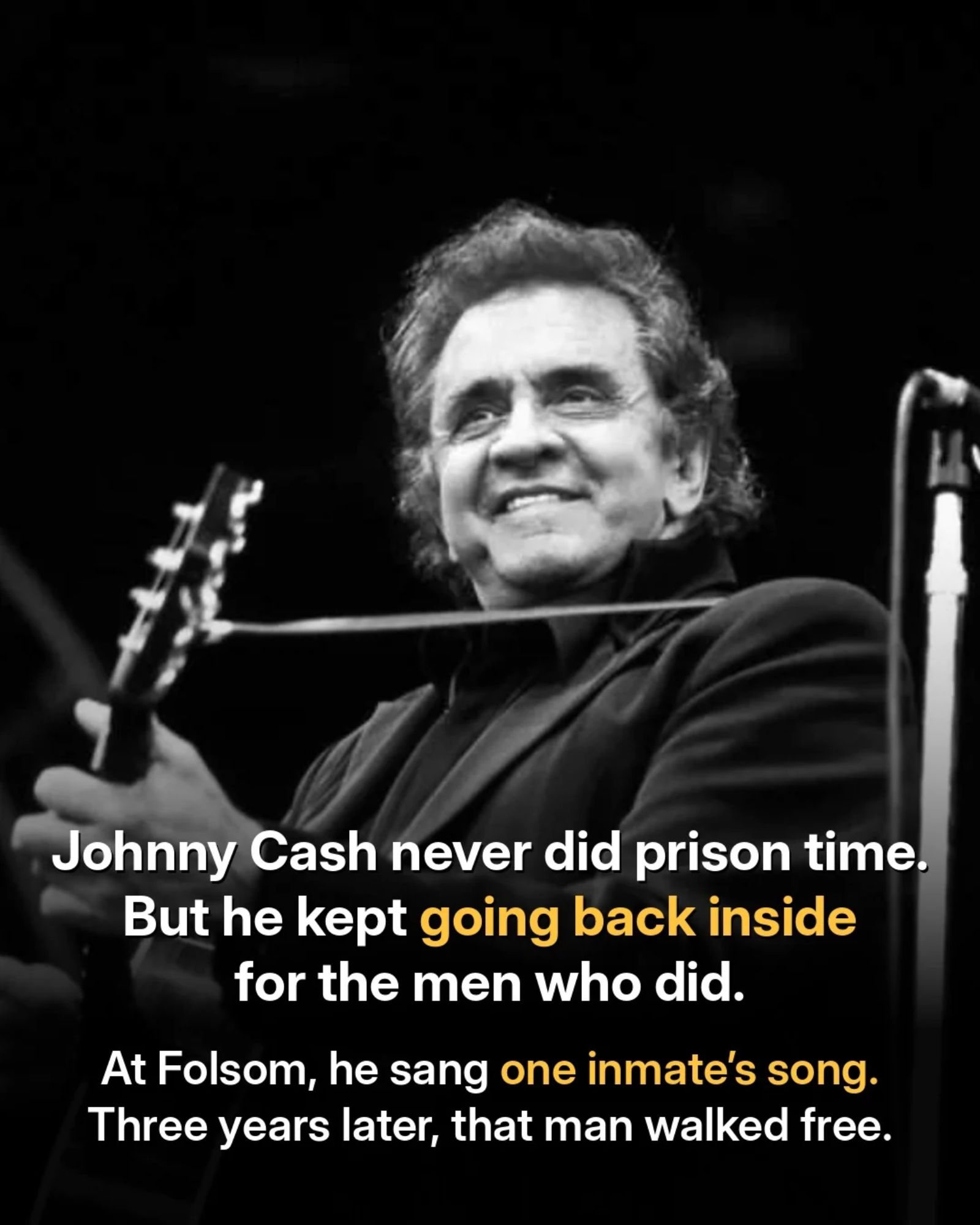
Most people picture Johnny Cash in black, a guitar across his chest and a crowd of inmates cheering him on. Because of that picture, a lot of people assume he served time himself. He didn’t. Johnny Cash was arrested seven times, mostly for minor offenses tied to pills and alcohol, and he spent a few nights in local jails. He was never sentenced to prison.
Those few nights still taught him something. He knew how quickly one bad stretch could swallow a man, and he spent much of his life going back for the men it had swallowed.
A Tape Handed Over the Night Before
In January 1968, Johnny Cash’s career was struggling. He was about to record a live album inside Folsom State Prison in California. The night before the show, his friend Reverend Floyd Gressett came to see him. Gressett often preached to the men at Folsom, and he brought a cassette tape that an inmate had recorded.
The inmate was Glen Sherley, who was serving time for armed robbery. He had written a song about the granite chapel that stands inside Folsom’s walls. Johnny Cash listened to it and made up his mind right away: he wanted to record it. He and his band rehearsed it that night.
“Hope We Do Your Song Justice, Glen”
On January 13, 1968, Johnny Cash walked into the prison’s mess hall, where the men were pounding the metal tables. Near the end of the show he told the room that the next song had been written by a man right there in Folsom Prison. Then he looked at the front row.
“This song is written by our friend Glen Sherley. Hope we do your song justice, Glen.”
Glen Sherley had no idea it was coming. The other inmates cheered and whistled while he sat there in shock. The song was “Greystone Chapel”, named after the stone house of worship inside the prison walls. Johnny Cash closed both of his Folsom shows with it, and it went out to millions of listeners on the album At Folsom Prison.
What Waited at the Gate
Johnny Cash didn’t forget the man in the front row. He pushed for Glen Sherley’s parole, and on March 7, 1971, Glen Sherley walked out of prison. Johnny Cash and June Carter Cash were waiting at the gate, and they had brought a publishing contract with House of Cash, Johnny Cash’s music company.
Within about a month, Glen Sherley was performing on Johnny Cash’s touring show. He moved to Nashville and married a woman who worked in the House of Cash office, and Johnny Cash stood beside him as best man. When Johnny Cash went to Washington in 1972 to speak about prison reform, Glen Sherley testified there as well.
He Kept Coming Back
Folsom was not a one-time stunt. Years earlier, Johnny Cash had played a New Year’s Day show at San Quentin, and a young inmate named Merle Haggard was in the audience. Merle Haggard later said that show helped turn his life around. In 1969 Johnny Cash went back to San Quentin to record another live album, and he also visited Cummins Prison in Arkansas. On July 26, 1972, he testified before a U.S. Senate subcommittee. He asked lawmakers to keep young people out of jail and to give first offenders a real chance to rebuild their lives.
The Chapter Nobody Tells
Life on the outside turned out to be harder than anyone had hoped. Glen Sherley had spent much of his adult life behind bars, and the adjustment was hard for him. In time Johnny Cash felt he had to let him go from the tour and from House of Cash. Glen Sherley’s struggles got worse, and in May 1978 he died by suicide. He was 42 years old.
Johnny Cash offered to pay for the funeral. His daughter Tara later said her father was devastated. He had believed that a good job and a little faith could keep a man steady, and losing his friend hurt him deeply.
The Visitor Who Never Stopped Returning
Johnny Cash’s own health declined in his last years. On July 5, 2003, he gave his final public performance at the Carter Family Fold in Hiltons, Virginia. He died on September 12, 2003, at age 71, from complications of diabetes.
He was never the convict. He was the man who kept walking back through prison gates, and once he was there waiting at the gate for a man coming out.
If you or someone you know is struggling, please reach out. In the United States, you can call or text 988 to reach the Suicide & Crisis Lifeline.