Scroll to the end of the article to hear the song.
On a summer night in 1969, the cameras were rolling at the Ryman Auditorium in Nashville, and Merle Haggard was about to say something on national television that most of his fans had never heard.
He was not a newcomer. By then Merle Haggard had a run of No. 1 country hits and a voice people trusted. He was a guest on The Johnny Cash Show, the ABC variety hour Johnny Cash taped at the Ryman, and the episode went out to living rooms across America on August 2, 1969.
What happened between the songs that night is still told to visitors who walk through the Ryman today.
A Conversation Nobody Expected
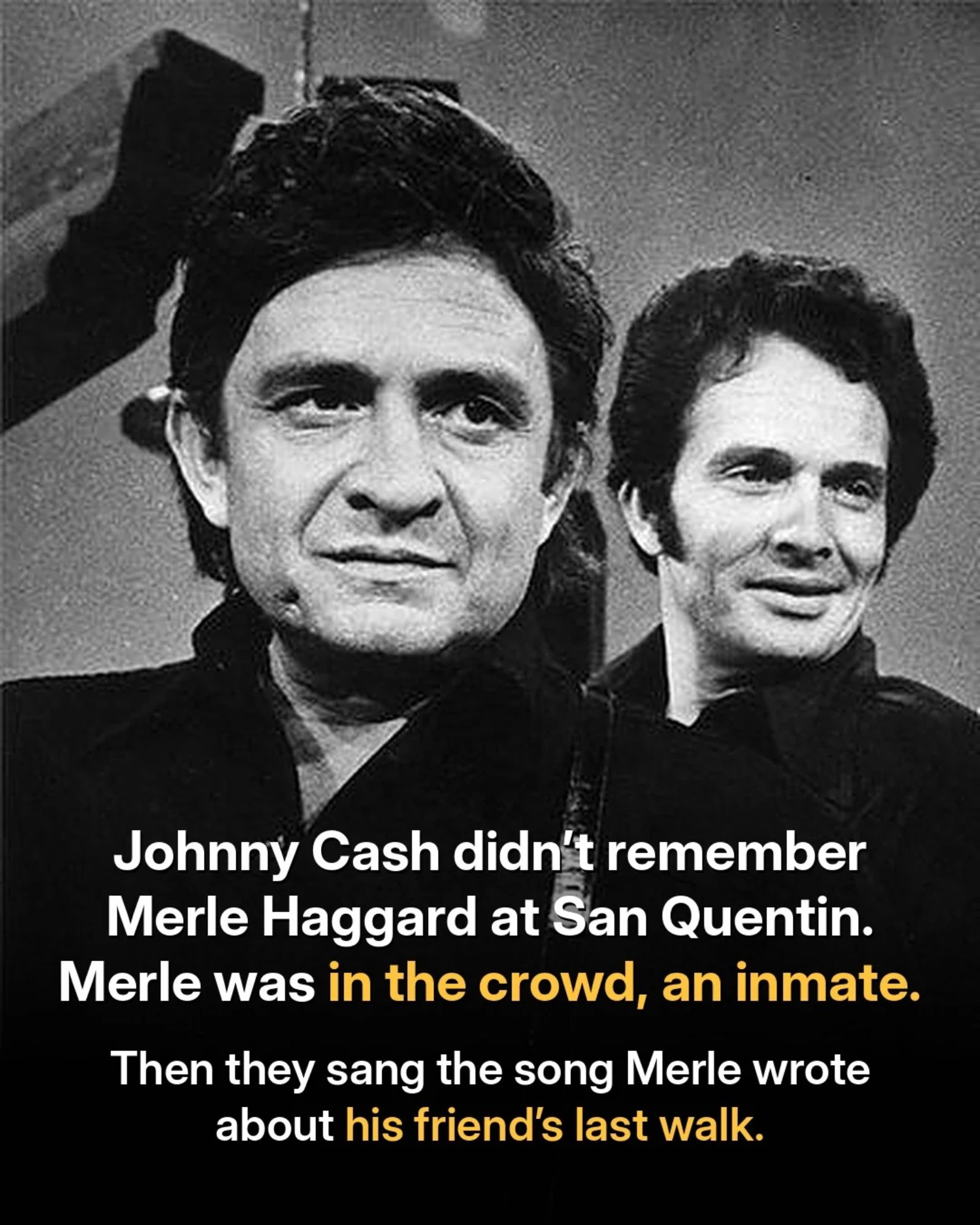
Johnny Cash brought up San Quentin, the California prison where he had played for the inmates years earlier. Merle Haggard picked up the thread and said that San Quentin was the first place he had ever seen Johnny Cash perform.
Johnny Cash said he didn’t remember Merle Haggard being part of that show. Merle Haggard’s answer turned the moment around. He hadn’t been on the stage. He had been sitting in the crowd, as an inmate.
The exact words have been passed down from memory rather than from a transcript, but the meaning has never been in doubt. A rising country star had just told the nation that he had done time in one of America’s toughest prisons.
The Show That Lit a Fire
To understand why that confession mattered, you have to go back to a New Year’s Day inside San Quentin’s walls. Merle Haggard was a young man in serious trouble, serving time after a botched robbery. Johnny Cash came in with his guitar and played for men most of the world had written off.
Merle Haggard never forgot it. Years later he said the show “set a fire under me that hadn’t been there before.” He decided he wanted a different life, and when he walked out of prison he went after music with everything he had.
So when he sat on that television stage beside the man who had sparked it all, the past and the present were suddenly in the same room.
The Duet
That same episode, Merle Haggard sat down next to Johnny Cash for a duet on one of his own songs, one he had written alone. It was not a random choice from his catalog. It came straight out of San Quentin too.
The Story Behind the Song
Inside San Quentin, Merle Haggard knew an inmate named Jimmy “Rabbit” Kendrick. As Merle Haggard later recounted in his autobiography, Rabbit planned an escape and invited him along. Merle Haggard chose to stay behind.
Rabbit got out, but his freedom did not last. He killed a California Highway Patrol officer, was caught, and was sent to death row. In November 1961, Merle Haggard watched his friend take his final walk through the prison. Rabbit was executed in San Quentin’s gas chamber.
That walk stayed with him. Out of it came a song told from inside a cell: a condemned man is led down the hallway, and his last wish is that a fellow prisoner who plays guitar play him a song he used to know, so his old memories can come alive one more time. The man with the guitar, telling the story, is the one left behind.
The Answer: “Sing Me Back Home”
The song was “Sing Me Back Home,” written by Merle Haggard and released with The Strangers in November 1967. It became his third No. 1 country hit and remains one of the most haunting songs in country music.
On that 1969 broadcast, the song took on a meaning it had never had on the radio. Listeners had always heard it as a story. Now they knew the man singing it had actually lived in those cell blocks. The guitar player in the song was not just a character. In a way, it was Merle Haggard himself.
That night, the man with the guitar finally told the country who he was.
What Came After
The reaction was not all warm. ABC heard from viewers who were unhappy that a former convict had been given a national stage. But the noise faded fast. Merle Haggard kept climbing, and his honesty about where he came from became part of why people believed every word he sang.
Johnny Cash had encouraged him to stop hiding that chapter. Merle Haggard took the chance, and instead of ending his career, it gave his songs a truth nobody could fake.
Some people leave prison behind. Merle Haggard carried it with him, turned it into music, and on one summer night in Nashville, he finally said it out loud.
Which Merle Haggard song means the most to you?