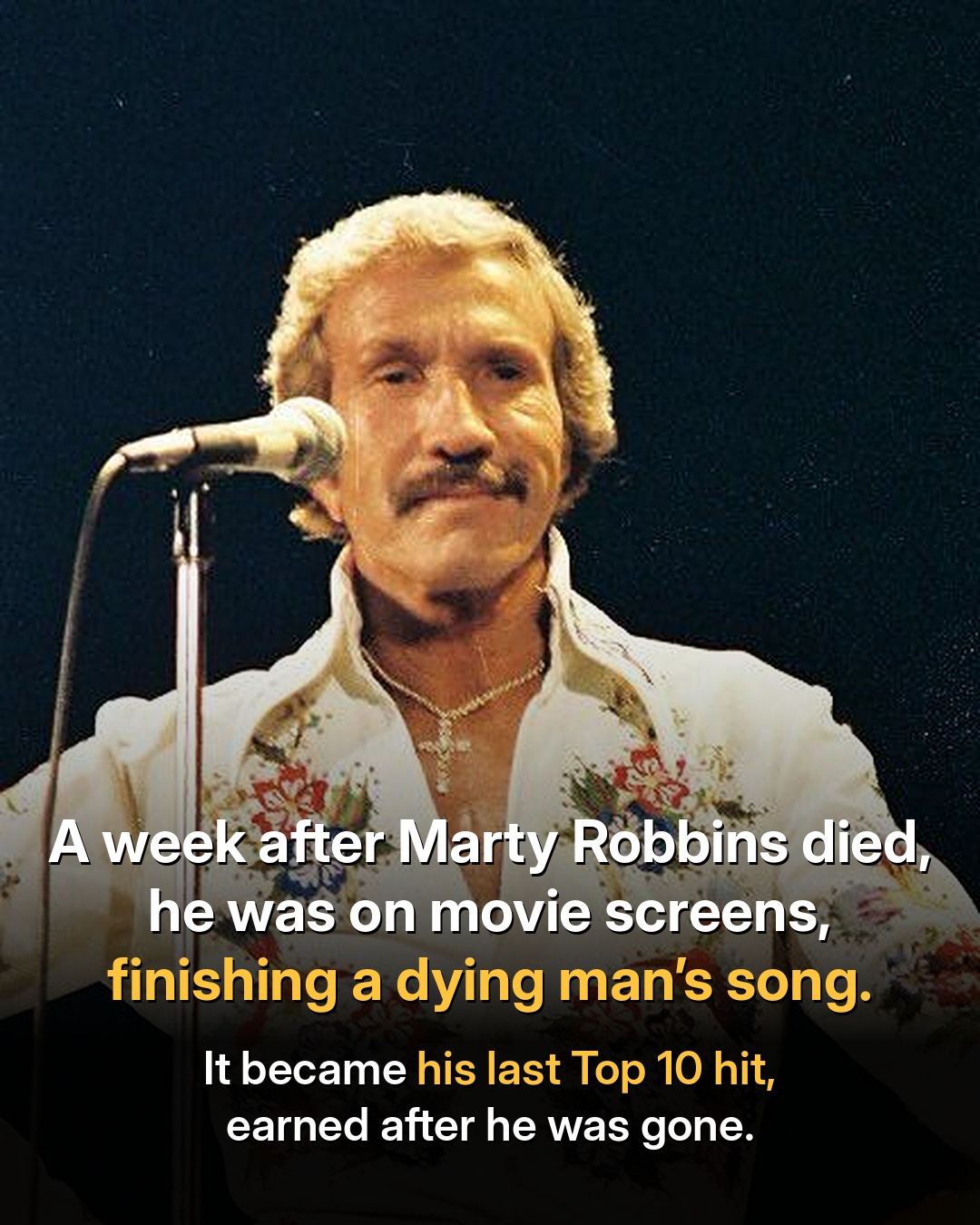
Marty Robbins died on December 8, 1982, at 57. One week later, moviegoers watched him walk up to a microphone and sing. A few weeks after that, the song he sang in that scene was climbing the Billboard country chart without him. It was called “Honkytonk Man,” and its story is one of the strangest and most moving goodbyes in country music.
A Legend Who Never Slowed Down
By 1982, Marty Robbins had nothing left to prove. His Western ballad “El Paso” earned the first Grammy ever given to a country-western singer, and he won a second Grammy for “My Woman, My Woman, My Wife.” The Academy of Country Music named him its Man of the Decade for the 1960s. He wrote more than 500 songs and was a fixture of the Grand Ole Opry for nearly three decades.
He also loved speed. Marty Robbins raced stock cars in NASCAR, and starting in 1965 he took the Opry’s last segment so he could head straight to the Nashville Speedway afterward. When the Opry left the Ryman Auditorium in 1974, he was the last performer on the old stage and the first on the new one.
A Heart That Had Already Warned Him
His heart had been sending warnings for years. Marty Robbins had his first heart attack in 1969 and underwent bypass surgery in early 1970, when the operation was still considered experimental. He recovered and went back to recording, touring, and racing. A second heart attack came in 1981, and he still kept going.
The Hall of Fame Surprise
On October 11, 1982, Marty Robbins was inducted into the Country Music Hall of Fame. His friend Eddy Arnold persuaded him to attend the ceremony and kept the honor a secret until announcing it live. Marty Robbins looked genuinely stunned. He told the audience he had never expected it and believed other artists deserved it before him.
Less than a month later, on November 7, 1982, he drove his final NASCAR race, the Atlanta Journal 500, in a Buick Regal built by Junior Johnson.
Six Days in December
On December 2, 1982, Marty Robbins had his third heart attack. Doctors performed a quadruple bypass. Afterward he was able to smile and squeeze a nurse’s hand, and for a moment there was hope. But his condition worsened. He died on December 8 at St. Thomas Hospital in Nashville. Around 1,500 people came to his funeral.
He had been honored as a legend while he was alive to hear it. Eight weeks later, he was gone.
The Film That Arrived One Week Too Late
Earlier that year, Marty Robbins had filmed a small role in Clint Eastwood’s Honkytonk Man. Eastwood plays Red Stovall, a struggling singer in the Great Depression who is dying of tuberculosis and gets one last chance to make a record. Marty Robbins plays Smoky, a session guitarist in the studio.
During the recording session, Red’s illness overwhelms him and he can’t finish the title song. Smoky steps up and sings the rest for him. It’s a quiet, generous moment, one professional helping another finish the work.
The film opened on December 15, 1982, one week to the day after Marty Robbins died. Audiences watched a man they had just lost finish the last song of a character who was dying. Nobody had planned it that way, which is part of why the scene hit so hard.
A Hit He Never Saw
His studio recording of “Honkytonk Man,” written by Dewayne Blackwell, entered the Billboard Hot Country chart in late December 1982 at No. 69. Over the next weeks it kept climbing: No. 18, then No. 15, then No. 12, and finally No. 10 in early 1983. It became the last Top 10 hit of his career, and its whole run on the chart happened after he died.
In 1983, Marty Robbins also received three honors at the Music City News Country Awards, including Single of the Year for “Some Memories Just Won’t Die.” Country music was still celebrating him months after his passing.
Why the Song Still Hurts a Little
On paper, “Honkytonk Man” is a movie theme about a drifter who lives for smoky bars, late nights, and the open road. Before December 1982, that’s all it was. After December 1982, it sounded like Marty Robbins taking one last bow without knowing it was the last.
That’s why so many fans still go back to it. It doesn’t sound like a farewell, and it was never meant as one. It’s just a great singer doing what he did best, one more time.
Which Marty Robbins song do you play when you want to remember him?