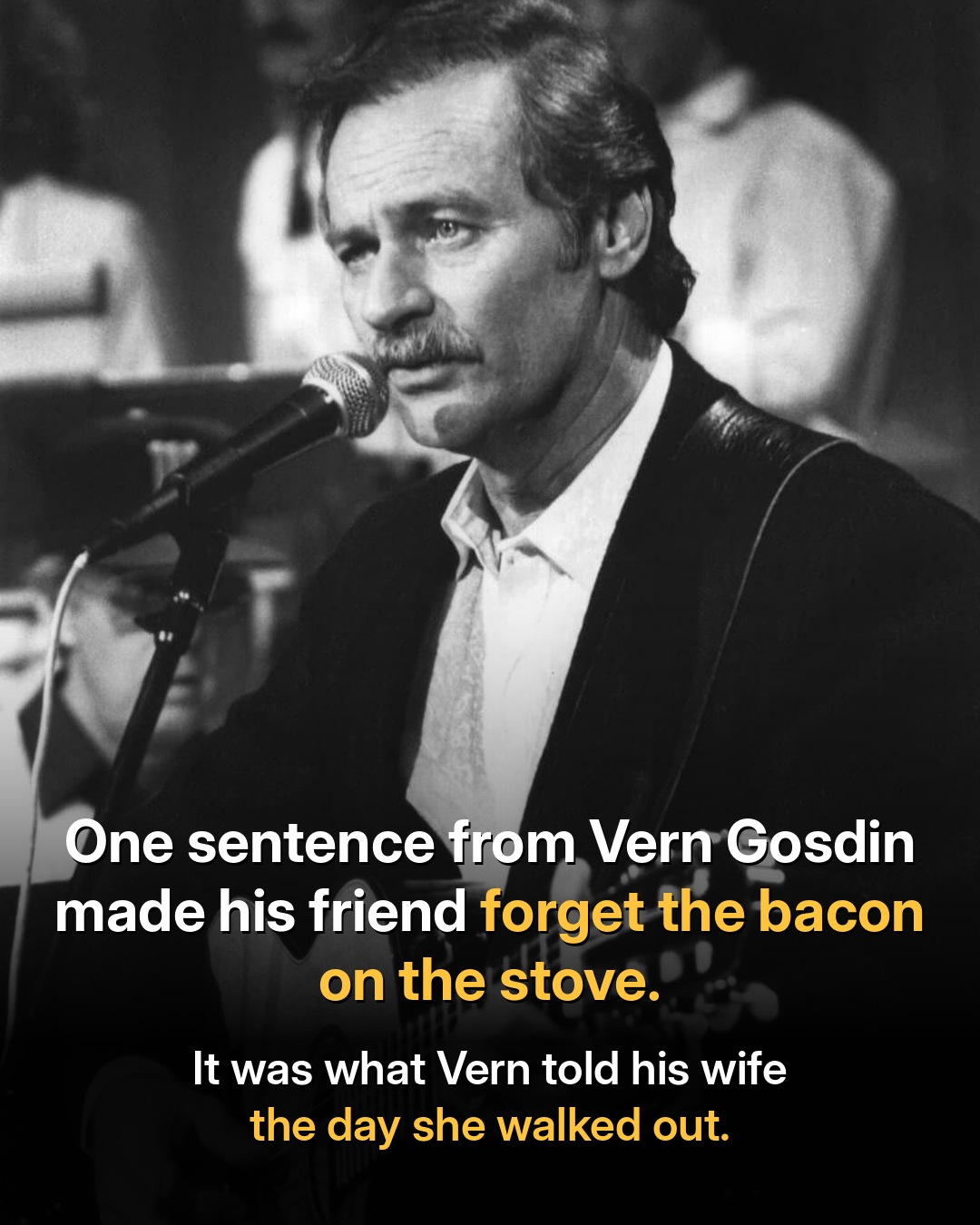
The answer is “I Guess I Had Your Leavin’ Comin'”, a song Vern Gosdin recorded and wrote with Dean Dillon and Buddy Cannon. It is the closing track on Chiseled in Stone, Vern Gosdin’s first album for Columbia Records. Most heartbreak songs are written alone late at night. This one started at a kitchen table in Nashville, over breakfast nobody ate.
A Singer Called “The Voice,” and a Marriage That Had Ended
By the mid-1980s, Vern Gosdin had been in country music for more than twenty years. He had sung harmonies on the West Coast with his brother Rex, quit the business to sell glass in Georgia, come back with Emmylou Harris singing beside him, and scored hits on small labels that struggled to get records into stores. Fans and fellow singers called Vern Gosdin “The Voice.” When Compleat Records went bankrupt, Vern Gosdin signed with Columbia in 1987.
At the same time, his home life was falling apart. Vern Gosdin’s wife, a woman he affectionately called “The Dude,” had walked out. Vern Gosdin did what many country singers do with a broken heart and went to see a songwriter.
Eggs, Bacon and One Honest Sentence
The songwriter was Dean Dillon, already one of the most trusted pens in Nashville. Vern Gosdin sat at the kitchen table in Dean Dillon’s home while Dean Dillon fried eggs and bacon at the stove. The two men talked about the woman who had gone.
Then Vern Gosdin told Dean Dillon what he had said to his wife when she left. There was no anger or accusation in it. It was a simple admission that, after everything, he might have earned her goodbye. In Vern Gosdin’s own retelling, the words were close to “Dude, I guess I had your leavin’ comin.'”
Dean Dillon heard the title of a song in that sentence. The bacon stopped mattering, and the two men began writing. When Vern Gosdin told the story in a 1988 interview in Franklin, Tennessee, he summed up the morning in one line:
“Dean forgot all about my breakfast.”
Three Names on the Credit
The finished song is credited to Vern Gosdin, Dean Dillon and Buddy Cannon. Buddy Cannon was Vern Gosdin’s close friend, neighbor and frequent co-writer. The same three men also wrote, with Hank Cochran, the jukebox anthem “Set ‘Em Up Joe.” Exactly when Buddy Cannon joined the work on this song has not been recorded. What is clear is that the song’s central idea came from Vern Gosdin’s own words about his own marriage.
A Quiet Track on a Landmark Album
“I Guess I Had Your Leavin’ Comin'” was never a big single. It sits at the end of Chiseled in Stone, the album that changed Vern Gosdin’s career. That record included “Set ‘Em Up Joe,” a No. 1 tribute to Ernest Tubb. It also included the title song, written with Max D. Barnes, which won the Country Music Association’s Song of the Year award in 1989.
Ending such a successful album with a man quietly taking the blame for his own heartbreak was very much in character. In the same 1988 interview, Vern Gosdin said he believed that something good could grow out of something bad if you looked hard enough. His next album, Alone, released in 1989, went even further. It traced the end of Vern Gosdin’s marriage from song to song and gave him his final No. 1 hit, “I’m Still Crazy.”
From One Kitchen Table to Another
Vern Gosdin died in Nashville on April 28, 2009. The song made at Dean Dillon’s table did not disappear with him. In 2023, Buddy Cannon’s daughter, Melonie Cannon, released A Tribute to Vern Gosdin and included “I Guess I Had Your Leavin’ Comin'” on it.
Melonie Cannon grew up around those songs. In her family’s Kingston Springs neighborhood, Buddy Cannon, Vern Gosdin and Melonie Cannon often sat around the Cannon kitchen table singing bluegrass, gospel and the hits of the day together. A song that started over a cold breakfast came back from another kitchen table, sung by someone who had heard Vern Gosdin’s voice in her own home.
Why the Song Still Matters
“I Guess I Had Your Leavin’ Comin'” works for the same reason Vern Gosdin’s best records work. It does not blame anyone, and it does not ask for pity. It is a grown man telling the truth about his part in his own loss. Dean Dillon recognized that truth fast enough to forget the food on the stove.