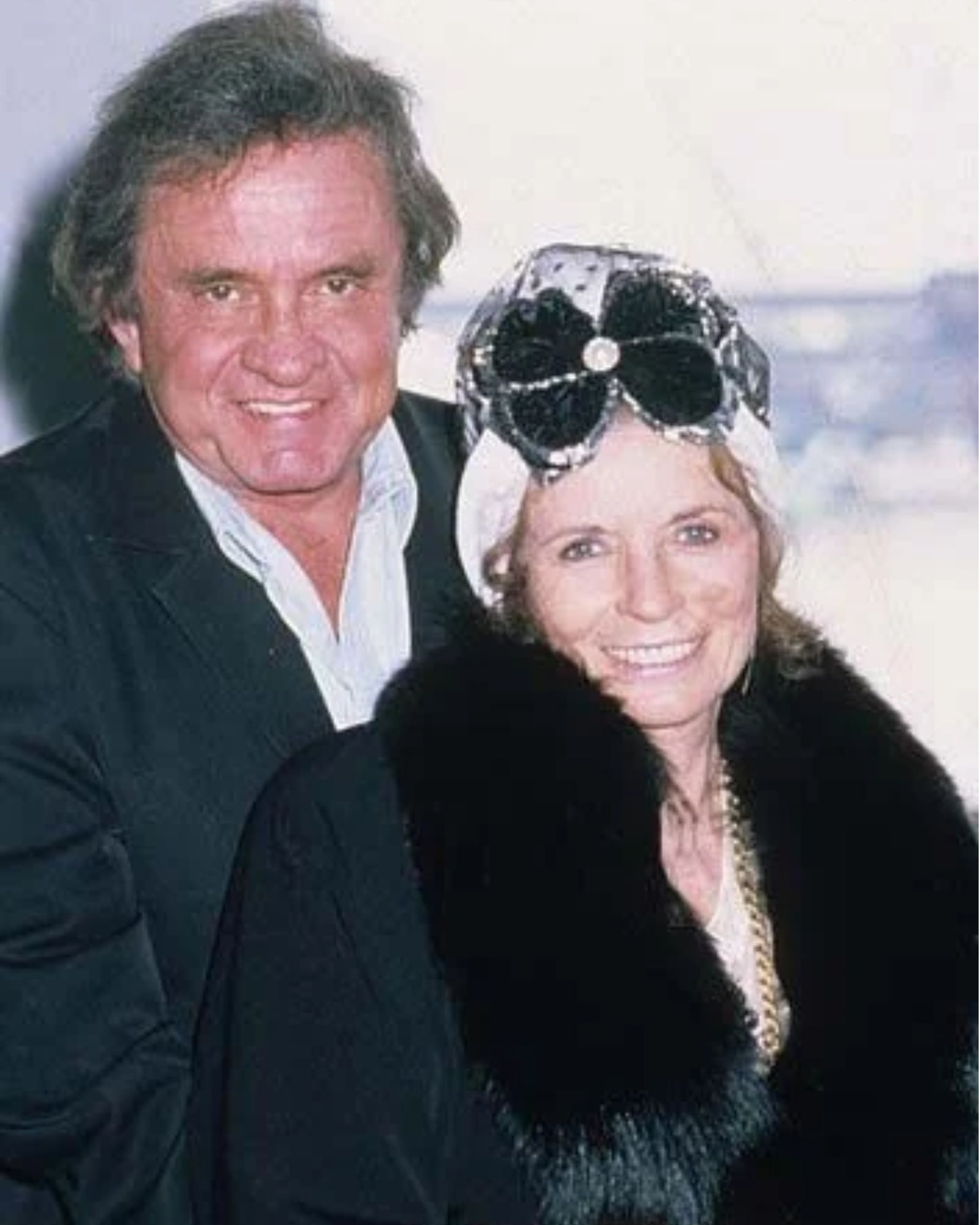
Johnny Cash once heard his own record on the radio, disliked it so much that he called producer Sam Phillips, and asked him to stop sending out copies.
The record was “I Walk the Line.”
It sounds almost impossible today. The unmistakable rhythm, the deep baritone voice, and the stripped-down arrangement helped make Johnny Cash one of the most recognizable singers in American music. But when Johnny Cash first heard the finished recording in 1956, the sound was not what Johnny Cash had expected.
Years later, Johnny Cash told Terry Gross during a 1997 Fresh Air interview exactly what happened. The story reveals how a simple studio experiment, a producer’s judgment, and an artist’s initial disappointment came together on one of country music’s most enduring recordings.
Before the Studio, There Was a Different Song
The origins of “I Walk the Line” went back to Johnny Cash’s military years. While serving in the Air Force, Johnny Cash owned a Wilcox-Gay recorder and became fascinated by a guitar sound heard during playback. That unusual musical idea stayed with Johnny Cash and eventually helped inspire the song.
Johnny Cash originally imagined the number as a slow love ballad.
There was another detail that might surprise longtime fans. According to Johnny Cash, the song initially carried the title “Because You’re Mine.”
While in Gladewater, Texas, Johnny Cash shared part of the unfinished song with fellow Sun Records artist Carl Perkins. Carl Perkins suggested a stronger title: “I Walk the Line.”
Johnny Cash accepted the suggestion.
What remained was to turn the song into a record.
April 2, 1956: A Different Sound at Sun Studio
On April 2, 1956, Johnny Cash recorded “I Walk the Line” at Sun Studio in Memphis, Tennessee, with producer Sam Phillips.
The musicians were Johnny Cash on vocals and acoustic guitar, Luther Perkins on electric guitar, and Marshall Grant on bass.
Sam Phillips believed the song needed a quicker tempo than the slow version Johnny Cash had originally envisioned.
Then came one of the most remarkable details of the session: a piece of paper placed among the strings of Johnny Cash’s acoustic guitar.
The paper altered the instrument’s sound, producing a dry, rhythmic effect that helped give the recording its distinctive drive. Both Johnny Cash and Sam Phillips later recalled the experiment, although their accounts differed over who actually placed the paper in the strings.
Combined with Luther Perkins’s economical electric guitar playing and Marshall Grant’s bass, the result was the lean, driving sound that became closely associated with Johnny Cash.
There was nothing elaborate about the arrangement. Its strength came from the way those few instruments worked together.
The Phone Call Johnny Cash Later Admitted Making
When Johnny Cash heard “I Walk the Line” on the radio, the reaction was surprisingly negative.
Johnny Cash later explained that the combination of the singing and instrumentation sounded strange to his ears. The recording did not match the way Johnny Cash expected to hear his own voice.
Johnny Cash believed a better performance was possible.
So Johnny Cash called Sam Phillips and asked the producer not to distribute any more copies of the record.
According to Johnny Cash’s recollection, Sam Phillips laughed at the request and encouraged Johnny Cash to give the recording a chance.
Sam Phillips had heard something in that recording that Johnny Cash had not yet learned to appreciate.
And the public soon proved Sam Phillips right.
The Record That Became Johnny Cash’s First No. 1 Country Hit
Sun Records released “I Walk the Line” on May 1, 1956.
The single became Johnny Cash’s first No. 1 country hit and also crossed over to the pop audience, reaching No. 17 on Billboard’s pop chart.
The song’s success helped establish the sound of Johnny Cash and the Tennessee Two, demonstrating that a recording did not require a large band or elaborate production to command attention.
For listeners, the deep voice and steady guitar rhythm were unmistakable. For Johnny Cash, those same qualities had initially sounded wrong.
That is what makes this particular studio story so memorable.
Johnny Cash had written the song, Sam Phillips had recognized the potential of a faster arrangement, and three musicians had created something distinctive with remarkably few instruments.
Yet the artist responsible for the record nearly rejected it after hearing the finished result.
Decades later, Johnny Cash could laugh about the experience and acknowledge that the recording had grown on him.
The version Johnny Cash wanted Sam Phillips to stop distributing was the very version that introduced millions of listeners to one of country music’s most recognizable sounds.