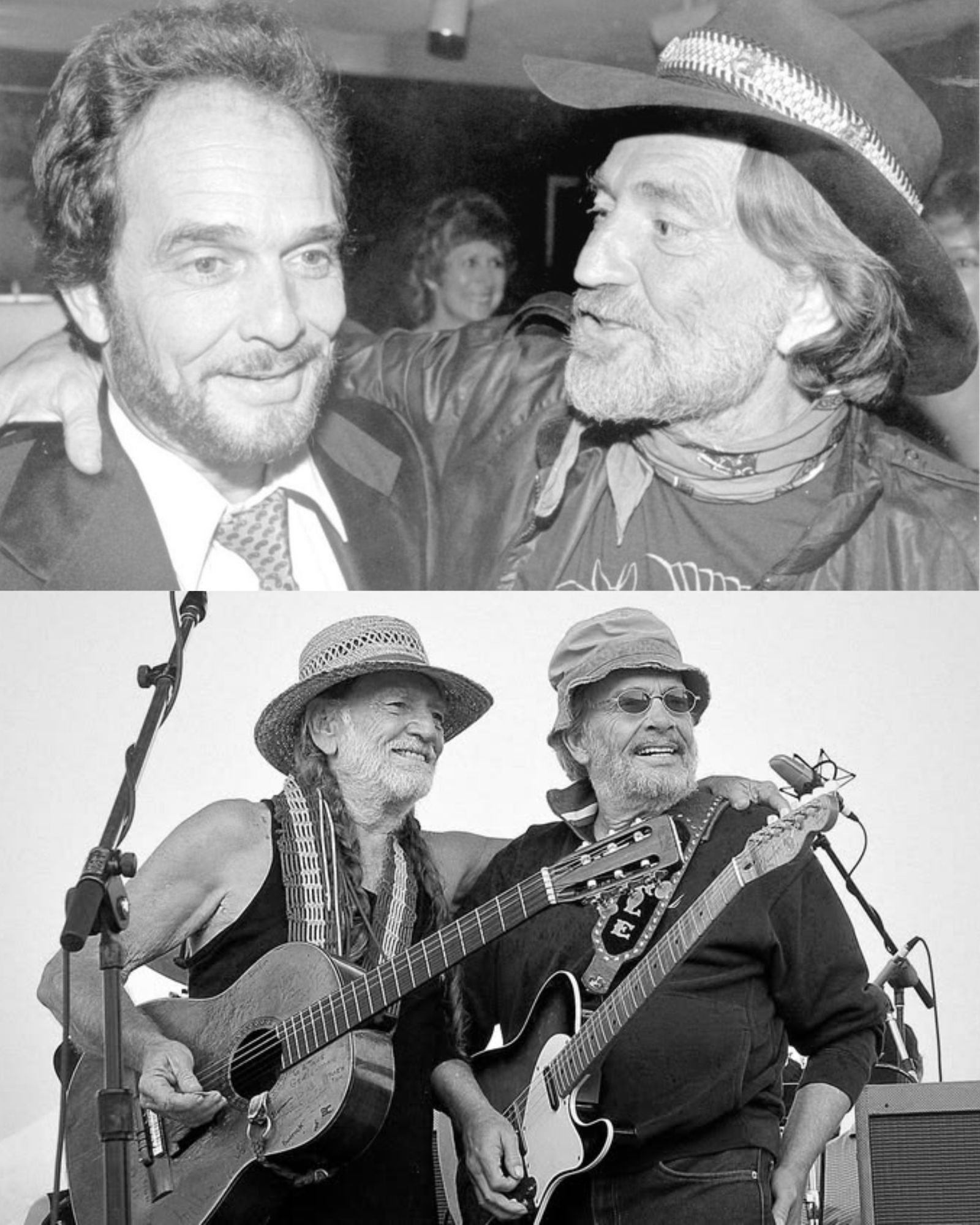
Merle Haggard had barely fallen asleep when Willie Nelson knocked on the door of a tour bus around four in the morning. After days of recording, Merle Haggard wanted nothing more than some rest.
But Willie Nelson had found a song that couldn’t wait.
What happened next became one of the most memorable recording stories of Merle Haggard’s career. The surprising part wasn’t simply that Merle Haggard recorded while exhausted. It was that Merle Haggard planned to replace the performance the following morning, only to discover that the recording was already on its way to New York.
Five Days in the Studio and One Missing Song
In 1982, Merle Haggard and Willie Nelson were working on their first collaborative album at Willie Nelson’s property near Austin, Texas.
After roughly five days of sessions, the musicians had recorded plenty of material. What they still needed was a song strong enough to become the centerpiece of the project.
The answer came through Willie Nelson’s daughter, Lana Nelson, who introduced Willie Nelson to a recording of “Pancho and Lefty” from Emmylou Harris’ 1977 album Luxury Liner.
The song had been written and previously recorded by Texas songwriter Townes Van Zandt, appearing on the 1972 album The Late Great Townes Van Zandt.
It told a mysterious Western story involving an outlaw named Pancho and a man named Lefty, with questions of friendship, loyalty, and betrayal woven throughout.
Willie Nelson immediately recognized its potential for the album.
There was just one problem. Merle Haggard had finally gone to sleep.
A Knock on the Tour Bus at 4 A.M.
Years later, Merle Haggard recalled the unusual session in an interview with the Houston Press and in Ken Burns’ PBS documentary Country Music.
Merle Haggard remembered getting only about ten minutes of sleep before Willie Nelson appeared at the tour bus.
Willie Nelson had brought the lyrics, written across a paper sack that had been unfolded for Merle Haggard to read.
Merle Haggard was so exhausted that reading the words was difficult. The reasonable solution seemed obvious: Willie Nelson could record the song immediately, and Merle Haggard could add the remaining vocal the following morning.
Willie Nelson had a different idea.
Willie Nelson wanted the two singers to record together that night.
Despite the exhaustion, Merle Haggard agreed and entered the studio. The performance was recorded with the understanding, at least in Merle Haggard’s mind, that another take could be made after some sleep.
That second chance never came.
The Recording Was Already Gone
The following morning, Merle Haggard returned to the studio and asked about recording the vocal again.
Instead, Merle Haggard learned that the recording had already been sent toward New York.
The musicians and producers had decided the performance was good enough to keep.
That detail makes the recording especially remarkable. Merle Haggard had approached the session as a temporary performance. The people listening to the result heard something worth preserving.
Willie Nelson later remembered the episode with amusement, observing that Merle Haggard could sing remarkably well even while half-asleep.
On the finished recording, Willie Nelson carries most of the narrative before Merle Haggard’s distinctive voice enters for the final verse. That late appearance gives the song another personality just as its story approaches the end.
From an Unplanned Performance to Country Music History
The album Pancho & Lefty arrived in 1983 and became a major commercial success. Its title track reached No. 1 on Billboard’s country singles chart in July 1983, while the album also topped the country albums chart.
For Townes Van Zandt, the success introduced a much larger audience to a song that had already been circulating among folk and country musicians for more than a decade.
For Willie Nelson and Merle Haggard, it became one of the defining recordings of their partnership.
And for listeners familiar with Merle Haggard’s reputation as a careful, expressive singer, the story offers an unforgettable detail about the performance.
Merle Haggard went into the studio expecting to sing the song again when properly rested. More than four decades later, country music fans are still listening to the version recorded that night.