Scroll to the end of the article to hear the song.
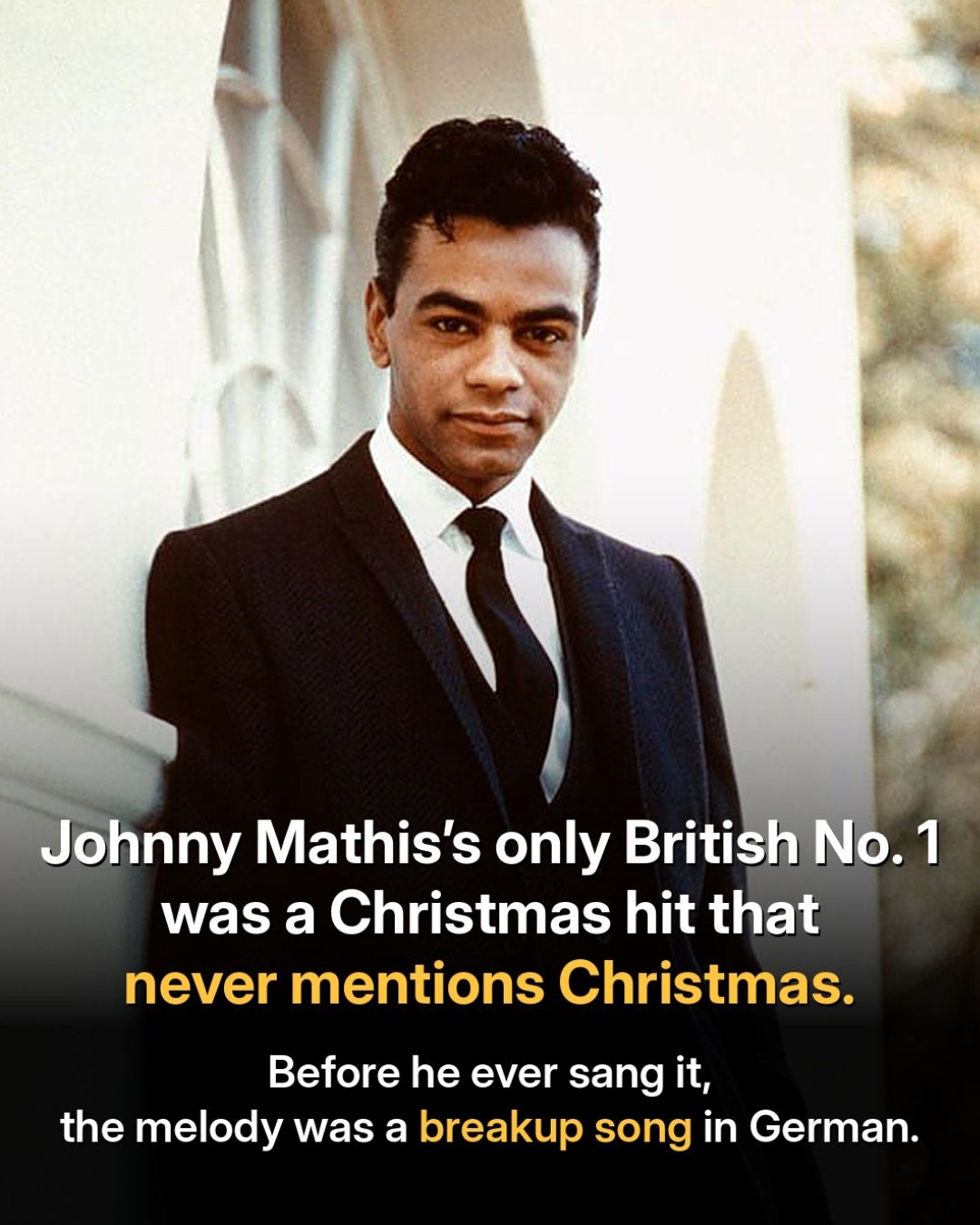
The song was “When a Child Is Born (Soleado).” Johnny Mathis released it in November 1976, and by Christmas week it was the best-selling single in Britain. It stayed at No. 1 for three weeks and sold around 885,000 copies there. It is still the only UK No. 1 single of his career, and the lyric never says the word Christmas.
A melody that had already lived two lives
Long before Johnny Mathis sang it, the tune belonged to an Italian songwriter named Ciro Dammicco, who worked under the name Zacar. He first used it in a 1972 song called “Le rose blu.” Two years later he reworked it into “Soleado,” a nearly wordless piece recorded by his band, the Daniel Sentacruz Ensemble. It became a big hit across Europe.
Then the melody crossed into Germany. In 1974 the singer Michael Holm put German words to it and called it “Tränen lügen nicht,” which means “Tears Don’t Lie.” It had nothing to do with Christmas. It was a breakup song, a plea to a man to think twice before leaving a girl whose tears were real.
The English words came from Fred Jay, an Austrian-born lyricist who would later co-write hits for Boney M. Jay wrote it as a Christmas song. Holm recorded that English version first, and it became a modest American hit, reaching No. 53 on the Billboard Hot 100 and No. 7 on the Easy Listening chart.
A Christmas song with no Christmas in it
Fred Jay’s lyric never names Christmas, Bethlehem or Jesus. It describes a tiny star shining high above and a world waiting for one child, a child who might grow up to bring peace. That star is often read as a nod to the Star of Bethlehem, and that was enough for record buyers. Johnny Mathis’s version, produced by Jack Gold for CBS, also has a short spoken passage in the middle.
The record came from his album I Only Have Eyes for You. Country fans who flipped the 45 over got a pleasant surprise: the B-side was Mathis’s cover of Charlie Rich’s “Every Time You Touch Me (I Get High).”
Christmas week, 1976
“When a Child Is Born” entered the British chart in November. In Christmas week it replaced Showaddywaddy’s rock ‘n’ roll revival hit “Under the Moon of Love” at No. 1, claiming the coveted Christmas No. 1 spot. It held on for three weeks, into January 1977, before David Soul’s “Don’t Give Up on Us” took over. The British music industry later certified it Gold.
Twenty years in the making
Johnny Mathis released his first single in 1956 and first reached the British chart in 1958. Hits like “A Certain Smile” and “Someone” made him a favorite there, but after “My Love for You” reached No. 9 in 1960, he did not make the British Top 10 again for fifteen years.
His way back came in 1975, when his cover of The Stylistics’ “I’m Stone in Love with You” climbed to No. 10. A year later, after twenty years of making records, Johnny Mathis finally had a British No. 1.
A hit that barely reached America
Here is the strange part for American fans. In the United States, Johnny Mathis’s recording never came close to that kind of success. Chart records show it peaked at only No. 123 on the Record World survey, across the Christmas seasons of 1976 and 1977. He later recorded it again as a duet with Gladys Knight & the Pips, which made a brief appearance on the British chart.
Johnny Mathis retired from live performing in 2025, after a final concert on May 18 in Englewood, New Jersey. He turned 91 this September. This Christmas marks fifty years since that record topped the British chart. Of all the songs he recorded over seven decades, the gentle one about a child and a tiny star is still his only No. 1 there.