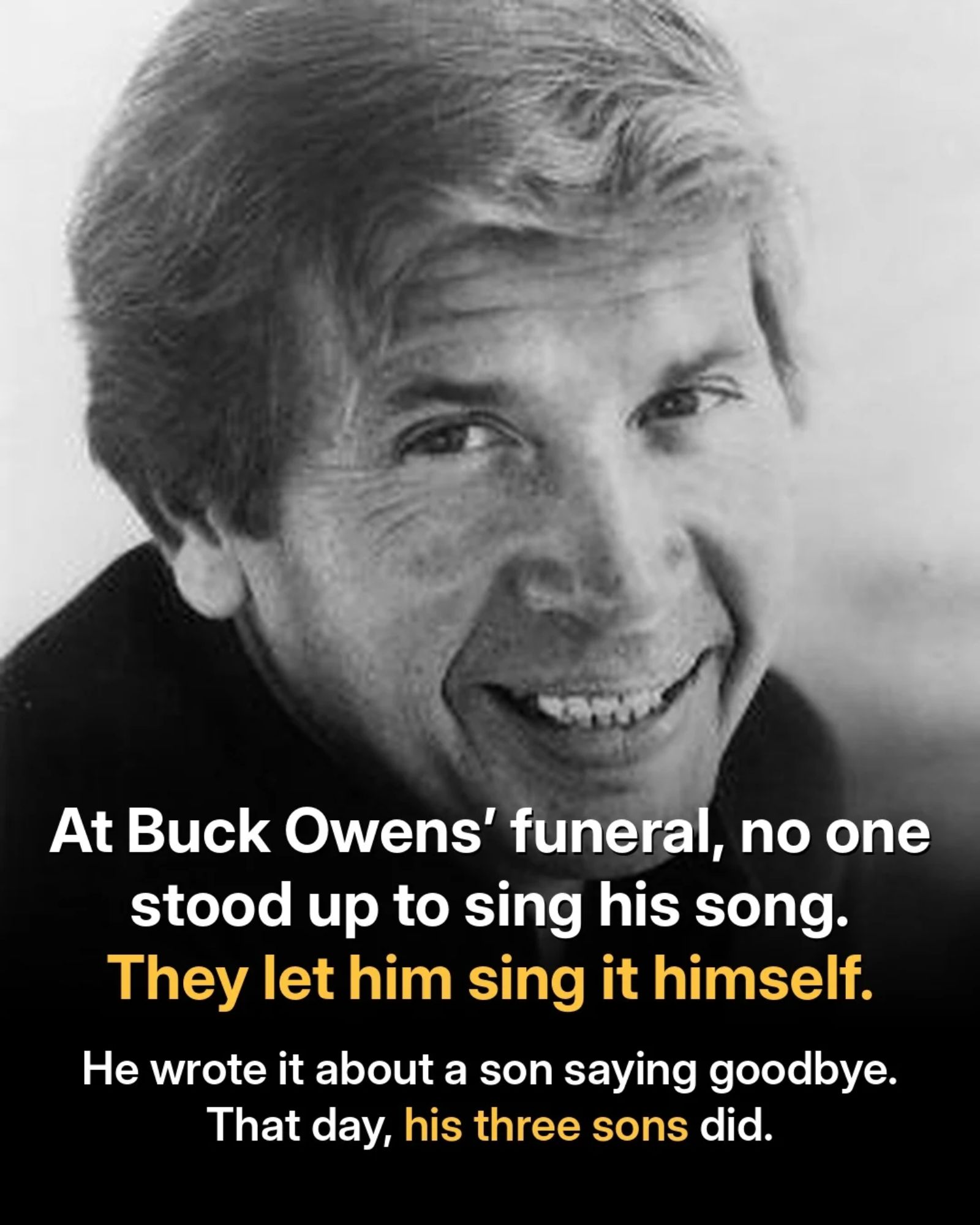
On the afternoon of April 2, 2006, more than 2,000 people filled Valley Baptist Church in Bakersfield, California. They came to say goodbye to Buck Owens, the man who had given the town its own sound and put it on the map of country music.
Inside, flowers had been arranged in the shape of his famous red, white and blue guitar. Garth Brooks sat among the mourners. Dwight Yoakam, Trace Adkins and Brad Paisley were there too, and each of them would take a turn at the front of the church before the service was over.
But the moment many people still talk about didn’t come from any of them.
A Service Full of Voices
The service was public, and it moved the way a Bakersfield farewell for Buck Owens should. Friends and family members spoke. Singers came forward one after another.
Dwight Yoakam, who owed Buck Owens more than almost anyone in that room, sang the old hymn “In the Garden.” Trace Adkins sang the traditional gospel song “Wayfaring Stranger.” Brad Paisley sang his own newest single as a tribute to the man he called a maverick. Most of what was sung that day were hymns and gospel songs.
And then, somewhere in the middle of all those live voices, the church heard one more voice. Everyone there had known it for decades.
It was Buck Owens himself.
The Record That Was Played
Nobody stood up to sing it. Nobody tried to cover it. Instead, his own recording of “Dust on Mother’s Bible” was played for the congregation.
It was not one of the songs people usually connect with Buck Owens. It wasn’t “Act Naturally” or “I’ve Got a Tiger by the Tail,” and it wasn’t one of the bright, twangy hits that filled honky-tonks across America in the 1960s. It came from a quieter place in his catalog.
Buck Owens wrote “Dust on Mother’s Bible” by himself. He recorded it with the Buckaroos in November 1965, and it became the title song of a gospel album that Capitol Records released on May 2, 1966. On an album full of faith songs, it was the slow, aching one.
What the Song Is About
The song tells a simple story. A man looks at the old Bible his mother left behind. It is worn with age, but to him she is still there on every page. On the night she was dying, she called him to her side, gave him that Bible, and asked him to let it guide his life.
He holds on to it and still hears her promise that they will meet again someday. In the end he wipes the dust away. He has learned what so many people learn too late: you never fully understand how much you miss a mother’s love until she is gone.
A song about a child called to a dying parent’s side, sung by a man who was now the one being mourned.
The Detail That Makes It Hard to Forget
Buck Owens had died on March 25, 2006, just eight days before the service.
No one has publicly explained why “Dust on Mother’s Bible” was chosen. Maybe no explanation was needed. The song he wrote was about a son standing beside a parent at the very end. That afternoon in Bakersfield, his own three sons, John, Buddy and Michael, stood up one by one to speak about their father. They remembered him as stern, but loving.
The song he had written about a son saying goodbye became part of the day his own sons said goodbye to him.
Why This Moment Still Matters
Country music has always been good at farewells. But it’s rare for an artist to be part of his own. That day, the stars sang hymns, the family shared memories, and the man everyone came to honor was heard one more time, through a record he had made more than forty years earlier.
For a few minutes inside that church, the goodbye sounded exactly like Buck Owens.
Is there a song you can’t hear without thinking of a farewell? Share it in the comments. Someone else might need to hear it too.