In 1972, Richard Sterban had a job most singers would have done anything to get. Every night he stood on stage behind Elvis Presley, singing bass with J.D. Sumner and the Stamps Quartet, the gospel group backing the King of Rock and Roll in packed arenas across America.
Then Richard Sterban walked away from it. Richard Sterban, the deep voice of The Oak Ridge Boys and a member of the Country Music Hall of Fame, died on Saturday, November 14, 2026, in Hendersonville, Tennessee. He was 83. His life is often told in hit records, but at its center is a choice he had to make twice.
A kid from Camden with a low voice
Richard Sterban was born in Camden, New Jersey, in 1943. Long before Nashville, he sang gospel in South Jersey and founded a quartet called the Keystones. He once said he wanted to be in “the best vocal group in the world.”
That dream took him south to Memphis and into J.D. Sumner and the Stamps Quartet. When Elvis Presley went looking for a new backup group, he hired J.D. Sumner, a longtime friend, and Richard Sterban happened to be in the lineup. In June 1972, that lineup backed Elvis Presley at his famous Madison Square Garden concerts in New York.
The phone call that changed everything
That same year, Richard Sterban got a phone call from William Lee Golden of The Oak Ridge Boys. The group’s bass singer was getting off the road. Did Richard Sterban want the job?
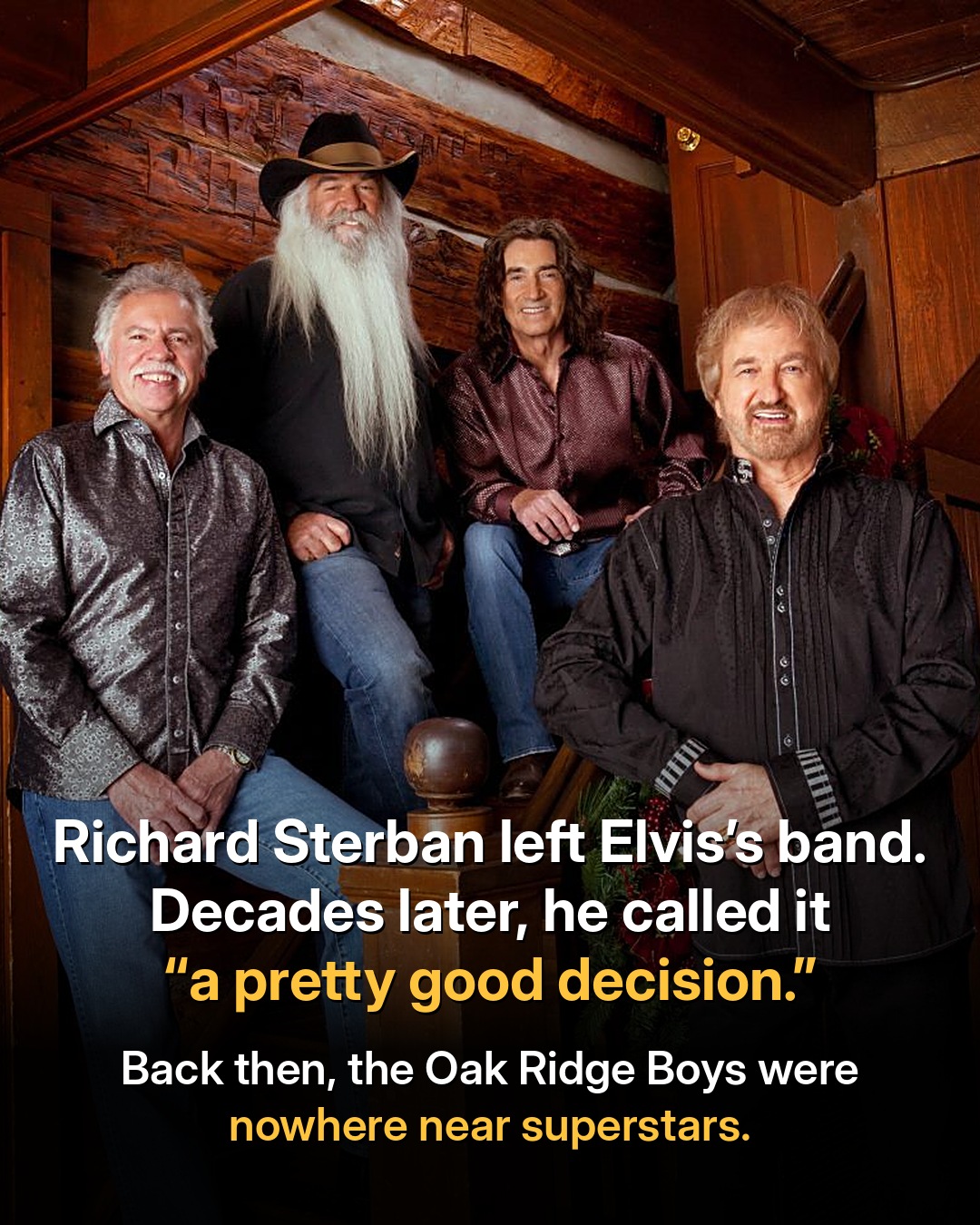
On paper it made no sense. Elvis Presley was arguably the biggest star in the world. The Oak Ridge Boys were a respected gospel quartet, but nowhere near superstar status. Richard Sterban was a fan of their sound, though, and he believed they had a great deal of potential.
He asked for a day to think it over, but he later admitted he already knew his answer. In late 1972 he left the Stamps and joined The Oak Ridge Boys.
“Back then, a lot of people questioned my decision, leaving Elvis. I followed my heart.”
Richard Sterban, 2021
The night Elvis Presley asked him back
The story didn’t end there. Some time after the switch, The Oak Ridge Boys were booked in Las Vegas while Elvis Presley was performing in town. Richard Sterban’s new bandmates wanted to meet the King, so Richard Sterban called, and Elvis Presley invited them over.
Elvis Presley met The Oak Ridge Boys in a dressing room. At some point he turned to his former bass singer and asked him straight out what it would take to bring him back. As Richard Sterban remembered it, the question was simple:
“What would it take for me to get you back?”
Richard Sterban said no a second time. He later called that moment one of the greatest compliments of his life, but he couldn’t leave The Oak Ridge Boys. He wanted to be part of the group.
From Elvis to “Elvira”
History proved the young bass singer right. In 1981, The Oak Ridge Boys released “Elvira,” and the low bass part Richard Sterban sang became one of the most recognizable sounds in country music. The song went to No. 1 on the country chart and No. 5 on the Billboard Hot 100.
Hits like “Bobbie Sue” and “American Made” followed. The Oak Ridge Boys joined the Grand Ole Opry in 2011, and in 2015 Richard Sterban, Duane Allen, William Lee Golden, and Joe Bonsall were inducted into the Country Music Hall of Fame. Richard Sterban told the whole story in his 2012 memoir, From Elvis to Elvira.
One more standing ovation
In September 2025, Richard Sterban stepped back from touring to focus on his battle with pancreatic cancer. Fans wondered if they had heard that famous voice live for the last time.
They hadn’t. On January 30 and 31, 2026, Richard Sterban walked back onto the Grand Ole Opry stage with his longtime partners to sing his part on “Elvira.” Both nights the audience rose to its feet. Lead singer Duane Allen called it a soul-stirring experience.
A steady force
After his passing, Country Music Hall of Fame CEO Kyle Young said Richard Sterban used his unmistakable bass voice to connect commercial country music to its deep gospel roots. Kyle Young called him a “steady force and a foundational figure in country music.”
Almost fifty years after that phone call from William Lee Golden, Richard Sterban looked back on leaving Elvis Presley. He said, with typical modesty, that he thought he’d made “a pretty good decision.”
Rest in peace, Richard Sterban.